This League of Legends beginner guide explains how to play LoL from your first login to your first teamfight. Learn one champion, follow your assigned role, earn gold and experience, then help your team destroy the enemy Nexus. No previous experience with a multiplayer online battle arena (MOBA) is needed.
Your first goal is not to get the most kills. It is to know where to go, how to use your abilities, when to retreat and how to turn an advantage into turrets and other objectives. This guide teaches standard five-versus-five Summoner’s Rift, with the important differences in beginner queues explained along the way.
What is League of Legends and how do you win?
League of Legends is a free-to-play, team-based strategy game in which two teams of five players control different champions. On the main map, Summoner’s Rift, the winner is the team that destroys the opposing Nexus, the central structure inside the enemy base. Kills, gold and powerful neutral monsters help you achieve that goal, but they do not win the game by themselves.
Three lanes connect the bases. Computer-controlled soldiers called minions march along them, while defensive turrets block the way. You push forward with your minions, defeat structures, break an inhibitor and eventually attack the Nexus. Riot also explains these fundamentals in its official How to Play guide. For perspective on the game’s wider audience, see RiftDaily’s League of Legends player count guide.
Riot’s introductory video gives a quick picture of the objective and the teamwork involved. The overall win condition remains the same even though the video shows an older version of the game.
The simplest way to win your first match
- Protect your champion and gain experience: stay near your minion wave instead of running into the enemy team alone.
- Earn gold: deliver the final hit to enemy minions, then spend the gold on recommended items.
- Push with allied minions: take enemy turrets when it is safe, then attack the inhibitor in that lane.
- Finish the base: destroy the Nexus turrets, then the Nexus. A high kill count is optional; destroying the Nexus is not.
How to start playing League of Legends
- Create a free Riot account. Use the official League of Legends website, choose your region carefully and confirm your account details.
- Install the Riot Client and League. Follow the installer for your supported computer. RiftDaily’s League of Legends download guide walks through installation and common setup problems.
- Complete the available tutorial. Learn to move, attack, use abilities, buy items and destroy structures before joining a regular match.
- Begin in Co-op vs. AI. You and other players can face computer-controlled opponents on Summoner’s Rift, so mistakes are easier to recover from.
- Try Swiftplay once unlocked. Choose a comfortable champion and role, then learn to work with human teammates against other players.
- Move to Normal Draft when ready. It offers more of the standard Summoner’s Rift experience, including a draft phase, without ranked pressure.
If the client fails to connect, check the League of Legends server status before changing settings or reinstalling. Availability can also depend on your region and any active maintenance.
Which game mode should beginners choose?
| Mode | Access for a new account | Best use |
|---|---|---|
| Co-op vs. AI | Available at the start | Learn movement, shop and towers against bots. |
| Swiftplay (Summoner’s Rift) | Account level 3 | Your first faster-paced player-versus-player matches. |
| ARAM | Account level 3 | Try teamfighting on a single-lane map, not standard laning. |
| Practice Tool | Account level 9 | Repeat last hits, abilities and item purchases without match pressure. |
| Normal Draft | Account level 10 | Practice standard team composition and champion selection. |
| Ranked Solo/Duo or Flex | Level 30 plus additional requirements | Competitive play after learning your roles and champions. |
Riot lists these account-level gates in its game-mode unlocking rules. Rotating modes and Arena can be fun later, but they follow different team sizes, maps or objectives. ARAM is useful for trying champions and teamfights, not for learning jungle routes or the three-lane map.
Important Swiftplay difference: Swiftplay accelerates the opening: players begin at level 3 with 1,400 gold under its accelerated rules. It does not use the same top, mid and bot role quests as standard Summoner’s Rift, and it removes Void Grubs and Rift Herald. Do not assume every item, spawn or timing in Swiftplay will be identical in standard Summoner’s Rift.
If you prefer to see these basics in action, this full beginner walkthrough from Skill Capped covers the interface, champion roles, Summoner’s Rift objectives, laning, vision, beginner champions, runes and items. It is an independent instructional video rather than an official Riot tutorial. Use the current client for exact control bindings and mode-specific details.
Understanding the Summoner’s Rift map
Summoner’s Rift has two opposing bases connected by top, middle and bottom lanes. The spaces between those lanes are the jungle, and a river cuts across the map. Neutral monsters occupy jungle camps and two major pits near the river. One team begins from the lower-left side of the conventional map view and the other from the upper-right, though your camera may be adjusted to make navigation more comfortable.

| Map feature | What it means to a new player |
|---|---|
| Top, mid and bot lanes | Three routes along which your minions advance and teams attack turrets. |
| Jungle and river | Paths, monster camps and approaches that let champions move between lanes. |
| Turrets | Dangerous defensive towers; approach enemy towers with allied minions nearby. |
| Inhibitors | Structures inside each base; destroying one causes stronger allied super minions to push that lane for a time. |
| Nexus and fountain | The Nexus is the final target; your fountain restores health and provides access to the item shop. |
| Minimap | The small map showing allied positions and what your team currently has vision of. |
The map is not fully visible at all times. Fog of war hides areas your team cannot currently see. Allies, allied minions, structures and wards reveal nearby ground, while unseen enemy champions can travel through the jungle. That is why watching the minimap matters even when your lane seems quiet.
What is the safe route from your lane to the Nexus?
Each lane has three defensive turrets leading toward an inhibitor. The base has two additional Nexus turrets. Your team must destroy the relevant lane defenses and at least one inhibitor before it can attack the Nexus. An inhibitor eventually respawns, so pushing a lane does not permanently open the base.
Turrets are not safe targets without minions. An enemy turret normally attacks nearby allied minions before your champion, but attacking an enemy champion under their turret can make it target you. If your wave dies, retreat instead of taking repeated turret shots. Destroying a turret matters because it opens safer routes through the map, not just because it awards gold.
League of Legends roles explained: Top, Jungle, Mid, ADC and Support
A standard team normally has one top laner, one jungler, one mid laner, one bot-lane damage dealer and one support. ADC means attack damage carry, usually a ranged champion who relies heavily on basic attacks. The support shares bot lane but focuses more on protecting allies, creating opportunities and vision than on taking farm.
| Role | Main job | What makes it appealing | First challenge |
|---|---|---|---|
| Top | Hold a solo lane, survive trades and pressure side lanes. | A clear lane assignment and often durable champions. | Long walks back to lane and isolated fights. |
| Jungle | Fight neutral camps, help lanes and secure objectives with Smite. | Influence several parts of the map. | Pathing, timing and deciding when to help. |
| Mid | Farm a short solo lane and help nearby fights. | Frequent action and a central position. | Keeping track of threats from both sides. |
| ADC (bot) | Farm consistently and deal sustained damage while staying safe. | A straightforward gold-to-damage progression. | Positioning against champions who can quickly reach you. |
| Support (bot) | Protect or initiate for allies, place wards and coordinate engages. | Learn teamplay without needing most minion last hits. | Managing vision and choosing safe moments to engage. |
For an absolute beginner, top with a durable champion, mid with a simple mage or support with a straightforward healer can be manageable starting points. ADC teaches last-hitting quickly. Jungle is absolutely playable as a newcomer, but it asks you to learn monster routes and objective decisions at the same time as basic combat.
In standard Summoner’s Rift, role quests can give role-specific progress and rewards, adding another reason to play your assigned lane or jungle. Swiftplay does not use the same full role-quest system. Follow the in-game objective and item tooltips rather than copying instructions from a different mode.
What should each role do in its first few minutes?
- Top: walk to the top lane, collect experience and practise short trades without chasing far from your turret.
- Jungle: take the recommended jungle starting item and Smite, clear nearby camps and look for a safe chance to assist a lane. A surprise visit to help a lane is called a gank.
- Mid: farm the middle lane, ward an approach route and ping if your opponent leaves toward another lane.
- Bot/ADC: stay near your support, last-hit minions and save your escape tools when enemies move toward you.
- Support: take the recommended support quest item, protect or set up your bot-lane partner and help establish vision. Your job is not to take every last hit.
Role assignments are not interchangeable in standard position-select queues. Staying near your assigned lane helps you earn the right experience and role-quest progress. If you are unsure where to go, look at your assigned position in champion select and the minimap when the match begins.
Best League of Legends champions for beginners
The best first champion is one whose abilities are easy to understand while you are still learning farming, map awareness and positioning. These are approachable options, not a win-rate ranking. You may need to unlock a champion or wait for a free rotation before trying it.
| Role | Beginner champion | Playstyle and abilities | First skill to practice |
|---|---|---|---|
| Top | Garen | Durable melee fighter. Q speeds him up and strengthens an attack; E spins through nearby enemies; R finishes weakened targets. | Approach for a short trade, then back away and recover. |
| Top | Malphite | Tank who slows with Q and can start a teamfight with a powerful R dash. | Avoid wasting mana and wait for a clear ultimate angle. |
| Jungle | Warwick | Sustaining fighter whose Q bites and heals; W helps locate low-health enemy champions. | Clear camps and choose fights you can actually finish. |
| Jungle | Amumu | Tank with a Q bandage toss to close distance and an R that immobilizes nearby enemies. | Engage when teammates are close enough to follow. |
| Mid | Annie | Mage with direct spells; Q helps secure minions, and her passive stun combines with R to summon Tibbers. | Track when your passive stun is ready. |
| Mid | Lux | Long-range mage with Q root, E area damage and a long-range R beam. | Stay behind allies and aim spells at committed targets. |
| ADC | Miss Fortune | Ranged damage dealer whose Q can bounce between targets and R fires a cone of bullets. | Last-hit safely and use R when enemies cannot easily escape. |
| ADC | Ashe | Marksman whose attacks slow enemies; W fires a volley and R launches a long-range stunning arrow. | Keep distance while attacking and watch escape paths. |
| Support | Sona | Enchanter using simple auras to damage, heal, shield and speed allies; R can stun enemies. | Position close enough to help without standing in front. |
| Support | Soraka | Healer whose W restores an ally’s health and R can heal teammates across the map. | Watch allied health while protecting your own. |
Pick one main champion and one backup in your preferred role for the next several matches. Learn what their Q, W, E, R and passive do, then practise one useful sequence. Champion familiarity leaves more attention for the minimap, opponents and objectives than switching characters after every loss.
Which champion should you actually pick first?
Pick Garen if you like close-range fighting, Annie if you prefer spells, or Miss Fortune if you want to attack from a distance. Each teaches a different core skill without demanding elaborate combos. Garen’s passive health regeneration is forgiving after short trades; Annie’s Q rewards correctly timing a last hit; Miss Fortune rewards finding a safe attack position before using her ultimate.
Riot’s official Garen spotlight shows the basic idea of approaching, dealing damage and retreating. The video is older, so use your current champion tooltips and recommended shop rather than copying its outdated item or rune suggestions.

After your first few matches, test the backup in the same role rather than changing roles and champion at once. If you prefer a different style, Riot’s official champion selection quiz can help you narrow the roster by playstyle.
League of Legends controls, abilities and interface
League offers two supported movement schemes. Point-and-click is the traditional default: right-click to move or attack and use the keyboard for abilities. Keyboard (WASD) lets you steer your champion with movement keys and uses a different ability layout. The settings menu is the source of truth because controls can be remapped globally or for individual champions.
What do abilities, health bars and cooldowns mean?
| Interface element | What to watch | First beginner habit |
|---|---|---|
| Health bar | How much damage a champion can still take. | Retreat and heal before taking another risky fight. |
| Mana, energy or another resource | What powers some abilities; different champions have different costs. | Do not spend every resource poking the enemy. |
| Passive ability | An effect your champion receives without a standard Q/W/E/R cast. | Read it once before leaving base. |
| Q, W and E | Usually three basic abilities with their own cooldowns. | Practise one simple sequence, not every possible combo. |
| R (ultimate) | Usually the strongest ability, often unlocked around champion level 6. | Wait for a useful target or teamfight, not just an available button. |
| Item slots and trinket | Equipped purchases and the warding tool. | Look at your active items and available ward before moving into fog. |
Cooldown means the waiting period before an ability can be cast again. Crowd control, often shortened to CC, means an effect such as a stun, root or slow that restricts an opponent. Knowing which ability is unavailable can be more valuable than knowing its exact damage.
Point-and-click controls to learn first
| Default input | What it does |
|---|---|
| Right mouse button | Move toward a location or basic-attack a target. |
| Q, W, E, R | Cast the champion’s three basic abilities and ultimate (when unlocked). |
| D and F | Cast the two selected summoner spells. |
| B | Recall back to base after channeling uninterrupted. |
| P | Open the shop, normally used to purchase items while at the fountain. |
| Space | Center the camera on your champion while held. |
| Y | Toggle camera lock. |
| Tab | Open the scoreboard to check items, levels and scores. |
Your champion’s health, resource bar, ability cooldowns, summoner spells, item slots and inventory sit along the bottom of the heads-up display (HUD). The minimap usually sits in a lower corner. Read the key labels displayed on the actual interface for items, wards and the ping wheel: those inputs can change with your movement scheme and custom keybinds. Press Esc → Hotkeys to review them. Enemy health and level are shown above visible champions.
WASD movement uses a different ability layout
For WASD movement, the directional keys move the champion and cannot simultaneously function as the old Q-W-E-R layout. Riot’s WASD input guide lists the initial scheme’s main defaults: right mouse button for Ability 1, Shift for Ability 2, E for Ability 3, R for the ultimate, Q and F for summoner spells, and left click to confirm casts. You can change these bindings, and each champion can have its own profile.
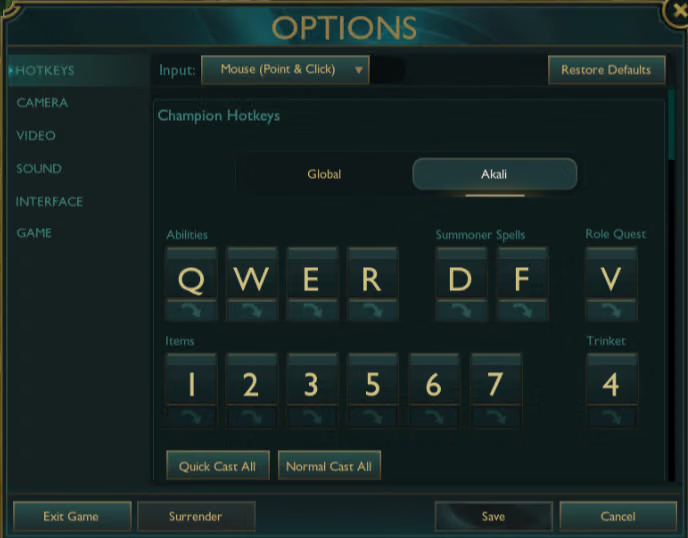
To try WASD, open Esc → Options → Hotkeys while in a match or tutorial. The first time you enable it, Riot also enables a Dynamic Camera option that follows your champion. Both the camera and keybindings can be customized. Riot locks the selected input scheme after the first 10 minutes of a match, so try it in the tutorial or Practice Tool before using it in a competitive game.
For a clear HUD, camera and graphics starting point, use RiftDaily’s League of Legends settings guide. Settings should help you see what happens, not distract you from learning the actual rules.
How a typical League of Legends match works
- Champion select: Choose a champion and role, then check your recommended runes, summoner spells and starting build. Draft modes may include bans and a more formal pick order.
- Opening: Buy the suggested starting item and move toward your assigned lane or jungle. Avoid walking alone into an unwarded enemy jungle.
- Laning: Collect last hits, gain experience, trade damage only when it is reasonably safe and watch for enemies leaving their lanes.
- First objectives: Help with a turret or nearby neutral objective when your wave is pushed and your team has enough people in the area.
- Mid game: When outer turrets fall, players move more often between lanes. Catch safe minion waves, group for objectives and avoid being caught alone.
- Late game: A single death can leave your team outnumbered for a decisive fight. Play around vision, major buffs and a coordinated push.
- Finish: After winning a fight, use surviving minions and teammates to take structures, open the base and destroy the enemy Nexus.
A match does not follow a fixed script. Your team might win through steady lane pressure or one major late-game teamfight. The useful decision is always the same: what can we safely gain while the enemy is unable to stop us? Swiftplay compresses this arc, so use the game clock and objective markers rather than expecting Normal Draft timings.
What changes after the first turret falls?
Before a turret falls, both teams often spend most of their time in their assigned lanes. Once a tower is down, teammates can rotate, meaning move to another lane or objective. A bot duo may help mid, a top laner may pressure a side lane, and the jungler can work with allies to control entrances to an objective pit. You do not have to copy every rotation; start by moving with teammates who are already nearby.
Dying has two costs. Your opponent may receive gold, and you lose time that could have been spent collecting minions or protecting a turret. When you respawn, look at the map before sprinting toward the nearest fight. Sometimes defending a wave at your own tower is more useful than arriving late to a fight that is already over.
Gold, experience and CS: How your champion gets stronger
Gold buys items; experience (XP) raises your champion’s level. Enemy minions give nearby eligible champions experience when they die, but you normally need to land the killing blow to receive their last-hit gold. The scoreboard calls your minion and monster kills CS, short for creep score.
| Source | Gold / XP lesson | Simple beginner habit |
|---|---|---|
| Minions | Nearby deaths grant XP; last-hitting earns extra gold. | Finish low-health minions without standing in danger. |
| Champion kills and assists | Reward successful fights, but also create downtime and map opportunities. | Fight when your team has numbers or a clear advantage. |
| Turrets and objectives | Can grant gold, XP, buffs, map access or pressure depending on the objective. | Push a wave with allies before attacking a tower. |
| Jungle camps | Supply income and XP mainly for junglers following their route. | Do not take your jungler’s early camps as a laner. |
Practise last-hitting without chasing every fight
- Watch an enemy minion’s health fall as your own minions attack it.
- Wait until one basic attack or a low-cost ability will finish the minion.
- Move between attacks instead of standing still beside the wave.
- If an enemy champion can punish you for one minion, accept missing that minion and preserve your health.
- After a wave, glance at the minimap and decide whether it is safe to stay, ward or recall.
For example, landing six safe last hits while avoiding a losing duel may put you in a better position than chasing one low-health champion across the river. Never risk an entire wave, your summoner spells and a death just to finish a flashy kill.
For a practical demonstration of minion timing, this last-hitting tutorial breaks down basic wave behavior, farming under your turret and several repeatable training drills. Its footage uses an older version of League, so treat it as a lesson in the underlying farming technique rather than a guide to current items or UI settings.
Why minion waves matter more than one extra kill
A minion wave is the group of allied soldiers traveling down a lane. Two common mistakes are using every ability on the wave when you want to farm safely, and leaving a large wave to chase a low-probability fight. Both can cost you gold and experience.
- Last-hit: wait until a minion is low enough that your attack finishes it. This earns gold while you can still stand in a safe position.
- Push: clear the enemy minions faster so your surviving wave moves toward the enemy turret. Pushing creates a window to recall, ward or help a nearby objective.
- Let the wave come to you: when enemies are threatening you, focus on collecting experience near your turret rather than forcing a duel far down the lane.
- Read the next wave: if a large friendly wave is about to crash into the enemy turret, consider staying until it arrives so the opponent must deal with it.
In your first games, avoid trying to master advanced wave freezes or complicated jungle pathing. The immediate win is recognizing when you can last-hit safely and when leaving your lane would cost too much.
When to recall and buy items
Use B in point-and-click controls to start a recall, which takes you back to your fountain if nothing interrupts it. A good moment is after you have pushed your minion wave toward the enemy tower, have enough gold for a meaningful purchase and can leave without giving the opponent a free turret. Spend your gold, restore health and return to lane. An item completion, level 6 ultimate or important ability upgrade can be a power spike, a moment when you are temporarily stronger than before.
Beginner builds, runes and summoner spells
You do not need to memorize advanced builds. League’s recommended item shop and suggested runes provide a sensible baseline for learning. Look first at what your champion is trying to do, then use that plan consistently enough to understand it.
| System | What it changes | Beginner-friendly approach |
|---|---|---|
| Starting items and upgrades | Stats such as attack damage, ability power, health, armor or movement speed. | Take a recommended starter, then follow a recommended core build and buy components on recall. |
| Runes | Bonuses and effects selected before the match that support a playstyle. | Use a recommended page matched to the champion and role; learn why its main rune activates. |
| Flash | A short repositioning blink with a long cooldown. | Save it to escape lethal danger or secure a genuinely important play. |
| Heal, Barrier, Ignite, Teleport | Defensive, offensive or map-movement summoner-spell choices. | Choose the recommended pairing for your champion and lane rather than swapping every game. |
| Smite | Helps the jungler fight camps and secure neutral monsters. | Take it when playing jungle and learn the objective-execution indicator. |
| Support / jungle quest items | Role-specific starting systems and progress toward useful rewards. | Follow the assigned role’s starter guidance and read the quest tooltip. |
A tank such as Garen or Malphite generally wants to survive longer in close combat; an ADC values reliable damage and safe positioning; an enchanter focuses on helping allies. These goals are more useful for a novice than memorizing a different six-item purchase order for every enemy composition. Items and rune effects do change between patches, so trust current in-game recommendations over an old screenshot.
Which item stats should a beginner recognize?
| Item stat | Plain-English meaning | Who often values it |
|---|---|---|
| Attack damage (AD) | Improves basic attacks and abilities that scale with it. | Marksmen and physical-damage fighters. |
| Ability power (AP) | Improves many spells and abilities that scale with AP. | Mages and some supports. |
| Armor / magic resistance | Reduce incoming physical / magic damage. | Champions needing to survive the enemy damage type. |
| Health | Raises the amount of damage you can take before dying. | Tanks, fighters and some supports. |
| Ability haste | Makes many abilities available more often. | Champions that benefit from frequent spell casts. |
| Movement speed | Helps you reach fights, escape and avoid attacks. | Every role; boots are a common early purchase. |
Physical damage and magic damage are different, and not every champion buys the same type of stat. Use the recommended item suggestions, hover an item to read what it does, and buy useful components when you cannot yet afford the full item. You do not need to solve the entire build before your first match.
League of Legends objectives: What matters besides kills?
Structures and neutral monsters turn a won fight into progress toward the Nexus. After your team wins a skirmish, ask which nearby reward is safe: an exposed turret, a dragon with your jungler, a warded jungle entrance, or a wave that can reach the enemy base. Chasing the last escaping champion is often the least useful option.
| Objective | Why teams care | Beginner decision |
|---|---|---|
| Turrets | Open the map and allow deeper pressure toward the enemy base. | Take them with allied minions after an enemy retreats or loses a fight. |
| Inhibitors | Release super minions into a lane for a limited period. | Break one when it is safe and use the stronger wave to pressure another objective. |
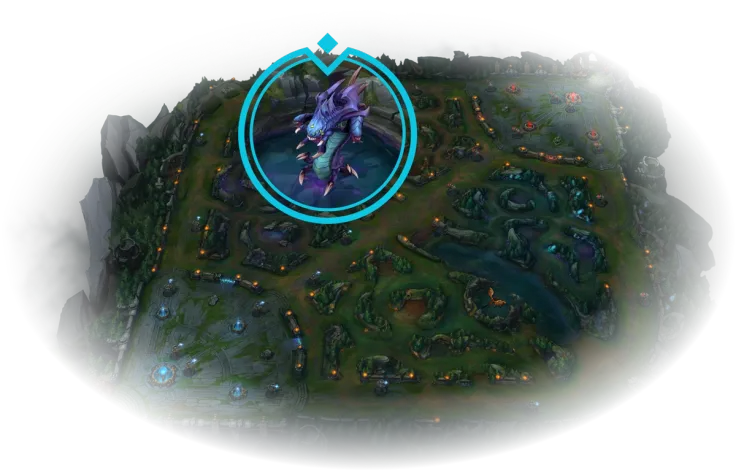
| Elemental dragons | Provide stacking team benefits; sufficient dragon control can unlock Dragon Soul. | Help when nearby, allies are present and the river is safe. |
| Elder Dragon | Gives a powerful temporary combat advantage to the slaying team. | Treat it as a high-priority team objective when available. |
| Void Grubs | In standard Summoner’s Rift, grant benefits that support pushing turrets. | Contest when your team can spare members without losing a lane. |
| Rift Herald | In standard Summoner’s Rift, can be used to help damage enemy turrets. | Coordinate its push with minions and a teammate. |
| Baron Nashor | Grants a powerful buff that improves your team’s push with minions. | Attempt it with enough allies, vision and a safe route out. |
Mode distinction: Riot removed Void Grubs and Rift Herald from Swiftplay while retaining them in standard Summoner’s Rift in its Summoner’s Rift gameplay update. Swiftplay also uses faster dragon and Baron progression. Individual spawn times and rewards may change later, so always follow the game’s current objective timers.
Dragons and Baron are powerful, but they are not mandatory fights every time they appear. Four elemental dragon kills by one team grant Dragon Soul in standard Summoner’s Rift under the usual rules; Elder Dragon provides a separate, temporary and dangerous combat buff. The Herald and Void Grubs help teams attack structures, while Baron empowers nearby minions for a decisive push. Their exact values and spawn timings may change by patch, so use the live objective icons rather than memorizing a static timetable.
How to decide whether your team should contest
- Count teammates. If your jungler is far away and the enemy team has five nearby, do not wander into the pit alone.
- Push the nearest wave. An enemy forced to protect a tower may arrive late to an objective.
- Get vision first. Ward the river, jungle entrances or approach paths before the fight starts.
- Use your health and gold wisely. Recall or finish an item before the objective if there is time.
- Choose a trade if needed. If a contest is clearly lost, defend your team’s towers or take a safe objective on the other side.
Minimap, wards and vision: Avoid surprise attacks
Map awareness is the habit of checking where visible enemy champions are, not simply staring at the minimap whenever a fight starts. If the opposing mid laner disappears and the river is dark, assume they could be moving toward your lane. Play farther back until you have better information.
- Use your warding trinket. Place a ward in a river brush or jungle entrance that an enemy might use to reach you. A ward reveals a limited area, not the whole map.
- Ward before you push. The farther you move from your turret, the more paths enemies have to approach you.
- Watch missing enemies. If an opposing laner leaves your screen, warn teammates with a missing-enemy or danger ping.
- Do not face-check dark bushes. Walking into an unwarded brush can put you in range of an entire enemy team.
- Adjust your position. Move toward the safer side of your lane when you know your teammate is nearby or the other side has no vision.

Look at the minimap for a moment between last hits, after using an ability or while walking back to lane. This simple rhythm becomes much easier to maintain than trying to remember a strict timer.
Faelights and the difference between seeing and guessing
Some Summoner’s Rift locations contain Faelights, recognizable glowing ground markers. Placing a ward on one briefly reveals a wider or more useful area than a normal ward. Riot introduced these as part of its vision-system updates. They are helpful when available, but a normal ward in the right river brush is still better than walking into a dangerous area just to reach a special spot.
A ward shows only what is inside its vision radius. If the enemy jungler disappears from the minimap, it does not mean that player has left the area. Use the information you do have: where enemies were last seen, which teammates are nearby and which escape route is open. Do not enter an unwarded objective pit alone to find out.
Teamwork, pings and surviving teamfights
League is easiest to understand as a collection of small team decisions. An ally landing crowd control, such as a stun or root, creates time for another player to deal damage. The correct follow-up is not always a kill: sometimes it is to retreat safely, protect your ADC or secure an objective.
Use pings to communicate quickly
- On my way: tell allies you intend to help, not merely that you wish they would fight.
- Danger / retreat: warn teammates when a fight looks unsafe or an enemy is approaching.
- Missing enemy: signal that your lane opponent disappeared from view.
- Objective or target pings: focus your team on a turret, monster or safe target.
Check and customize the ping wheel in Hotkeys. Voice chat availability and team-communication rules can differ by region and rollout; RiftDaily’s League of Legends Team Voice guide explains the feature separately. You can still coordinate effectively with pings, and you can mute disruptive players rather than responding to insults.
Where to stand in a teamfight
If you play a tank, look for chances to protect teammates or start a fight they can actually reach. If you play a mage or ADC, attack an accessible opponent without walking past the enemy frontline. If you play support, watch the ally most likely to be threatened and save important healing, shields or control for the moment it changes the fight. Good positioning often means doing consistent damage safely instead of chasing a distant low-health target.
Teamwork also means accepting mistakes. Make one brief, useful ping or adjustment, then return to the game. Positive communication fits the broader League of Legends Honor system, but it is also a practical way to keep your team focused.
Recognize a good fight before pressing every ability
- Check numbers: five allies against three visible opponents is often safer than fighting two against four.
- Check health and cooldowns: do not force a fight when your main stun, escape or ultimate is unavailable.
- Fight where teammates can help: a support opening a fight does little if the damage dealers are too far away.
- Protect the right target: sometimes shielding your ADC or interrupting an enemy diver wins more than chasing a low-health enemy.
- Use the outcome: if opponents must retreat, push the nearby lane or take vision before looking for another battle.
A good beginner teamfight is one you can explain: your team had the numbers, your allies were ready, and there was something useful to gain afterward. If those reasons are missing, walking away is often a smart play.
The mechanics become easier to practise when you choose one topic at a time. If a specific role or system still feels confusing, RiftDaily’s League of Legends guides are a useful next stop after your first matches.
Common League of Legends beginner mistakes and how to fix them
| Common mistake | What usually goes wrong | Better next decision |
|---|---|---|
| Chasing kills | You follow an enemy into fog or beneath a turret. | Stop when you lose vision or your escape route. |
| Overextending | You push far past safety with no knowledge of enemy locations. | Ward the approach, check the map and retreat if enemies are missing. |
| Ignoring last hits | You trade constantly but fall behind in items. | Take safe CS between short trades. |
| Fighting while outnumbered | An opponent arrives first and turns a 1v1 into a 1v2. | Count visible champions before committing. |
| Attacking a turret alone | Your minions are gone and the turret focuses you. | Wait for a wave and respect turret damage. |
| Forgetting the shop | Gold sits unused while opponents finish items. | Recall after pushing a wave when you can afford an upgrade. |
| Starting objectives blindly | Enemies collapse on the monster pit. | Set vision, count players and have a safe exit. |
| Changing champion every game | You relearn controls instead of learning the map. | Repeat a champion long enough to form reliable habits. |
| Copying another mode’s build or timer | Swiftplay or a rotating queue uses different rules. | Read the current mode’s tooltip and recommended shop. |
One of the most misleading beginner statistics is the kill/death/assist score, often called KDA. A player who safely farms, protects an ally and helps take two turrets may do more to win than someone who collects several risky kills but repeatedly dies before objectives.
League of Legends terms you will hear in your first games
| Term | What it means in a match |
|---|---|
| Laning phase | The early part of a game when you usually farm and trade in your assigned lane. |
| Last-hit / CS | Finishing a minion for gold; CS is the scoreboard count of minion and monster kills. |
| Trade | Deal damage to an opponent and try to take less damage in return. |
| Gank | A champion, often the jungler, moves into a lane to surprise or pressure an opponent. |
| Roam / rotate | Leave your current area to help another lane or objective. |
| Peel | Use protection or crowd control to keep an enemy away from a teammate. |
| Poke | Deal smaller amounts of damage from a safer distance before a full fight. |
| Kite | Move between attacks or spells to maintain distance from a pursuing enemy. |
| Fed / snowball | A champion has gained a substantial lead; snowballing means using that lead to build an even larger one. |
| Split-push | Pressure a side lane while other teammates occupy opponents elsewhere. |
These words are shortcuts for common decisions, not concepts you must master before queuing. You can learn them naturally from what happens in your own matches.
Your first five matches: A practical beginner checklist
Focus on one improvement at a time instead of trying to master the entire game in a single session.
| Match | Your main goal | Success looks like |
|---|---|---|
| 1: Tutorial or Co-op vs. AI | Move, attack, cast and buy. | Find the shop, recall and attack a turret with minions. |
| 2: Co-op vs. AI | Learn a single champion and lane. | Use all your abilities with purpose and collect a few safe last hits. |
| 3: Co-op vs. AI or Swiftplay | Build map awareness. | Look at the minimap regularly and avoid at least one risky chase. |
| 4: Swiftplay when unlocked | Cooperate around an objective. | Follow one sensible ally ping and join a safe turret or dragon play. |
| 5: Swiftplay or Normal Draft when unlocked | Connect farming to a win condition. | Recall for upgrades, group when appropriate and push after a won fight. |
Before, during and after each match
- Before: choose your main champion and a backup, verify role, controls, spells and suggested runes, then buy the recommended starting items.
- During: go to the correct lane, prioritize safe XP and farm, glance at the minimap, use a ward and back away from outnumbered fights.
- After: choose one fix for the next game, such as missing fewer easy last hits, recalling sooner or placing your first ward before pushing.
You do not have to win those five games to succeed at the checklist. Repeating the same useful decisions matters more than one unexpectedly strong score.
A simple practice routine when things feel overwhelming
- In Co-op vs. AI or the Practice Tool once available, spend a few minutes moving around your champion without fighting.
- Last-hit one minion wave using basic attacks; do not spend abilities unless you need to.
- Read your passive and practise Q, W, E and R on a safe target, paying attention to cooldowns.
- Walk back to your fountain or recall, buy a recommended item and find the path to your lane again.
- In a real match, choose just one goal, such as using a ward before pushing or checking the map between waves.
Account progression, champion unlocks and ranked play
Playing games increases your account level and unlocks additional modes. You can expand your champion pool with Blue Essence (BE), an in-game currency used for champion purchases and other eligible content. RiftDaily’s Blue Essence guide explains how earning and spending BE works. The free champion rotation and account rewards are useful ways to try champions before choosing which ones to unlock permanently.
As you play one champion repeatedly, the champion mastery system tracks and rewards experience with that character. Mastery reflects time and accomplishments with a champion, but it is not the same thing as your competitive rank.
When can you start playing ranked?
Ranked Solo/Duo and Ranked Flex unlock at account level 30 once you own at least 20 champions and have played 10 Swiftplay or Normal Draft games. These are Riot’s stated eligibility requirements, not a recommendation to queue immediately at level 30. If you have never played a standard draft match, learn one or two roles, last-hitting and the most common objectives first.
Ranked matchmaking gives you a competitive rating and a visible climb through tiers. RiftDaily’s League of Legends ranks guide explains the ladder and LP (League Points). Ranked is more enjoyable once you know your champion’s basic matchups, have a backup pick and can contribute even when you lose lane.
Frequently Asked Questions about League of Legends for beginners
Is League of Legends hard to learn?
League has a steep learning curve because it combines champion abilities, farming, map awareness and teamwork. The first few matches become more manageable when you repeat one champion in one role and focus on a single skill at a time.
Can I play League of Legends for free?
Yes. League of Legends is free to download and play. You can unlock champions through gameplay, while optional purchases include cosmetics and other paid content. You do not need to buy skins to compete.
What is the easiest role for a complete beginner?
Top lane with a durable, straightforward champion such as Garen is a practical first choice. Mid with Annie or support with Sona can also work well. Choose a role you enjoy enough to practise repeatedly.
Who is the easiest champion to learn first?
Garen is a strong starting option for learning melee combat and lane spacing. Annie teaches simple spell use and last-hitting, while Miss Fortune teaches ranged attacking. Ease depends on whether you prefer fighting up close or staying at range.
Should I start with Swiftplay or Normal Draft?
Start with Co-op vs. AI, then use Swiftplay once you reach level 3 for your first player-versus-player matches. Normal Draft unlocks at level 10 and is a better next step when you want to practise the standard Summoner’s Rift draft and pacing.
Do I need to learn every champion before playing?
No. Learn your own champion’s abilities first, then gradually recognize the opponents you meet often. Knowing whether an enemy can stun, dash or attack from long range is more useful than memorizing the entire roster immediately.
How do I get better at League of Legends quickly?
Repeat one or two champions, practise safe last-hitting, watch the minimap between waves and review one avoidable mistake after each game. Improvement comes from making those small decisions more consistent, not from chasing more kills.
When should I try ranked matches?
Wait until you meet the level-30, 20-owned-champion and 10-game eligibility requirements and feel comfortable in standard Summoner’s Rift. Being eligible is the minimum; having a reliable role, backup champion and basic objective awareness is a better readiness test.
Your next ten League of Legends games: Build habits that actually win
Your first games will feel chaotic because every champion, ping and objective can be unfamiliar. Keep the plan simple: reach lane safely, earn XP, take farm you can secure, use the minimap and move with teammates when there is a worthwhile objective. A match in which you die less, recall at better moments and help break a turret shows useful progress even if the final result is a loss.
For the next ten games, stick with a comfortable champion for most matches and add only one new habit at a time. If mechanics feel awkward, revisit the controls and camera settings. If you are losing lane despite surviving, practise gold income and champion purchases. If you win fights but struggle to finish games, focus on the turrets, inhibitors and Nexus that turn your advantage into victory.
When you are ready to go further, use RiftDaily’s League of Legends guides to find your next learning topic, or return to the ranked system explainer when competitive play starts to interest you. The game becomes easier to read once those simple decisions stop taking all of your attention.