The Ascended are mortals transformed by Shurima’s Ascension ritual into beings with celestial power and lives spanning millennia. The empire called its honored god-warriors the Sunborn, and their ranks included scholars, commanders and healers as well as conquerors. Nasus, Renekton, Azir and Xerath belong to this history, as do the warriors who later became Darkin.
Ascension changed bodies far more reliably than it perfected people. Shurima’s champions defended the world against the Void, enforced imperial rule, and eventually fought wars that threatened the people they once protected. Understanding their origins also explains why a Darkin, its weapon and its host are three different things, and why Targon’s Aspects belong in the story without being the same kind of being.
Ascended, Sunborn and the power of the Sun Disc
- Origin: the Shuriman empire used the Sun Disc to channel celestial power into chosen mortals.
- God-warriors: the Ascended Host served as the empire’s extraordinary military and intellectual elite.
- Baccai: failed or flawed Ascensions expose the ritual’s dangers and the harsh judgments attached to it.
- Darkin: fallen Ascended whose later corruption and imprisonment did not erase their Shuriman origins.
- Aspect hosts: mortals empowered by celestial Aspects through a different Targonian process.
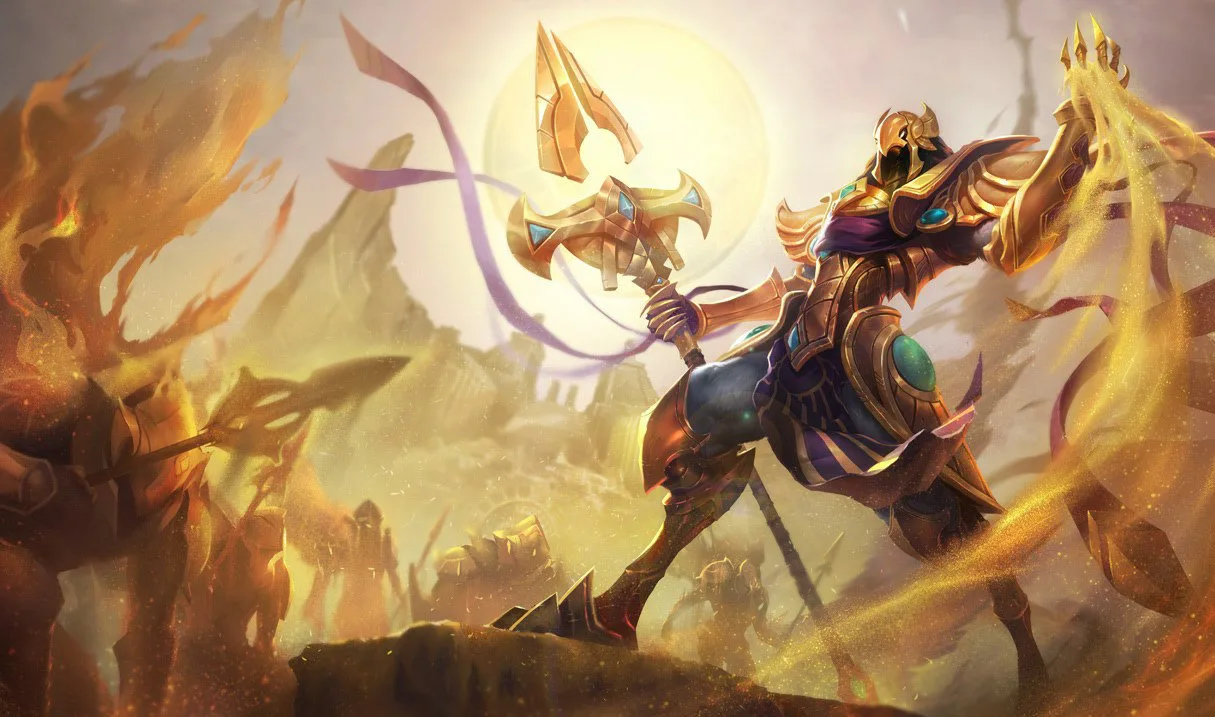
Shuriman Ascended and Targonian Aspect hosts both wield celestial power, but they gain it through different means. The Sun Disc transforms mortals into god-warriors, while Targon’s Aspects choose mortal vessels. Their histories are closely connected, but their origins and identities remain distinct.
Ascended champions and the Darkin they became
These nine named beings connect League’s champion roster directly to Shuriman Ascension. Rhaast appears through Kayn rather than as a separately selectable champion. The Darkin rows describe their present vessels, not the bodies in which they originally ascended.
| Champion or Darkin | Present identity | Ascension and its consequences |
|---|---|---|
 Emperor of the Sands | Ascended emperor | Killed during his original ritual; completed his Ascension after returning and saving his descendant. Commands sand soldiers and rebuilds his capital. |
 Curator of the Sands | Jackal-headed god-warrior | Scholar and strategist who ascended while dying of illness. Survived the empire’s fall and seeks to guide its restoration. |
 Butcher of the Sands | Crocodilian god-warrior | Ascended beside his brother, then sacrificed his freedom to imprison the emperor’s betrayer. Emerged convinced his brother had betrayed him. |
 Magus Ascendant | Ascended being of arcane energy | Stole the power intended for the emperor. His surviving sarcophagus fragments are restraints around his energy form, not a Darkin weapon. |
 Darkin Blade | Fallen Ascended bound to a greatsword | Overwhelms mortal bearers and reshapes their flesh. His present body is a temporary imitation of his lost god-warrior form. |
 Hound of a Hundred Bites | Darkin bound to a dagger | Her consciousness spread through a pack of dune hounds. The dogs are her hosts, not animals that underwent the ancient Sun Disc ritual. |
 Darkin Scythe | Darkin wielded by Kayn | The ancient Ascended consciousness in the scythe contests control of its mortal wielder. |
 Arrow of Retribution | Darkin associated with a bow | His current body was formed from the Ionian lovers Valmar and Kai. Their souls remain distinct from the Darkin sharing it. |
 The Unsundered | Darkin associated with a glaive | An Ascended who resisted his fallen kin and willingly accepted sealing. Returned through a mortal’s sacrifice and hunts other Darkin. |
Renekton’s rage does not make him a Darkin, and Xerath’s catastrophic transformation does not make him one either. Darkin describes a particular fallen lineage and history, not every dangerous Ascended. Conversely, a Darkin remains part of Ascended history even after losing its original body.
Mortals, descendants and relic-bearers connected to the Ascended
An inherited bloodline, ancient weapon or encounter with a god-warrior does not automatically confer Ascension. These connections explain how the Ascended’s legacy reaches champions who have different origins.
| Character | Connection | Identity to keep separate |
|---|---|---|
| Sivir | Descendant of Shurima’s last emperor and bearer of Setaka’s Chalicar. Her blood awakened the magic that restored her ancestor. | Mortal heir, not an Ascended god-warrior. |
| Cassiopeia | Betrayed the expedition’s guide and was bitten by a magical tomb guardian. | Her serpentine transformation is not a Sun Disc Ascension. |
| Ezreal | Recovered a powerful gauntlet from Ne’Zuk’s tomb. | A mortal explorer using an Ascended-era artifact. |
| Kassadin | Wields the Nether Blade once carried by Horok. | A mortal fighting the Void with assembled magical equipment. |
| Malphite | The surviving shard of the Monolith built by Ne’Zuk. | A living magical creation, not Ne’Zuk or an Ascended host. |
| Jax | Fought Shuriman god-warriors during the Icathian rebellion and helped kill one at Bai-Zhek. | An Icathian survivor and opponent of the Ascended Host. |
| Vladimir | Learned hemomancy from a Darkin master. | A blood mage, not a Darkin merely because he uses the same art. |
| Taliyah | Helped the emperor’s descendant escape the devastation at Vekaura. | A stoneweaver protecting people caught in an Ascended conflict. |
| K’Sante | Defends independent Nazumah and killed the cobra-lion studied by Tope. | A mortal monster hunter who resists divine domination. |
| Xin Zhao and Yunara | The former became the Darkin glaive’s vessel; the latter guarded its prison. | The host, guardian and Darkin have separate histories. |
| Rammus | Shuriman legends sometimes identify him as an Ascended guardian. | His true origin remains unconfirmed. |
How the Sun Disc created Shurima’s god-warriors
Ascension began with celestial intervention. In Aurelion Sol’s biography, the Aspects deceive the Star Forger into wearing a crown that binds him and exposes his knowledge. They then direct mortals to construct a disc that channels his celestial power into immortal god-warriors. When the first disc fails, a more powerful one replaces it.
This makes the Sun Disc more than a monument to sun worship. It is the mechanism connecting mortal bodies to a source of power beyond Runeterra. The empire turned access to that mechanism into a sacred institution, with priests, ceremonial rules and an Ascended Host whose authority exceeded that of ordinary soldiers.
The Sun Priests normally selected people whose service merited the honor, often near the end of their mortal lives. Military achievement mattered, but so did other contributions: Nasus preserved knowledge, while Xolaani was remembered as a healer. Imperial approval and spiritual worth were also vulnerable to pressure, as Azir’s demand for his own ritual demonstrates.
- Selection: the priesthood assessed a candidate’s worth and prepared the ceremony.
- The dais: the candidate entered the ritual space beneath the Sun Disc.
- Transformation: celestial energy remade mortal flesh and granted extraordinary power.
- The risk: survival and a complete transformation were not guaranteed.
The priesthood’s selection was not an infallible magical restriction. Nasus’s biography describes Renekton carrying his dying brother into the light and expecting to perish. Both emerged transformed. Xerath later took that precedent as evidence that an unchosen person could seize Ascension, with disastrous consequences.
Ascended history: conquest, Icathia and the fall of Shurima
The Ascended Host helped build an empire through conquest as well as protection. Its armies enforced Shuriman authority over other peoples, and its heroes were not necessarily heroes to those they conquered. Nasus collected the learning of defeated cultures; Renekton’s destruction of Nashramae’s library nearly brought the brothers to blows.
Icathia’s rebellion and the war against the Void
The turning point came when Icathia rebelled and unleashed the Void against its Shuriman overlords. The weapon the rebels hoped to control consumed their own people as well as their enemies. God-warriors who had overwhelmed mortal armies now faced something that could unravel them from existence.
Riot’s Where Icathia Once Stood presents the disaster from the rebels’ side. Aatrox’s biography supplies the longer aftermath: years of fighting eventually halted the advance and sealed major rifts, but surviving Ascended carried psychological wounds that their powerful bodies could not heal.
- Setaka fell: the warrior-queen’s death removed a central leader of the Ascended Host.
- The Monolith failed: Ne’Zuk’s enormous living fortress could not destroy the Void, despite its immense magical power.
- The survivors changed: grief, anger and trauma endured long after the battlefield victory.
Xerath’s betrayal and Renekton’s sacrifice
Centuries later, Azir prepared to ascend as emperor. Xerath, his enslaved childhood companion and trusted magus, had spent years building the power and influence needed to betray him. Immediately before the ceremony, Azir freed Xerath and Shurima’s slaves, but Xerath continued with his plan.
He blasted Azir out of the protected ritual space and took his place. Azir burned away, the unleashed power devastated the capital, and Xerath forced the priests to keep channeling energy until his flesh became a vortex of arcane power. Xerath’s biography describes both the theft and the transformation.
Nasus and Renekton returned too late to save the city. Their magical sarcophagus could not fully contain Xerath, so Renekton dragged him into the Tomb of the Emperors and ordered Nasus to seal them inside. Over centuries of imprisonment, Xerath convinced Renekton that his brother had deliberately abandoned him.
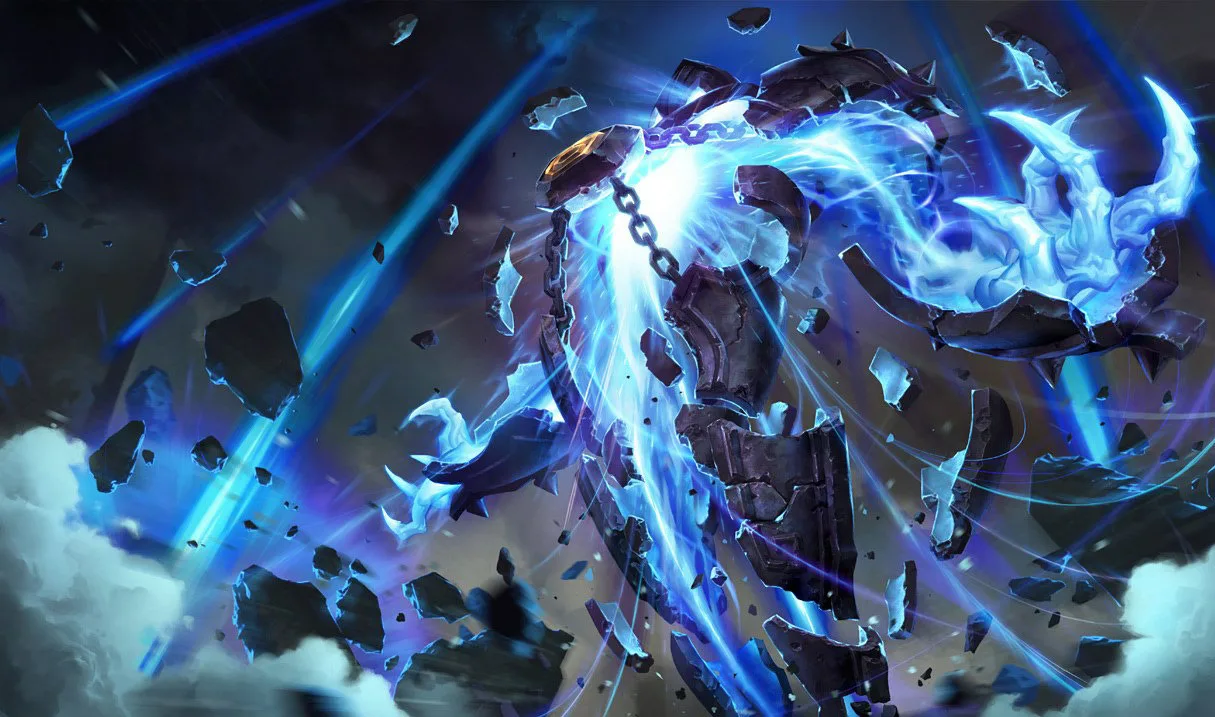
Azir’s return and the unfinished imperial conflict
The tomb’s reopening freed Xerath and Renekton. Nearby, Sivir’s spilled blood revived Azir, initially as an incomplete being of dust and will. Rather than reclaim his throne first, he carried his dying descendant to the Oasis of the Dawn. Saving her completed the transformation that his original ceremony had denied him.
Riot’s Rise of the Ascended cinematic follows this connection between Sivir’s survival, Azir’s selfless act and the restoration of Shurima.
Azir raised the capital and Sun Disc, but restoring buildings could not restore consensus. Xerath seeks dominion of his own, Renekton hunts the brother he once loved, and Nasus hopes to recover something of the old empire without losing his brother again. Mortal communities must decide whether the return of god-warriors means protection or another demand for obedience.
Ascended powers, animal forms and the limits of immortality
Ascension grants tremendous power, but it does not give every god-warrior the same abilities. A transformed body, extraordinary longevity and a connection to celestial magic are recurring features. The expression of that power depends on the individual.
- Physical transformation: Nasus resembles a jackal and Renekton a crocodile. Azir has a hawk-like, armored form. Their animal features do not make them naturally born animal species.
- Magic and command: Azir shapes sand into soldiers and reconstructs his capital, while Xerath unleashes destructive arcane energy.
- Knowledge and craft: Nasus accumulated centuries of scholarship. Ne’Zuk combined Ascended power with Ixtali elemental mastery to create the Monolith.
- Healing and endurance: god-warriors can survive injuries and spans of time that would destroy mortals, but regeneration has limits. Ta’anari retained a crippling spinal injury.
- Learned sorcery: blood magic allowed fallen Ascended to reshape flesh. It was part of their later history, not a requirement of every Ascension.
“Immortal” does not mean impossible to kill. Setaka died, Jax helped bring down an Ascended, and the gathering in Twilight of the Gods ended in multiple deaths. Nor did the Sun Disc’s fall instantly kill its creations: Nasus survived outside the capital, while Renekton and Xerath endured their imprisonment.
Animal form is not an absolute rule either. Xerath’s body became energy. Nor is rage a reliable classification: Renekton’s brutality and trauma are part of his personal history, not evidence that every violent god-warrior becomes a Darkin.
Baccai: failed Ascension and the people it left behind
Baccai are associated with Ascensions that left their subjects flawed or incomplete. The ritual could produce suffering and exclusion rather than an honored place in the Host. Riot’s Legends of Runeterra card text for Baccai Reaper describes survivors who fled or were spared and remained hidden in tombs.
The Baccai are not simply powerless versions of the champions. Baccai Sandspinner wields destructive sand magic, while Forsaken Baccai remembers a friendship with Rhaast before their Ascension ceremony. These details make them survivors of the same institution, with individual grievances and relationships.
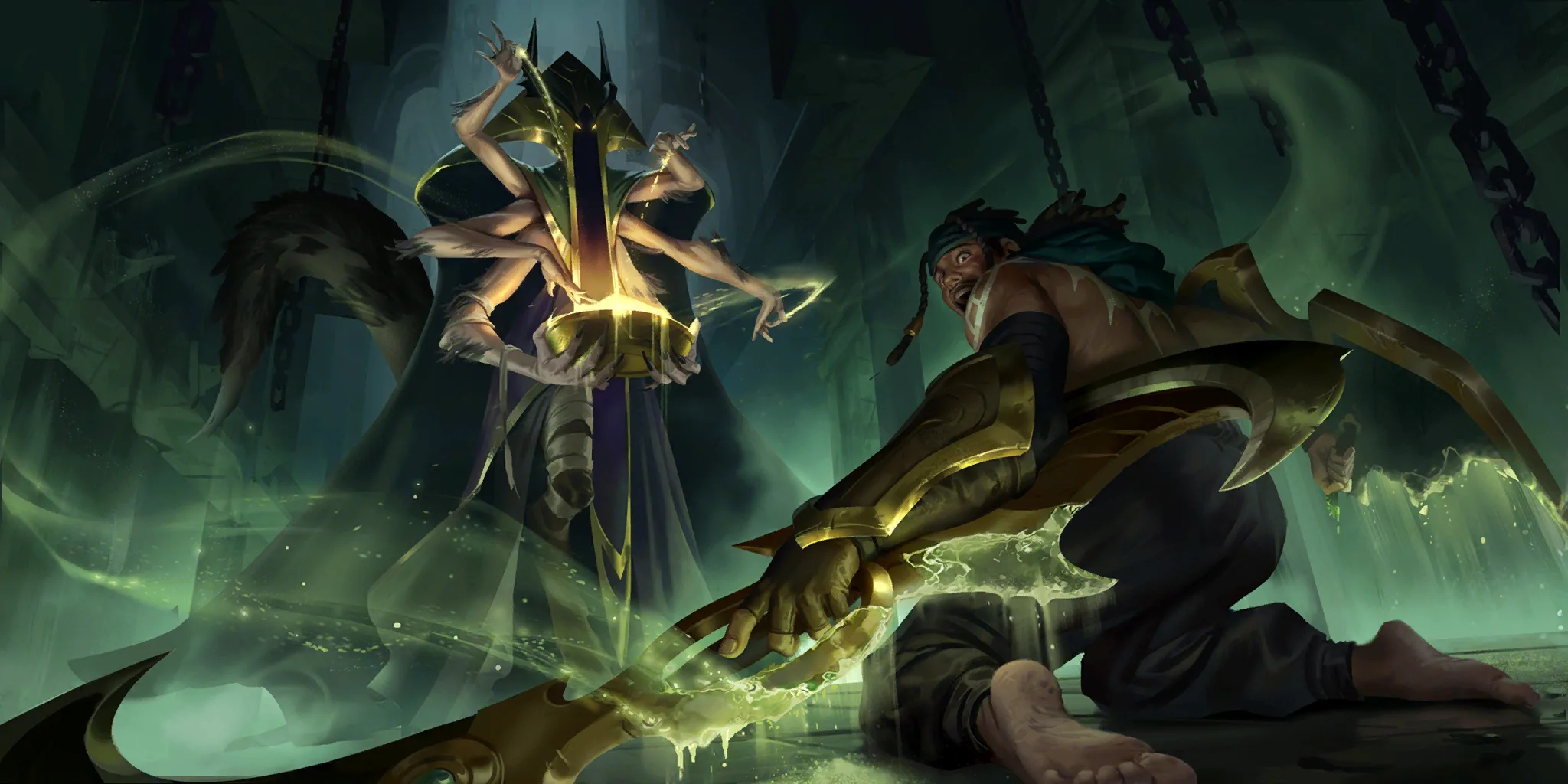
A flawed transformation does not necessarily mean a powerless being. Xerath seized the Ascension ritual and emerged as living arcane energy, unlike the animal-shaped god-warriors honored by Shurima. His extraordinary strength shows why power alone cannot distinguish a successful transformation from a disastrous one.
There is another important exception in K’Sante’s biography. Tope identifies the cobra-lion as a Baccai and theorizes that Xerath fused Shuriman animals through a corrupted Ascension ritual. That explanation remains Tope’s theory within the story. It should not be turned into a blanket claim that every Baccai was once human, or that every monster in Shurima came from the Sun Disc.
- Baccai Reaper and Baccai Sandspinner: examples of dangerous survivors represented in the card game.
- Rampaging Baccai and Baccai Witherclaw: portray the resentment and fury associated with failed transformation.
- Forsaken Baccai: preserves a personal connection to Rhaast’s life before he became a Darkin.
- The cobra-lion: a monster whose proposed Baccai origin is explicitly an in-world explanation, not a universal rule.
How Ascended became Darkin and lost their bodies
The Darkin were not created as a separate species beneath a different Sun Disc. They were Ascended who fell into tyranny and forbidden sorcery. The Legend of the Darkin separates the major stages: the trauma of fighting the Void, the loss of imperial leadership, and the wars that followed as rival god-warriors claimed the world.
Blood magic gave these conflicts a new horror. Fallen Ascended could alter flesh and impose their will on others. Xolaani, remembered as a healer, used hemomancy to control her brethren, while Aatrox became her bitter enemy. Their power did not free them from mortal motives; it made those motives catastrophic.
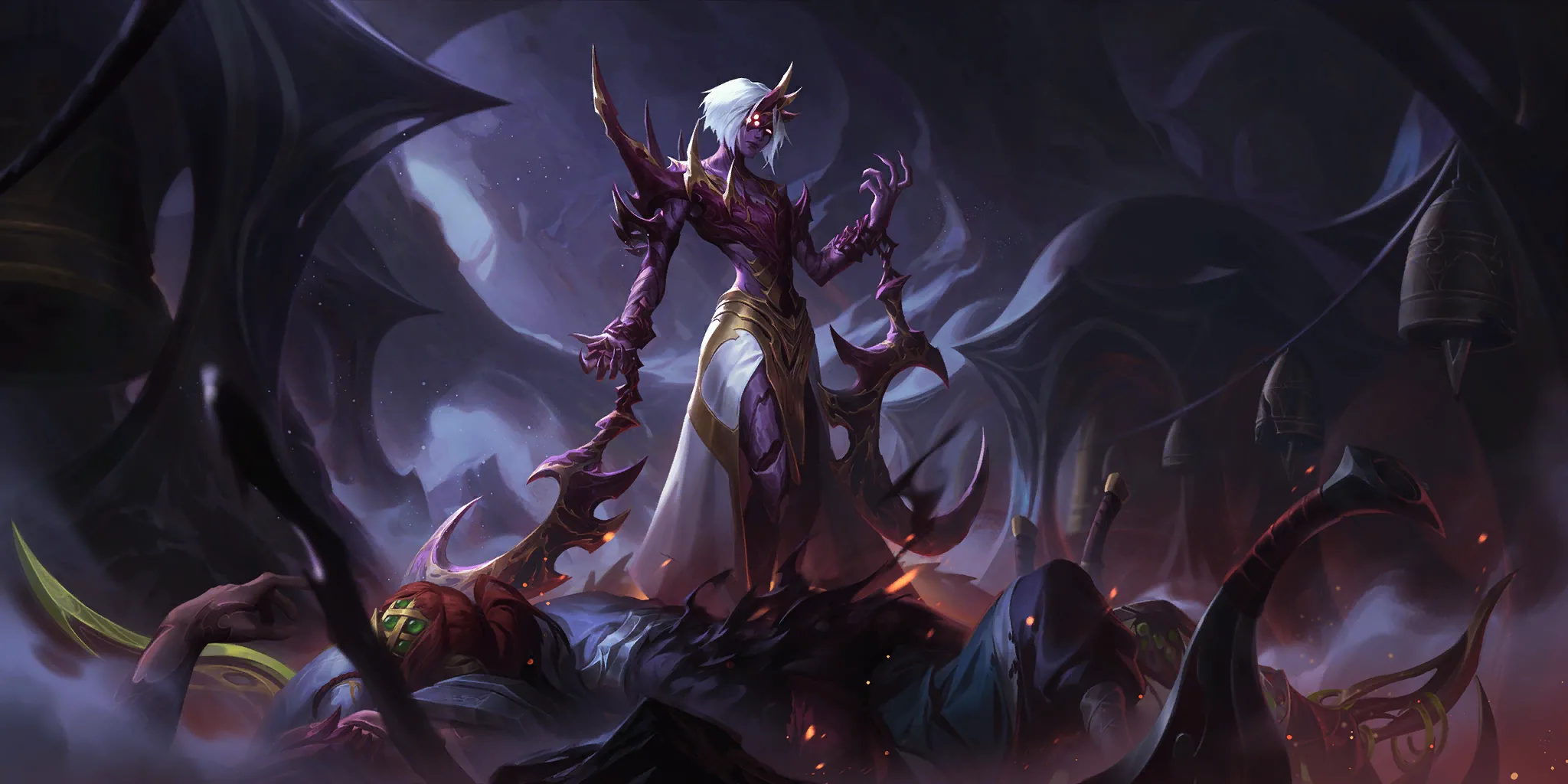
Targonian intervention helped mortals end the wars. The Aspect of Twilight supplied knowledge used against the fallen god-warriors, while the Aspect of War rallied resistance. Many Darkin were bound into artifacts that preserved their consciousness while denying them an independent body. Others were killed; imprisonment was not the fate of every fallen Ascended.
Weapons, hosts and the survival of a separate mind
A Darkin weapon contains a being, not just a magical effect. Contact can give that being a route into living flesh, but the result varies enormously. Aatrox consumes successive bodies, Rhaast struggles against a resisting wielder, and Naafiri discovers a shared existence across nonhuman hosts.
Varus’s story makes the distinction particularly clear. Valmar carried the dying Kai into a forbidden well hoping to save him. The Darkin remade their bodies into one vessel, yet both human souls survived within it. Riot’s As We Fall belongs to the Retribution arc that tells this tragedy.
The ancient archer who ascended was Varus. Valmar and Kai did not travel back through his life or become the original god-warrior. The same principle applies to Kayn and Rhaast: League’s alternate gameplay transformations should not be mistaken for confirmation that their ongoing lore conflict has already ended.
Zaahen and Xin Zhao’s sacrifice
Zaahen complicates the idea that every Darkin embraces destruction. His biography remembers his earlier role guiding candidates toward Ascension, his loyalty to Setaka, and his attempt to bring Rhaast back from brutality. Mortally wounded in their battle, he used the same corrupting blood magic he opposed.
He later accepted confinement within his glaive to contain the danger inside himself. Ionia became central to that imprisonment through Yunara and the temple she guarded. Twilight’s End brings Xin Zhao into the story: his sacrifice gives Zaahen a way back into the world.
Zaahen is the ancient Ascended and Darkin; Xin Zhao is the mortal vessel involved in his return. Yunara is their ally and guardian, not another Darkin. Zaahen’s official profile describes his present struggle as a hunt for his fellow Darkin while resisting the corruption within himself.
Historical Ascended beyond the playable champions
The Ascended Host was much larger than League’s roster. Named leaders, seers, artificers and fallen warriors survive in stories and artifacts, even when their original lives are only partly recorded.
| Figure | Role in Ascended history | Surviving connection |
|---|---|---|
| Setaka | Warrior-queen and leading figure of the Ascended Host; died in the conflict around Icathia. | Nasus buried her with the Chalicar, later recovered and now wielded by Sivir. |
| Ne’Zuk | Ixtali Ascended mage who built the Monolith to attack the Void. | His creation survives through Malphite; Ezreal found a gauntlet in his tomb. |
| Horok | Ascended who fought deep beneath the desert and helped show his kin how to combat the Void. | His Nether Blade is carried by Kassadin. |
| Xolaani | Healer whose command of blood became a means of subjugating others. | Remembered in Xolan’s monument and represented by the Darkin Bloodletters in Legends of Runeterra. |
| Ta’anari | Panther-like Sunborn who tried to end the wars between his brethren. | Gathered rival god-warriors at Nerimazeth and used the Chalicar under Myisha’s guidance. |
| Enakai | Ta’anari’s old companion, who ascended alongside him and carried him from Icathia. | Died in the celestial attack at Nerimazeth. |
| Shabaka and Shabake | Raven-like seer twins whose minds were damaged while sealing the Great Rift. | Their visions anticipated the danger at the gathering; both were destroyed there. |
| Xuuyan, Syphax and Zigantus | Rival fallen god-warriors present at Nerimazeth. | Ta’anari killed Xuuyan; Syphax and Zigantus died in the subsequent celestial fire. |
| Naganeka, Valeeva and Cebotaru | Fallen Sunborn who attended the same gathering. | Escaped its destruction, according to Myisha. Naganeka also appears in the card game. |
| Moneerah | A figure from the fallen brotherhood mentioned in its recollections. | Reportedly killed by Nasus after delving into Nashramae’s ruined library. |
Ne’Zuk establishes that the empire’s Ascended history also includes Ixtal and its elemental traditions. Malphite’s biography describes the Monolith’s construction and destruction, while Whom Does the Desert Know? credits Horok’s campaign against the Void and recounts his death through Ne’Zuk’s betrayal.
What happened at Nerimazeth?
In Twilight of the Gods, Ta’anari assembles his kin hoping to stop their endless war. Myisha teaches him magic that draws on their power and ultimately strips away his own Ascended state. Using Setaka’s Chalicar, he calls down destructive celestial light that kills several of those gathered.
The survivors matter: Naganeka, Valeeva and Cebotaru escape, while Ta’anari becomes mortal again. Myisha then kills him and gives his heart and the Chalicar to a mortal ally for the next phase of the campaign. The story is a particular operation against the Darkin, not an account in which every Darkin was sealed into a weapon at the same meeting.
The wider Darkin roster in Legends of Runeterra
The card game extends the fallen Ascended beyond the playable League champions. Its named Darkin include Xolaani and Naganeka, together with Joraal, Horazi, Taarosh, Ibaaros, Anaakca, Baalkux, Styraatu and Praa the Breachwalker. Their artifacts range from an aegis and lodestone to a halberd, harpoon, spear, staff, harp and fan.
These are additional Darkin, not alternative names for their hosts. Baalkux’s card text even describes him taking hold of an ancient tree, widening the possibilities beyond human bodies. The Darkin Saga’s specific battles and transformed card states should be read in their narrative context, rather than assembled into an assumed, settled timeline for every champion.
Ascended and Targonian Aspects: connected power, different identities
Shuriman Ascension transforms a mortal through the Sun Disc. An Aspect host is a mortal chosen by a celestial being associated with Targon. The relationship can preserve the person’s agency, overwhelm it, or take an unusual form. Sharing a celestial source does not make the two processes interchangeable.
The clearest contrast is between Aatrox and Pantheon. Aatrox began as a Sun Disc god-warrior. The celestial Pantheon later occupied Atreus, suppressing his personality. Aatrox killed that Aspect, but Atreus survived and eventually reignited its weapons through his own resolve.
| Champion | Celestial relationship | Important distinction |
|---|---|---|
| Leona | Host of the Aspect of the Sun. | Retains her own will and Solari convictions; she is not a Shuriman Sunborn. |
| Diana | Host of the Aspect of the Moon. | Her transformation connects her to the suppressed Lunari faith. |
| Taric | Chosen as the Aspect of the Protector. | A mortal’s ascent and calling to protect the world, not a Sun Disc ceremony. |
| Zoe | Merged with the Aspect of Twilight. | Chosen without completing the usual mountain climb; distinct from the earlier host Myisha. |
| Pantheon | Atreus, former vessel of the slain Aspect of War. | The current champion is the surviving man wielding divine power, not the original celestial personality. |
Myisha and Zoe must also be kept separate. Zoe’s biography identifies a previous Twilight host with the ending of the Great Darkin War; Myisha appears directly in the histories of Ta’anari and Naafiri. Zoe inherits the celestial relationship, not a retroactive identity as every earlier host.
There are related figures outside that five-champion grouping. Kayle and Morgana are daughters of Mihira, the mortal vessel of Justice, and inherit celestial power through that family history. Aurelion Sol and Soraka are celestial beings themselves, not humans promoted into Shuriman godhood.
Frequently asked questions about Ascended
Who are the Ascended champions?
The Shuriman lineage represented in League includes Azir, Nasus, Renekton and Xerath, plus the Darkin Aatrox, Naafiri, Varus and Zaahen. Rhaast is another Ascended-origin Darkin represented through Kayn. Targonian Aspect hosts form a related but distinct group.
Are all Ascended Darkin?
No. Darkin are fallen Ascended with a particular history of corruption and war. Nasus, Azir, Renekton and Xerath are not classified as Darkin merely because they possess immense power or commit violence.
Why does Xerath look different from other Ascended?
Xerath stole the power intended for Azir and forced the priests to continue the ritual until celestial energy overwhelmed his flesh. He became a being of arcane power. The stone fragments surrounding him are remnants of the magical sarcophagus Nasus and Renekton used to try to imprison him.
Can Ascended die?
Yes. They can live for millennia and survive extraordinary injuries, but they can be killed. Setaka’s death and the casualties at Nerimazeth are clear examples. A Darkin’s binding can separately preserve its consciousness after losing a host body.
Was Naafiri originally a dog?
Her present canine bodies are dune-hound hosts acquired after she was imprisoned in a dagger. They are not the original body in which she belonged to the ancient Ascended lineage.
Are Sivir and Rammus Ascended?
Sivir is a mortal descendant of Azir, not an Ascended. Rammus is unresolved: his official biography presents Ascended status as one of several beliefs about his origin.
Are Pantheon and Leona Shuriman Ascended?
No. Their powers come from Targonian Aspects rather than the Sun Disc. Leona is the Sun’s host; Pantheon is Atreus, who survived the death of the Aspect of War and continues to wield divine power.
The Ascended legacy still shapes Runeterra
Shurima’s Ascended were created to extend mortal service into eternity, but their stories expose what that promise could not solve. Nasus could preserve knowledge without preserving his empire. Renekton could save his brother and still lose his trust in him. Azir gained the power he once demanded only after choosing another person’s life over his own ambition.
Their legacy survives through more than the remaining god-warriors. It lives in the weapons carried by mortal champions, the Baccai excluded from imperial glory, and the Darkin seeking bodies after centuries of confinement. Targon connects these stories through celestial intervention, while the people living beneath such powers continue to bear their consequences.
- Continue with Shurima’s history and champions for the restored empire and the communities living under its shadow.
- Explore the Darkin for the weapons, rivalries and host struggles left by the fallen Ascended.
- Read about Targon and its Aspects to follow the celestial beings and mortal vessels behind the intervention.
- Follow Icathia’s rebellion and the Void for the catastrophe that changed the Ascended Host.