League of Legends player count in 2026 is best read as an estimate, not an official live counter. The safest current range is roughly 120 to 135 million monthly active players worldwide, with around 30 to 40 million people logging in on a typical day. That still puts League among the biggest PC games in the world, even if it is no longer growing as fast as it did during its peak years.
The short answer is simple League of Legends still has a very large player base in 2026, Riot does not publish a public live population tracker, and the most useful numbers come from third-party estimates built around monthly active users, daily activity, and regional patterns rather than an in-client dashboard.
- Estimated monthly players: about 120 to 135 million
- Estimated daily players: about 30 to 40 million
- Estimated concurrent players: roughly 1 million or more worldwide at a time
- Most commonly cited peak period: 2022 to 2023
- Best way to read the data: as a range, not a single exact live figure
League of Legends player count right now
The simplest way to describe the League of Legends current player count is this: most credible estimates land in the low-130-million range per month, while daily activity is commonly placed around 30 to 40 million players. If you want one clean shorthand for the LoL current player count, about 131 million monthly active users is a fair midpoint. Even so, the range is more honest than pretending there is one exact live number.
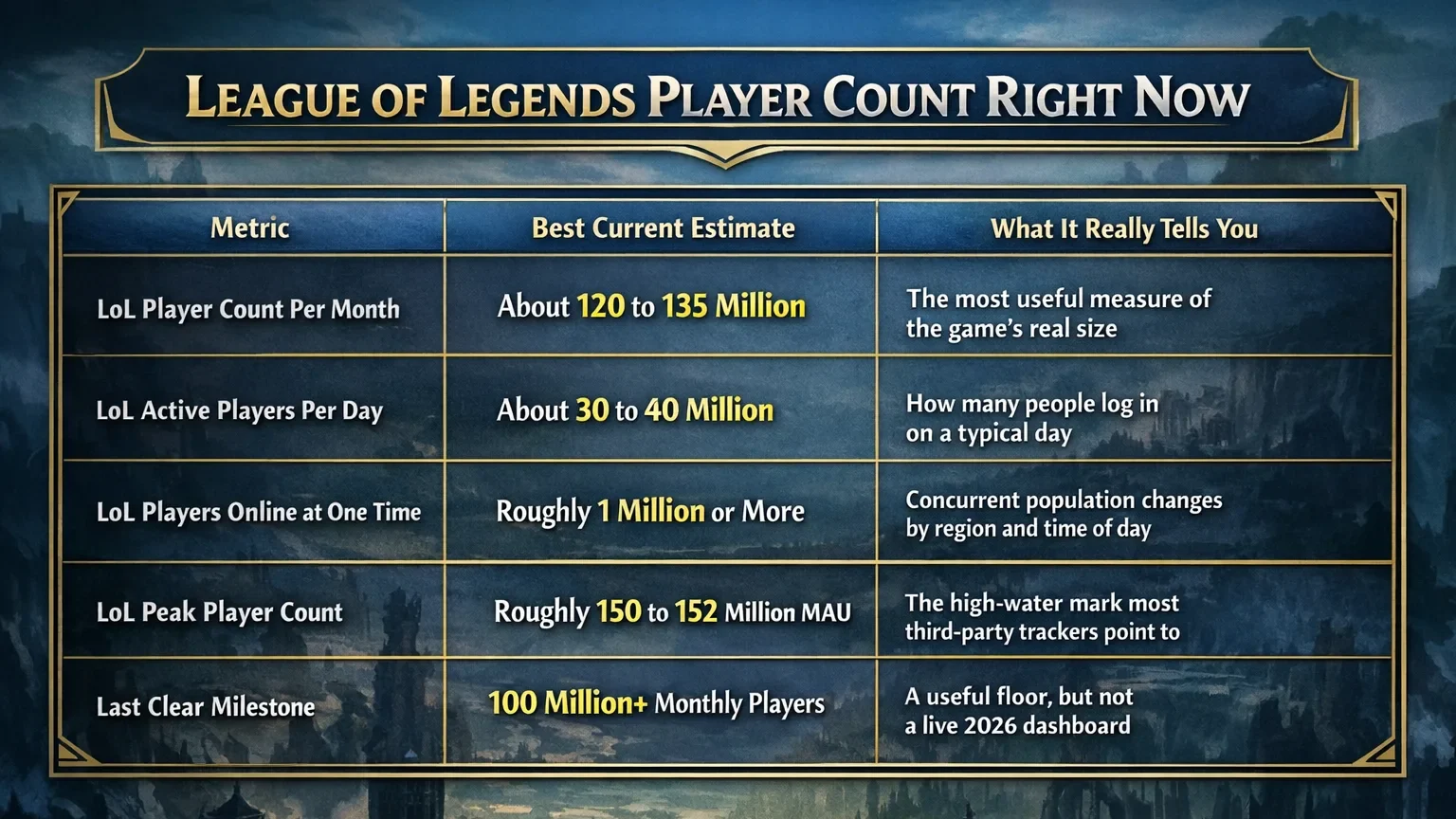
| Metric | Best current estimate | What it really tells you |
|---|---|---|
| League of Legends player count per month | About 120 to 135 million | The most useful measure of the game’s real size |
| League of Legends active players per day | About 30 to 40 million | How many people log in on a typical day |
| LoL active players online at one time | Roughly 1 million or more | Concurrent population changes by region and time of day |
| League of Legends peak player count | Roughly 150 to 152 million MAU | The high-water mark most third-party trackers point to |
| Last clear Riot-confirmed milestone | 100 million-plus monthly players | A useful floor, but not a live 2026 dashboard |
That table also explains why so many “live counter” pages can feel confusing. Some estimate monthly users, some estimate daily users, and others try to guess concurrent players. Those are different measurements, so separating them is one of the easiest ways to understand the real League of Legends player count.
For returning players, the practical takeaway is reassuring. Matchmaking is still healthy in major regions, ranked ladders are still active, and the game is populated enough that most people are not waiting long for standard queues outside of niche modes or off-hours.
What actually counts as the LoL player count?
When people search for League of Legends player count, they usually mean the core PC and Mac game, not every product in the wider Riot ecosystem. That distinction matters because older headlines sometimes blur together League PC, Wild Rift, Teamfight Tactics, or broader Riot milestones and present them as one neat LoL total.
The safest interpretation is to treat the count as the active audience for the main game listed on the official League of Legends site. Riot has shared major historical milestones through Riot Games, but it does not run a public page showing exactly how many people are online in League at any given second. Even a basic League of Legends overview helps here, because it reminds readers that the game has been live since 2009, which makes raw account totals much less useful than active-player estimates.
| Term | What it means | Why it matters |
|---|---|---|
| Registered accounts | Total accounts ever created | This number is inflated by old accounts, abandoned accounts, and smurfs |
| Active players | People who actually log in over a period such as a day or month | This is the best way to judge how big the game is right now |
| Concurrent players | How many people are online at the same moment | This helps explain queue health, but it is not the same as daily or monthly reach |
If you mix those three ideas together, League can look much bigger or much smaller than it really is. Monthly active users are usually the best shorthand for overall popularity. Concurrent players are better for understanding how busy the game feels minute to minute.
League of Legends player count by year
Zooming out helps more than staring at a fake live counter. The long-term pattern is easy to follow: explosive early growth, a huge second wind around 2019 to 2022, then a smaller but still enormous plateau. Put simply, the LoL player count is below its peak, but it is nowhere close to falling off a cliff.
| Year | Estimated monthly active players | Trend |
|---|---|---|
| 2011 | 15 million | Breakout growth phase |
| 2012 | 32 million | League goes mainstream |
| 2013 | 67 million | Huge expansion year |
| 2014 | 70 million | Growth slows, stays strong |
| 2015 | 90 million | Another major jump |
| 2016 | 100 million | Riot-confirmed milestone year |
| 2017 | 81 million | Noticeable dip |
| 2018 | 75 million | Soft period continues |
| 2019 | 116 million | Strong rebound |
| 2020 | 137 million | Massive engagement boost |
| 2021 | 149 million | Near-peak scale |
| 2022 | 152 million | Commonly cited peak zone |
| 2023 | 152 million | Still near peak |
| 2024 | 132 million | Step down from the top |
| 2025 | 131 million | Mostly stable, slightly lower |
The trend matters more than the exact decimal point. The League of Legends peak player count appears to have landed around 2022 to 2023, while the current range is lower but still huge by any normal standard. That is why every new season, major event, and balance cycle still matters, and why our latest patch notes and recent game updates are worth watching if you want to track where interest could move next.

Official signs that League is still healthy
If you want a better reality check than social media doom posts, look at the systems Riot still actively supports. Healthy live-service games usually show the same patterns over time: regular updates, continued work on matchmaking and ranked play, and a competitive calendar that still matters to players. League of Legends continues to check those boxes.
| Signal | What it shows | Why it matters |
|---|---|---|
| Regular patch cadence | League still receives frequent balance and systems updates | Games in decline usually do not keep a steady update rhythm for long |
| Ranked and matchmaking work | Riot continues to tune queue quality, skill distribution, autofill, and progression | That level of attention usually means the core player base still matters |
| Champion, item, and system changes | The game is still being shaped instead of simply left alone | Active development is a stronger health signal than old account totals |
| Global esports ecosystem | Regional leagues and international events still anchor the year | A strong competitive structure usually reflects long-term confidence in the game |
The ranked side is especially important. Riot still spends time on matchmaking quality, queue times, visible rank, and how skill is distributed across the ladder. Those are not surface-level tweaks. They are core systems, and they only keep getting attention when a game is still being treated as a major long-term product.
The esports side tells the same story. League continues to run on a full competitive calendar, with regional leagues feeding into major international events. A game that is truly fading does not usually keep that level of seasonal structure, developer attention, and ecosystem investment year after year.
Is League of Legends dying in 2026?
No, League of Legends is not dying in 2026. A better description is that it is a mature game with a massive established audience. It is no longer in its fastest-growth era, but it still operates at a scale most online games never reach. A multiplayer title with this many players, regular updates, active ranked ladders, and a long-running esports scene is not dying in any meaningful sense.
What is true is that the game feels different from its peak. Some long-time players think League has become less surprising. Others dislike parts of Riot’s monetization direction, or feel the game is harder for brand-new players to get into than it used to be. That is not the same as death. It is what happens when a live-service game lasts long enough to move from breakout obsession to established giant.
The clearest way to read the current moment is this: League is aging, not disappearing. The player base is smaller than it was at its absolute high point, but it is still enormous, still active, and still supported in all the places that matter most, updates, ranked play, and esports.
Why the game can feel smaller than the numbers suggest
A giant monthly total sounds impressive, but what players actually feel is day-to-day friction. Queue times, lobby quality, role balance, smurfs, off-meta frustration, and whether a patch makes the game feel fresh all shape perception more than a headline number ever will. That is why a game can keep tens of millions of daily players and still have veterans saying it feels quieter.
This video is worth including because it captures that tension well. It is less about proving the League of Legends player count is collapsing, and more about why some players feel less excited even while the game remains huge.
For returning players, the important part is not the video title, but the underlying point: even when the audience is still huge, the game can feel smaller if the client is frustrating, the learning curve is steeper, or the current patch does not spark much excitement. That is exactly where our LoL guides and League troubleshooting fixes can help.
League of Legends ranked player distribution in 2026
One of the most useful ways to understand the active LoL player base is to look at ranked distribution. Early 2026 solo queue data shows that most ranked players still sit between Bronze and Gold, while the apex tiers remain tiny. That matters because it tells you where the competitive population actually lives, not just how many people log in overall.
| Rank tier | Approximate share of ranked players | What it tells you |
|---|---|---|
| Iron | 2% | A much smaller bucket than before, after Riot’s recent distribution changes |
| Bronze | 18% | Still one of the largest homes for everyday ranked players |
| Silver | 25% | One of the biggest single skill bands in solo queue |
| Gold | 25% | Another major chunk of the ranked population |
| Platinum | 17% | A large mid-to-upper ladder segment |
| Emerald | 9.1% | A meaningful slice of the ladder, but much smaller than Silver or Gold |
| Diamond | 3.6% | Already a small fraction of ranked players |
| Master | 0.99% | The ladder gets extremely thin here |
| Grandmaster | 0.093% | Tiny apex population |
| Challenger | 0.042% | The rarest visible tier in standard ranked play |
The main takeaway is simple: most League players are not in high Diamond, Master, or Challenger. They are in the broad Bronze-to-Gold middle of the ladder. That is why conversations driven by top streamers and pro players can make the game seem more top-heavy than it really is.
This also connects back to Riot’s 2026 ranked work. Riot has been adjusting MMR-to-rank distribution, autofill behavior, queue times, and the relationship between visible rank and actual skill. In practice, that means the ladder is not static. The shape of ranked in 2026 is partly the result of Riot trying to make the system feel more coherent across the full skill range.
League of Legends active players by region
No public regional counter exists, so any breakdown of League of Legends active players by region has to be treated as an estimate rather than an official Riot readout. Even so, the overall shape is consistent across most serious third-party analyses: China is still the largest piece of the global player base by a wide margin, Europe is the biggest Western cluster, Korea punches far above its population size, and North America remains large enough to matter even if it no longer feels like the center of the game.
| Region or server group | Estimated share of global player base | What stands out |
|---|---|---|
| China | Roughly 50 to 55% | By far the biggest share of the global League of Legends active players, supported by multiple servers, huge player density, and long-term esports strength |
| Europe, mainly EUW and EUNE | Roughly 15 to 20% | The largest Western cluster, with EUW doing most of the heavy lifting for ranked activity, streaming interest, and competitive depth |
| South Korea | Roughly 10 to 12% | Smaller population than China or Europe, but unusually high engagement and one of the strongest cultures for high-level play |
| North America | Roughly 10 to 12% | Still a sizable region for the LoL player count, even if the server feels smaller than it did during earlier peak years |
| Brazil, LATAM, Türkiye, SEA, Japan, Oceania, and others | Roughly 10 to 15% combined | Smaller individually, but important together because they add a meaningful share of daily and monthly activity |
That regional split explains a lot. A patch can hit one area harder than another. A strong Worlds run can reignite interest in a specific server group. Prime-time ranked hours in Europe or North America can make the game feel packed locally, while the global population is actually being carried by activity somewhere else. In short, League does not rise and fall evenly across the world.
China dominates the League of Legends current player count discussion for a simple reason: even conservative regional models usually place it at around half of the entire global audience by itself. Europe is the next-biggest cluster, Korea has extraordinary engagement for its size, and North America still matters even if it no longer feels as central as it once did. If you want to keep up with the stories that shape those shifts, keep an eye on our League news.
How the LoL player count compares with Dota 2 and other MOBAs
Comparing League with other MOBAs is useful, but only if the metric mismatch is obvious. League of Legends is usually discussed through estimated monthly active users. Dota 2 is much easier to track through live Steam concurrency. Those are not the same measurement, which is why a direct one-number comparison can be misleading if you do not label it clearly.
| Game | Best public metric | Current scale | Important caveat |
|---|---|---|---|
| Honor of Kings | Monthly active users | About 260 million | Massive mobile-first audience, especially in China |
| League of Legends | Estimated monthly active users | About 120 to 135 million | Best read as a global MAU estimate, not a public live counter |
| Mobile Legends: Bang Bang | Monthly active users | About 110 million | Huge mobile-first reach, but not a direct PC-to-PC comparison |
| Arena of Valor | Estimated active players | About 11.6 million | Important in some regions, but much smaller overall |
| Pokémon Unite | Estimated monthly active users | About 7.6 million | Healthy cross-platform audience, but far below LoL |
| Dota 2 | Steam concurrent players | Roughly 300,000 to 600,000 depending on time of day | This is live concurrency, not monthly active users, so it is a different kind of number |
| SMITE 2 | Steam concurrent players | Thousands at a time | Niche but active, with a much smaller footprint than League |
| SMITE | Steam concurrent players | Low thousands at a time | Legacy audience remains, but at a much smaller scale |
The important point is not that Dota 2 is small. It is that Dota 2 is public in a way League is not. Steam shows how many Dota 2 players are online right now, while League’s size is usually described through broader active-user estimates. So when someone says “Dota 2 only has a few hundred thousand players,” they are often comparing Dota’s concurrency with League’s monthly reach. That is not a fair metric match.
Once the numbers are labeled properly, the picture gets clearer. League remains the biggest PC-first MOBA by total audience, while Dota 2 remains the clearest direct PC rival with far more transparent public data. That is a more useful comparison than pretending both games expose the same kind of player-count signal.
Why different websites show different League numbers
Different websites disagree because they are not always counting the same thing, and they are not always using the same method. One may model monthly active users. Another may estimate daily activity. Another may focus on concurrency. Add in smurfs, inactive accounts, regional timing differences, and separate Riot ecosystem products, and you get totals that look different while still pointing to roughly the same reality.
That is why the best approach is not to chase one magic number. It is to look for the broader pattern, then anchor it to the parts we do know, Riot’s historical milestones, the ongoing patch cadence, the active competitive calendar, and how the community actually experiences the game day to day. For broader player sentiment, r/leagueoflegends is still useful for reading what people are feeling, even if it is not a statistical source.
Frequently asked questions about League of Legends player count
How many people play League of Legends right now?
The safest answer is that the League of Legends player count sits around 120 to 135 million monthly active players, with daily activity still in the tens of millions. There is no official live counter, so the best current answer is a range, not a single exact number.
What is the LoL active players number per day?
Most modern estimates place LoL active players somewhere around 30 to 40 million per day. That figure matters because it says more about queue health and day-to-day activity than monthly totals do.
What is the League of Legends peak player count?
The League of Legends peak player count is usually estimated at roughly 150 to 152 million monthly active users, with the strongest period landing around 2022 to 2023. That is the most widely repeated peak range for the core game.
Is the LoL player count official?
No. Riot has shared major milestones in the past, but it does not publish a public live dashboard for the main game. Modern numbers are best treated as informed estimates rather than official real-time totals.
Does Wild Rift count as the same player base?
Not always. When most people search for the League of Legends player count, they usually mean the core PC and Mac game. Wild Rift, Teamfight Tactics, and other Riot titles can complicate older headlines if they are bundled together.
Is League of Legends bigger than Dota 2?
Yes, by total audience size. Dota 2 remains the clearest direct PC MOBA rival, but League of Legends reaches a much larger global player base overall. The reason Dota 2 feels more transparent is that Steam exposes its live concurrency publicly.
Can you still get fast matches in 2026?
In most major regions and common queues, yes. The League of Legends active players total is still more than large enough to keep core matchmaking healthy for the average player.
What the numbers mean going forward
The clearest way to read the League of Legends player count is this: the game is below its all-time high, but it is still one of the biggest titles in PC gaming. The smartest summary is not “League is dead,” and it is not “every live counter is accurate.” It is that the player base remains huge, the exact live figure is unknowable outside Riot, and the best modern answer is a well-supported range.
If you want to track where the number could move next, focus on the same things players always respond to, major patches, meaningful system changes, ranked health, esports momentum, and whether returning players can find their footing again. Start with our latest patch notes, follow the big stories in League news, use our LoL guides to catch up on the meta, and check our recent game updates for the broader picture.