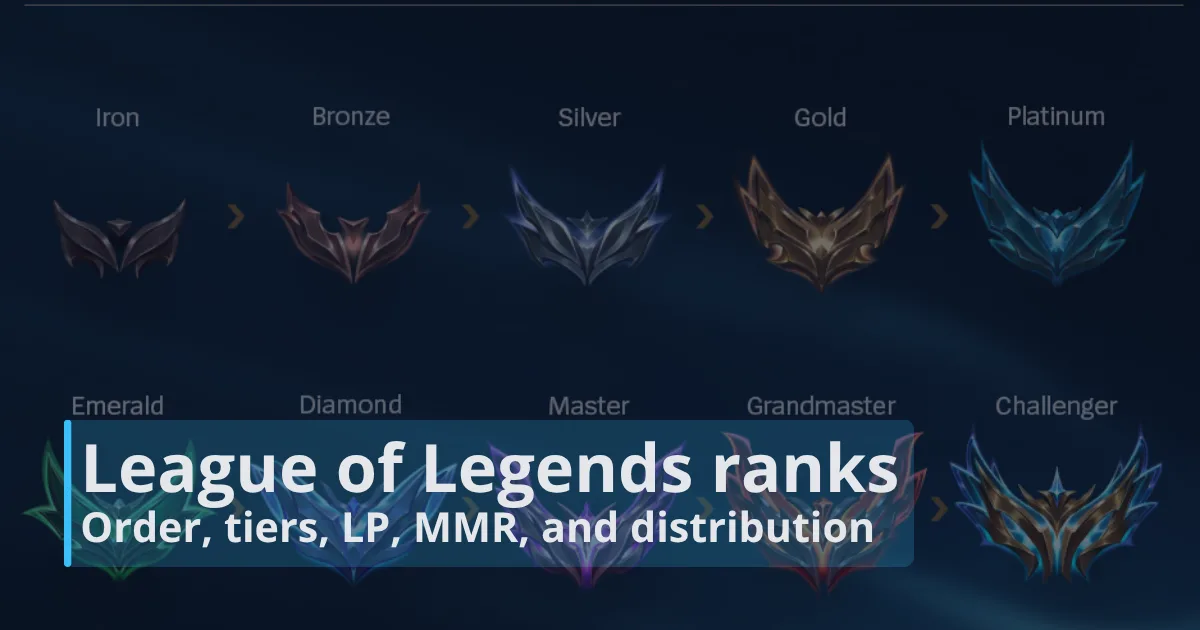
League of Legends ranks are Riot’s competitive ladder for Solo/Duo and Flex, and the current order is Iron, Bronze, Silver, Gold, Platinum, Emerald, Diamond, Master, Grandmaster, and Challenger. If you only need the quick answer, that is the full list of League of Legends ranks in order, with Iron as the lowest tier and Challenger as the highest rank in League of Legends.
The deeper answer is where the climb gets interesting. The modern League of Legends rank system uses visible tiers, divisions, LP, hidden MMR, placement games, resets, and different queue restrictions depending on how high you climb. Once you understand how those pieces connect, your rank stops feeling random and starts feeling much easier to read.
League of Legends ranks in order
Here are all League of Legends ranks in ascending order:
- Iron
- Bronze
- Silver
- Gold
- Platinum
- Emerald
- Diamond
- Master
- Grandmaster
- Challenger
Unranked appears before placements are finished, but it is not one of the official ranked tiers.
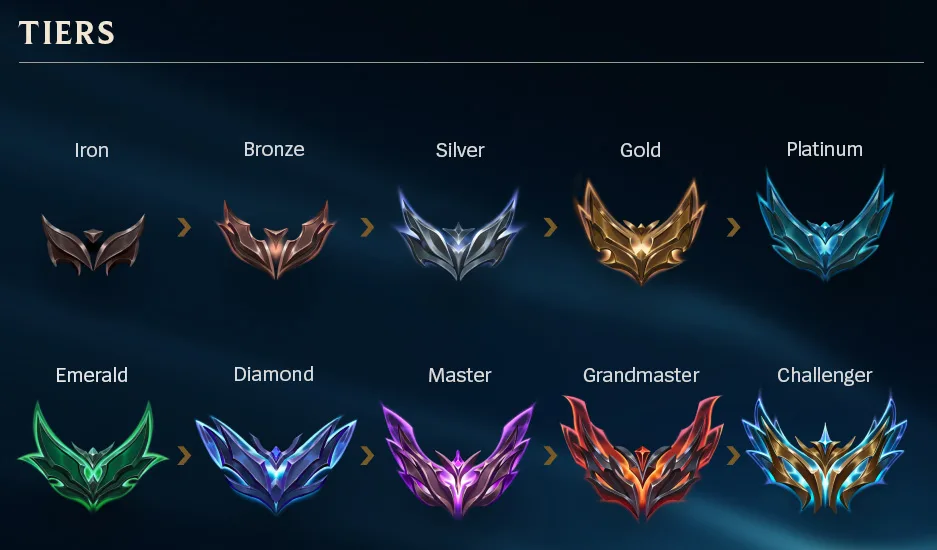
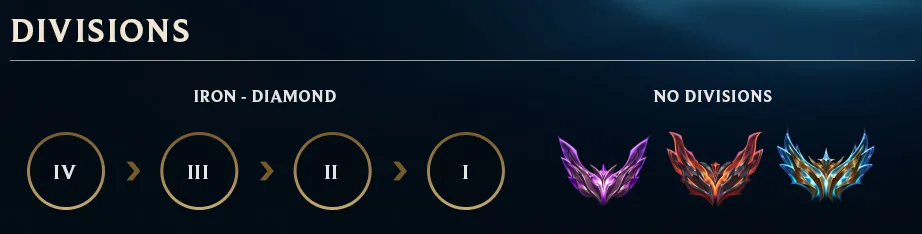
Iron through Diamond each have four divisions, from IV to I, while Master, Grandmaster, and Challenger are single-division apex tiers.
League of Legends rank tiers at a glance
If you want one section that covers League of Legends rank tiers, League of Legends rank distribution, and what each tier usually represents, this is the fastest place to start. The percentages below are estimated 2026 Solo/Duo distribution figures, included to show the general shape of the ladder rather than an official live Riot breakdown.
| Rank | Divisions | Approx. share of ranked players | What it usually means | Best next improvement |
|---|---|---|---|---|
 | IV to I | 2.6% | Players are still building the basics, farming, vision habits, champion comfort, and fight selection. | Play one role, shrink your champion pool, and stop giving away free deaths. |
 | IV to I | 16% | Players know the basics exist, but they do not apply them consistently when a match gets messy. | Farm more reliably, ward where it matters, and stop chasing every kill. |
 | IV to I | 23% | The game starts to look structured, but discipline still disappears under pressure. | Repeat your good habits every game instead of relying on momentum or mechanics alone. |
 | IV to I | 24% | Players usually understand lanes, objectives, and comfort picks, and games feel more deliberate. | Turn leads into towers, dragons, and clean resets instead of coin-flip fights. |
 | IV to I | 18% | Mechanics and matchup knowledge improve, and small mistakes start getting punished much faster. | Sharpen mid-game decisions and stop forcing fights that do not need to happen. |
 | IV to I | 11% | Strong players who usually understand macro, but still lose games to greed or tilt. | Be calmer around Baron, side lanes, and objective trades. |
 | IV to I | 3.7% | High-level laning, faster punishment, stronger macro, and much less room for sloppiness. | Review patterns in your losses and stay consistent across long sessions. |
 | Single division | 1.1% | The climb becomes elite, with much tighter margins around tempo, resets, and map control. | Waste less time, clean up your recalls, and punish windows faster. |
 | Single division | 0.073% | Apex ladder pressure, daily movement, and constant competition for limited spots. | Protect LP through consistency, discipline, and smart queueing. |
 | Single division | 0.031% | The visible peak of the League of Legends rank ladder. | Hold your spot through elite decision-making, preparation, and constant performance. |
Even as an estimate, that distribution matters more than it first seems. Roughly 7 out of 10 players sit in Gold or below, which helps explain why those tiers feel so crowded and varied. Emerald already puts you in a relatively small part of the ladder, Diamond is a clear step above that, and Master or higher is truly elite. If you want more context on how large the overall ladder is, our LoL player count guide helps put those percentages into perspective.
What is a good rank in League of Legends?
A good League of Legends rank depends on your goal, but a practical answer is simple. Gold is above average, Emerald is genuinely strong, Diamond is high-level play, and Master or higher is elite. A lot of players feel stuck in Silver or Gold for long stretches, so even reaching Platinum means you are already doing a lot more right than the average solo queue player.
This is also where expectations get weird. Some players treat Gold like it is low because streamers and top players normalize much higher tiers. In reality, Gold is still a solid result, Emerald is where the climb starts feeling serious, and Diamond is far enough up the ladder that most ranked players will never touch it.
How the League of Legends rank system works
Before you can even queue, you need to unlock ranked. Right now, Ranked Solo/Duo and Ranked Flex open at level 30 once you own at least 20 champions and have played 10 Swiftplay or Normal Draft games. That part alone trips up a lot of newer players who assume level 30 is the only requirement.
Once ranked is unlocked, each queue begins with five placement matches. Those games decide your starting tier and division, and you cannot place higher than Diamond III. One nice detail, especially for new players, is that placement losses do not subtract LP. You simply gain 0 LP for a defeat during placements rather than dropping backward.
After placements, the League of Legends rank system becomes very straightforward on paper. Win games, gain LP. Lose games, lose LP. Reach 100 LP in your division and you promote automatically, with leftover LP carrying over. Reach 100 LP in division I and you move into the next tier without playing a promo series.
Demotions work in reverse. If you lose more LP than you have, you can drop a division. If you fall out of a tier, you usually land in the highest division of the next tier down with 25, 50, or 75 LP depending on how your visible rank compares to your hidden skill estimate. For a full official breakdown of how the current ladder is structured, Riot’s Ranked Tiers, Divisions, and Queues page is the cleanest reference.
LP, MMR, Aegis of Valor, and why your gains can look strange
LP is visible. MMR is not. That is the core idea most players need to understand. Your hidden MMR is what Riot uses to decide who you should be matched with, while your League of Legends rank is the visible label that shows where you currently sit on the ladder. When your MMR is higher than your visible rank, you usually gain more LP for wins and lose less for defeats. When your MMR is lower than your visible rank, the opposite happens.
That is also why two players with the same League of Legends rank can see completely different LP screens after the same result. Riot’s official MMR, Rank, and LP guide explains this better than almost anything else because it frames rank as a visible translation of your hidden skill level rather than a perfect mirror of it.
There are a few newer wrinkles worth knowing too. Aegis of Valor can protect your LP on a ranked loss or double your LP on a win when you play an autofilled game or sometimes a priority role and still earn a strong mastery grade. Riot has also added a climb indicator in loading screen views to help explain why someone with a lower visible tier may still belong in your lobby. Both of those changes matter because the 2026 ladder is trying to make matchmaking feel fairer and less confusing at a glance.
This video is still one of the best simple explanations of how visible rank, MMR, and LP interact.
Watch it once, and a lot of the weirdness around LP gains starts making much more sense.
League of Legends rank distribution, and why it changed so much
League of Legends rank distribution is not fixed. Riot adjusts the ladder over time because the player base changes, the average skill floor rises, and some parts of the ladder can become too crowded or too stretched out. That is one reason older guides to LoL ranks often feel slightly off even when their basic tier list is correct.
One of the biggest recent changes came from Riot’s MMR-to-rank distribution dev post, which explained why the company wanted Iron to better represent truly newer players and why Diamond had become too broad for the skill spread inside it. In plain English, Riot wants each band of the ladder to feel more meaningful, with less of the old problem where players in the same broad tier could be miles apart in actual skill.
That is also why your rank today may not mean exactly what it meant two or three years ago. The ladder is still the ladder, but its shape is not static. Riot Games keeps tuning it as part of the live service, which is why following official updates matters if you care about ranks in LoL beyond a casual level.
For the current environment, the broad picture is fairly clear. The middle of the ladder is still packed, Gold and Silver are still huge population bands, Emerald is a real bridge tier rather than a cosmetic extra step, and the top end of Diamond into Master is more demanding than many older articles make it sound.
Solo/Duo vs Flex, and the queue rules that matter
League of Legends ranks are tracked separately by queue. Your Solo/Duo rank is independent from your Flex rank, and that matters because players often assume good or bad results in one queue somehow spill into the other. They do not. Each queue has its own visible rank and its own MMR.
| Queue | What it is best for | Party rules | Restrictions that matter most |
|---|---|---|---|
| Ranked Solo/Duo | Testing your individual climb, laning, and decision-making with one partner at most. | Solo or duo only. | Restrictions tighten as you climb. Lower ranks can queue more loosely, Diamond gets much stricter, and Master+ follows special apex rules. |
| Ranked Flex | Team play, coordinated comps, practice for grouped play, and Clash preparation. | Groups of 1, 2, 3, or 5. | No parties of 4. Diamond and below are far more flexible, but you need to be at least Emerald to queue with Masters and above. |
In Solo/Duo, restrictions scale with rank. Iron can queue up with players as high as Silver, Silver can queue up to Gold, and the allowed range narrows steadily from there. By Diamond, the rules are much tighter, and from Master onward you are dealing with true apex-tier restrictions. In Flex, the system bends a lot more, but that freedom can still create tougher matches if your group has a huge skill spread.

That matters for more than convenience. Queue rules shape the quality of the climb itself. If you want a cleaner test of your own level, Solo/Duo is usually the better benchmark. If you want team-oriented practice, Flex makes more sense. If you want more ranked improvement help beyond the rules, our League guides are the best place to branch out next.
What each League of Legends rank usually feels like
A lot of articles list the tiers and stop there. That misses the useful part. The best way to understand League of Legends ranks is to treat each one as a cluster of habits, not just a badge.
Iron and Bronze
Iron is where ranked fundamentals are still forming. CS is inconsistent, wards are often late or random, recall timings are rough, and fights happen because someone was visible, not because the play made sense. Bronze is usually less chaotic, but the same core issue remains: players know what they should do, but they do not repeat it. These tiers reward simplification more than anything else. One role, two or three champions, fewer panic fights, and more respect for vision can move a player surprisingly fast.
Silver and Gold
Silver is where League begins to look like recognizable League. Most players understand objectives, can lane without completely collapsing, and know the rough job of their role. Gold is the next step, where those same ideas show up more consistently. Games are still throwable, but they are less random. Small wave mistakes, bad recalls, and sloppy rotations start to matter more, which is why Gold often feels like the first genuinely satisfying milestone for solo queue players.
Platinum and Emerald
Platinum is where impatience becomes expensive. Players punish greed more quickly, matchups feel sharper, and leads disappear fast when someone overstays or forces a bad objective. Emerald sits right between Platinum and Diamond for a reason. It is a bridge rank, and it feels like one. This is also where a lot of players get stuck. Many players here are strong enough to build leads, but not steady enough to close games cleanly. Overchasing, risky dives, and emotional decision-making are common reasons people stall out.
Diamond
Diamond is the last stop before the true apex ladder, and it feels sharp. Players manage waves with intent, punish map mistakes faster, and understand champion identity much better than the rest of the ladder. At the same time, Diamond is still full of players who can play brilliantly for twenty minutes and then lose the game with one ego decision. That is why consistency, not just mechanics, is what usually separates Diamond climbers from Diamond gatekeepers.
Master, Grandmaster, and Challenger
Master and above is where League of Legends ranks stop feeling casual, even for very serious players. Time is wasted less often, map movements are cleaner, and punishments arrive faster. Grandmaster and Challenger add another layer of pressure because the ladder is not just difficult, it is crowded by people fighting to hold limited spots. If you follow how top solo queue play overlaps with pro-level preparation, our esports coverage is a useful next read.
This rank-by-rank breakdown is a helpful companion if you want a quick outside perspective on how each tier usually looks in real games.
It is most useful when you watch it as a checklist for your own habits, not as a label for everyone else.
Rank resets, seasons, rewards, and other details players miss
One of the easiest ways to misread your League of Legends rank is to forget when resets actually happen. Your rank does not stay fixed forever, and the biggest reset happens at the start of a new ranked year. Riot’s current system also uses seasonal participation and reward progress in ways that many older guides still gloss over.
That matters because a lot of early-season confusion is really just visual rank lagging behind MMR. Someone may look lower ranked than you on paper while still belonging in your game. If ranked feels random here, it usually is not. More often, it is the system pushing visible rank back toward hidden skill after resets and fresh placements.
Rewards matter too. Victorious skins and ranked rewards are tied much more closely to participation and progress than the old Gold-only shortcut many veterans still remember. That is one of several reasons older League of Legends rank guides can feel outdated even when the headline list of tiers is still correct.

To stay on top of live changes, it helps to keep an eye on our League news, latest patch notes, game updates, and even our League leaks coverage when you want to separate confirmed ranked changes from speculation.
Frequently asked questions about League of Legends ranks
What are the ranks in League of Legends in order?
The ranks in League of Legends in order are Iron, Bronze, Silver, Gold, Platinum, Emerald, Diamond, Master, Grandmaster, and Challenger. Those are all League of Legends ranks currently used on the main ranked ladder.
What is the highest rank in LoL?
The highest rank in LoL is Challenger. It sits above Grandmaster and represents the very top visible end of the ranked ladder in each region.
How many placement games are there in League of Legends?
There are five placement games in each ranked queue. You do not lose LP during placements, and the highest possible finish after placements is Diamond III.
Do all League of Legends ranks decay?
No. Decay only affects Diamond and above. Diamond players bank more days per match and lose 50 LP when decay triggers, while Master, Grandmaster, and Challenger bank fewer days and lose 75 LP when decay hits, which makes the apex climb much harder to maintain passively.
Can you duo at every rank in League of Legends?
No. The higher you climb, the tighter the rules become. Lower tiers can duo more freely, Diamond gets much stricter, and Master+ follows special restrictions. Flex is more forgiving than Solo/Duo, but it still has rules of its own, especially if you want to queue with Masters and above.
Why am I gaining less LP than someone in the same rank?
Because your visible rank and your hidden MMR are not always aligned. If your MMR is lower than your current tier, your wins can award less LP and your losses can hurt more. If your MMR is higher than your visible rank, the opposite tends to happen. Riot’s Ranked FAQ is useful for edge cases that do not fit the usual pattern.
Can you get LP back if a teammate AFKs or if a cheater is banned?
Sometimes, yes. Riot may award Consolation LP if you lose because a teammate was verified for AFK, leaving, or intentional feeding and the match meets the listed conditions. If you lose to a confirmed cheater and that account is later banned, Riot can also restore the LP you lost from that match.
What should I check if ranked is unavailable or looks broken?
Start with patch timing, queue status, and server health, then work through client-side fixes. Our troubleshooting hub is the fastest place to check the common causes before assuming your account or LP is bugged.
Use your rank as a tool, not a label
League of Legends ranks are most useful when you treat them as feedback, not identity. Learn the order, understand what LP and MMR are telling you, keep an eye on live changes through League news and latest patch notes, and use our League guides when you need practical help turning knowledge into better games.
If ranked itself is changing, watch our game updates and League leaks coverage with equal care, because only one of those is confirmed. If your interest is more about the top end of the ladder, keep following esports coverage. And if you want to understand how your own progress fits into the wider game, the LoL player count guide is a good companion piece.
Done right, your League of Legends rank becomes a really useful snapshot. It tells you where you are, what habits still need work, and what kind of climb you are actually on.