The Riftbound ban list contains 12 active Standard Constructed restrictions, with 10 more announced for November 23, 2026. On that date, the main competitive circuit will have 15 banned cards and seven banned battlefields, or 22 entries in total. Constructed 2v2 has the same restrictions plus one banned Legend, Master Yi, Wuju Bladesman.
Riot Games announced the newest eight card bans and two battlefield bans on November 13, 2026. They are not effective before November 23. Korea and Traditional Chinese-region competitive circuits follow a separate rollout tied to their set releases, so the applicable event region matters as much as the card name.
For a tournament before November 23, use the earlier twelve-entry Standard list. For main-circuit events on or after November 23, check the full twenty-two-entry list below, then confirm the format and local rules. Korea has an additional exception: it temporarily lifts its older card and battlefield bans from the same date.
Riftbound ban list 2026: every banned card and battlefield
The November additions are scheduled rather than active until November 23. Here, main circuit means regions applying Riot’s November 23 schedule; it does not include the delayed Korean and Traditional Chinese-region rollout. Earlier restrictions are shown as the main-circuit list carried forward from Riot’s September Rules Hub. Local competitive circuits can differ.
Ten new bans effective November 23, 2026
| Card or battlefield | Type | Set | Effective date | Main reason |
|---|---|---|---|---|
| Riven, Broken Blade | Champion unit | Radiance (RAD-043) | Nov. 23, 2026 | Riven’s near-riskless conquers and stuns |
| Zhonya’s Hourglass | Gear | Origins (OGN-077) | Nov. 23, 2026 | Protects key units; Hidden and Astral Heron synergy |
| Stellacorn Herder | Unit | Spiritforged (SFD-048) | Nov. 23, 2026 | Unrestricted card draw from repeated movement |
| Nocturne, Horrifying | Champion unit | Origins (OGN-194) | Nov. 23, 2026 | Early zero-Energy reveal plays |
| Rhasa the Sunderer | Unit | Origins (OGN-195) | Nov. 23, 2026 | Near-free, recurring high-Might threat |
| Brynhir Thundersong | Unit | Origins (OGN-026) | Nov. 23, 2026 | Locks opponents out of playing cards |
| Dazzling Aurora | Gear | Origins (OGN-160) | Nov. 23, 2026 | Repeatedly plays expensive units for free |
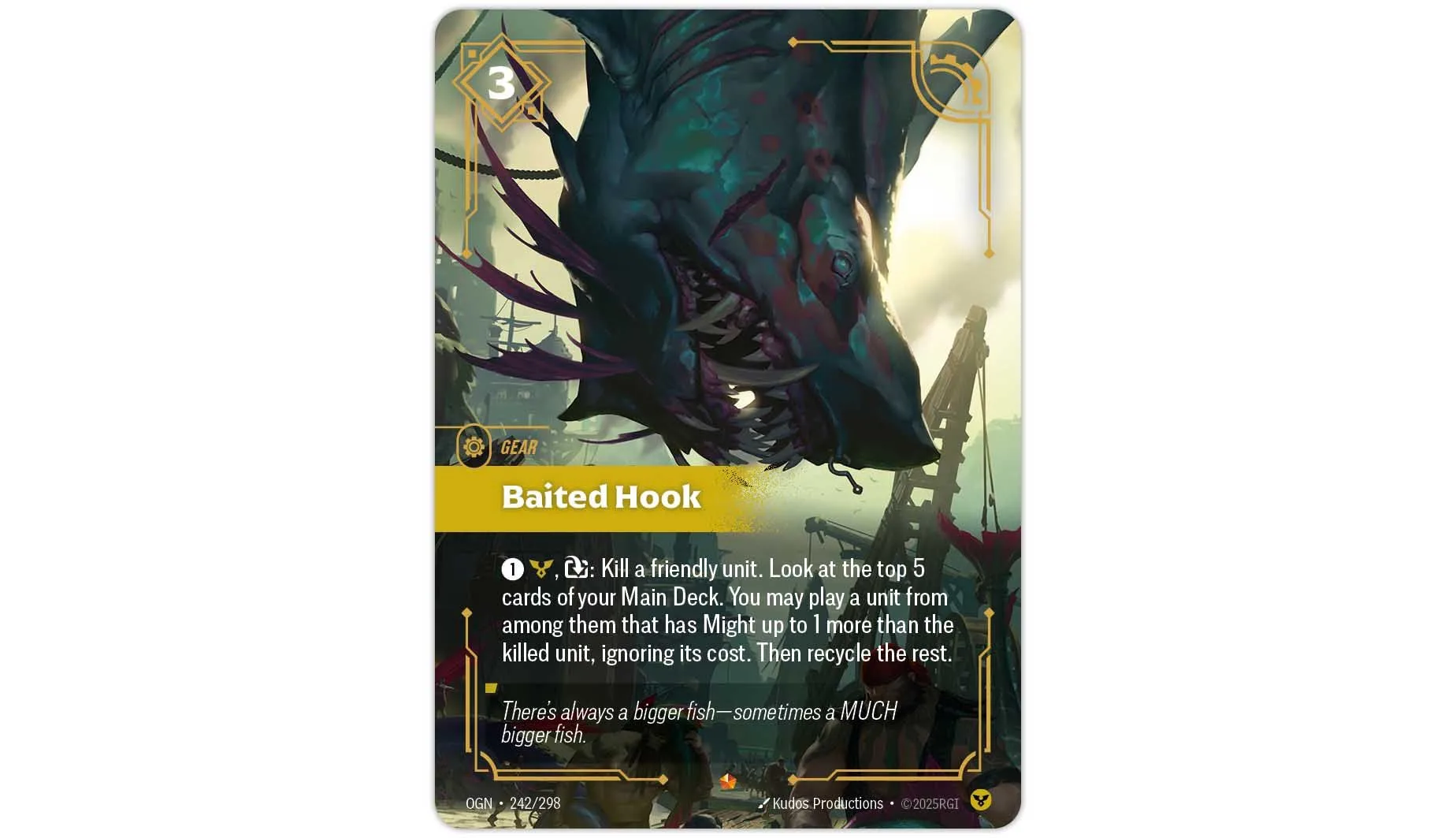
| Baited Hook | Gear | Origins (OGN-242) | Nov. 23, 2026 | Cheats costly units using Might rather than cost |
| Emperor’s Dais | Battlefield | Spiritforged (SFD-207) | Nov. 23, 2026 | Low-risk conquers and unit extraction |
| Star Spring | Battlefield | Unleashed (UNL-215) | Nov. 23, 2026 | Moves units home, reducing conquest risk |
The new additions are confirmed in Riot’s Radiance ban announcement. All eight cards and both battlefields are banned in both Constructed formats on the stated date in the main circuit. They are not additional bans on the Riven, Kennen or Kai’Sa Legends themselves.
Earlier bans still listed for the main circuit
| Card or battlefield | Type | Set | Effective: Standard / 2v2, 2026 | Main reason |
|---|---|---|---|---|
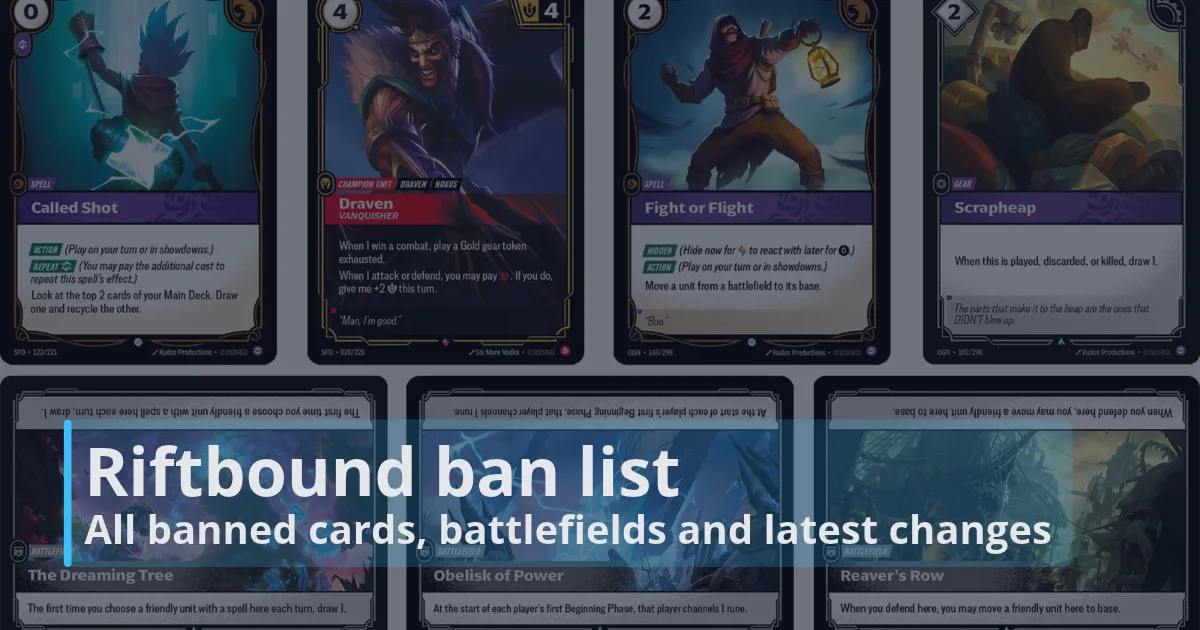
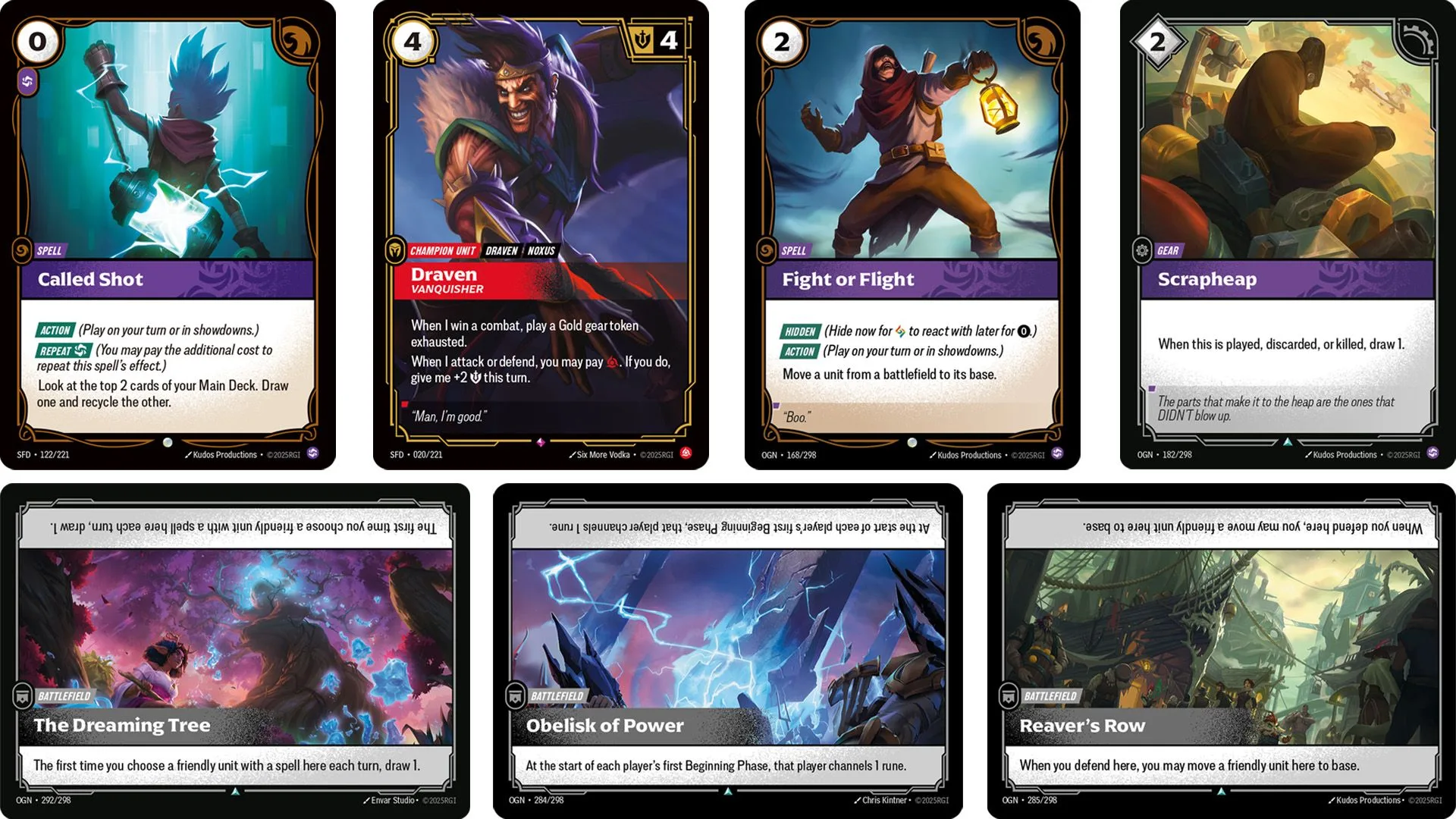
| Called Shot | Spell | Spiritforged (SFD-122) | Mar. 31 / Jul. 24 | Excessively efficient card selection |
| Draven, Vanquisher | Champion unit | Spiritforged (SFD-020) | Mar. 31 / Jul. 24 | Overperforming early Draven play |
| Fight or Flight | Spell | Origins (OGN-168) | Mar. 31 / Jul. 24 | Overly versatile combat escape |
| Scrapheap | Gear | Origins (OGN-182) | Mar. 31 / Jul. 24 | Free card flow in Miracle decks |
| The Dreaming Tree | Battlefield | Origins (OGN-292) | Mar. 31 / Jul. 24 | Too much repeat card draw |
| Obelisk of Power | Battlefield | Origins (OGN-284) | Mar. 31 / Jul. 24 | Overly consistent early resources |
| Reaver’s Row | Battlefield | Origins (OGN-285) | Mar. 31 / Jul. 24 | Safe retreat and uninteractive conquest |
| Stealthy Pursuer | Unit | Origins (OGN-177) | Jul. 24 / Jul. 24 | Potential infinite Recruit loop |
| The Arena’s Greatest | Battlefield | Origins (OGN-290) | Jul. 24 / Jul. 24 | Strong going-first battlefield selection |
| Aspirant’s Climb | Battlefield | Origins (OGN-276) | Jul. 24 / Jul. 24 | Automatic pick; longer games |
| Ekko, Recurrent | Champion unit | Origins (OGN-110) | Sep. 18 / Sep. 18 | Repeated-turn infinite combo |
| Stacked Deck | Spell | Origins (OGN-183) | Sep. 18 / Sep. 18 | Excessive Kennen card selection |
Riot’s original announcement used the shortened name “Dreaming Tree”; the printed battlefield is The Dreaming Tree. The March news story remains useful as a record of Riftbound’s first-ever ban list, but it does not include later changes.
Constructed 2v2-only Legend restriction
| Legend | Type | Set | Effective date | Main reason |
|---|---|---|---|---|
| Master Yi, Wuju Bladesman | Legend | Proving Grounds (OGS-019) | Jul. 24, 2026 | Defensive bonus for both allies; overrepresented among top teams |
The totals after November 23 are 22 banned Standard entries (15 non-battlefield cards and seven battlefields), and 23 in 2v2 after adding the Master Yi Legend. Alternative-art printings and promos with the same banned card name do not provide a legality workaround.
Why Riot targeted Riven, Broken Blade and her support cards
Riven was the most common deck in Stuttgart. Riot reported that Riven represented 43% of registered decks at the European Regional Championship, took three of the Top 4 places and eight of the Top 16, and posted approximately 60% or better non-mirror win rates in high-level competition. Riot identified that combination of popularity and results, not simply the fact that Riven was strong, as an unhealthy metagame pattern.
Those are Riot’s aggregate figures in the ban announcement. The separate official European Championship deck breakdown reports 40.9% Riven on Day 1 and 49.0% on Day 2, so those day-specific percentages should not be mistaken for a contradictory win-rate statistic. For event format, dates and qualifiers, see RiftDaily’s European Regional Championship guide.
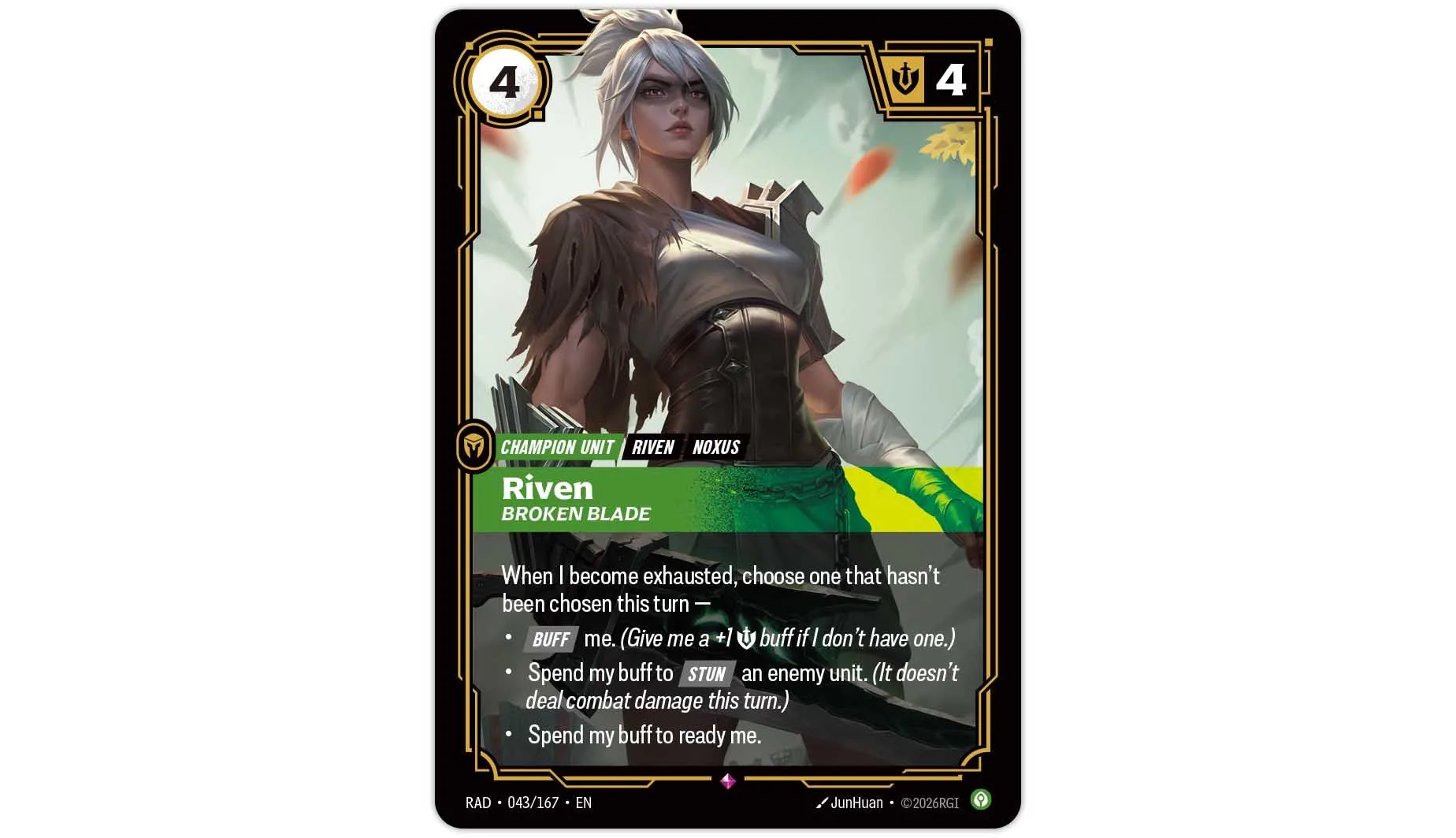
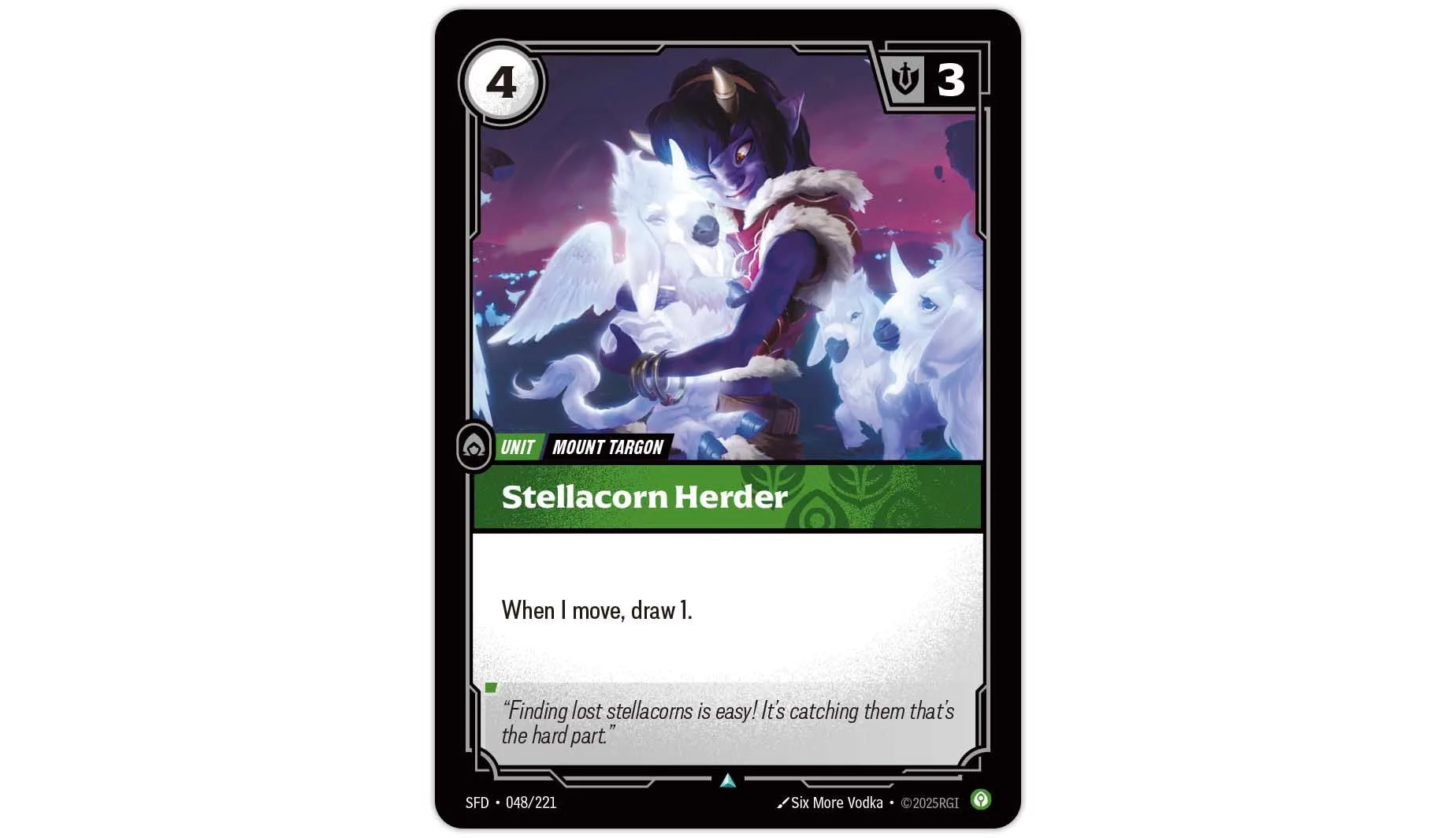
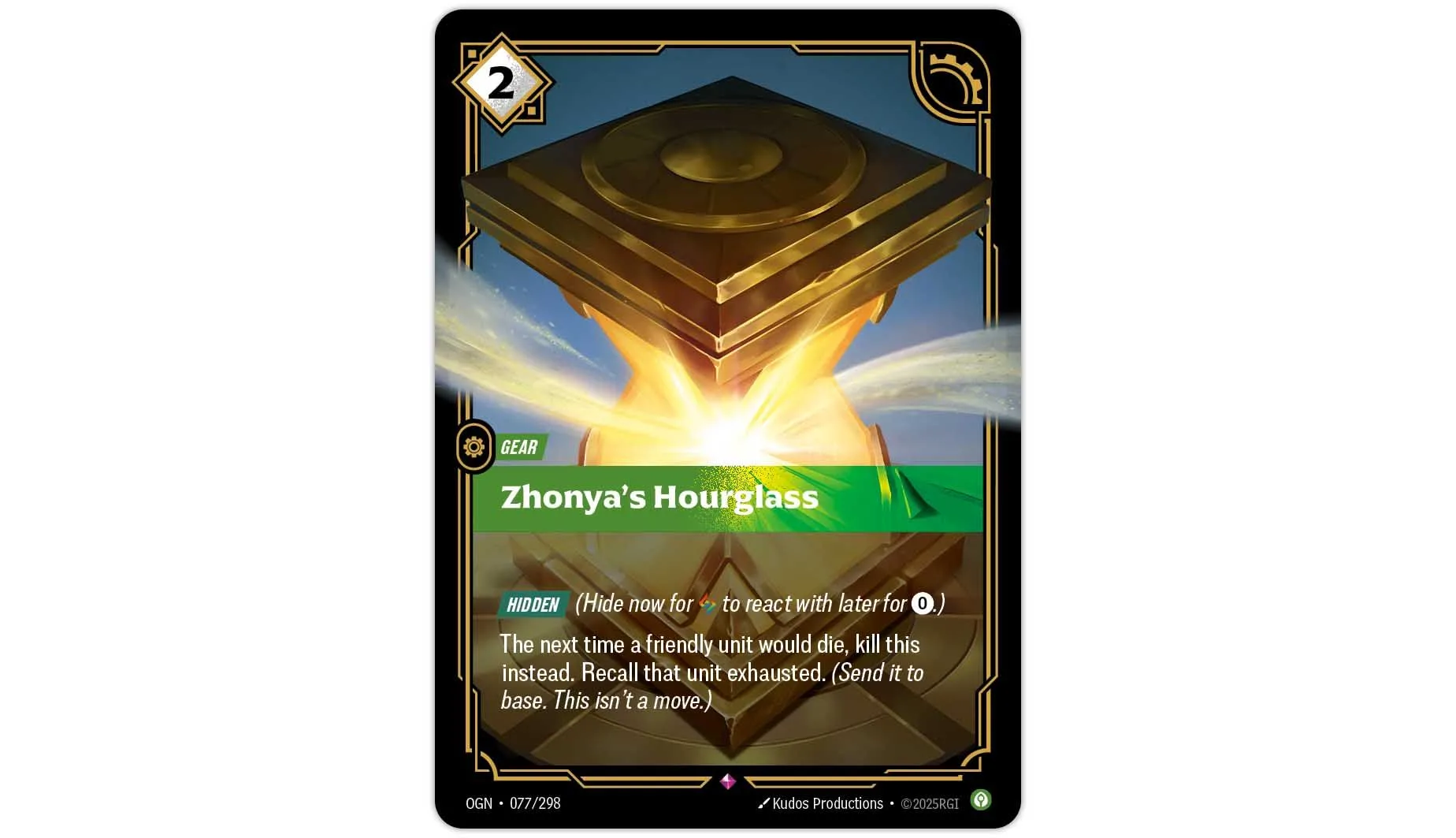
Riven, Broken Blade: a chosen champion with very little risk
The four-Energy Riven, Broken Blade is the Riven deck’s powerful chosen champion unit, not the Legend. When she becomes exhausted, her buff can ready her or stun an enemy unit. That means Riven can take a battlefield, remain a threat and punish attempts to hold it, all much earlier than many opposing decks can interact profitably. Riot particularly objected to the combination of turn-two consistency and the ability to conquer without committing to the usual risk.
Deckbuilding consequence: a Riven Legend deck can still exist, but it needs another legal chosen champion and a new turn-two plan. The banned champion unit cannot be placed in the Champion Zone or included in the 40-card main deck at affected events. Players testing other Riven cards can consult RiftDaily’s Vendetta card guide rather than assume that the whole Riven identity was removed.
Stellacorn Herder: card draw without a meaningful limit
Stellacorn Herder draws a card whenever it moves. Repeated movement effects could turn that simple line into a steady draw engine. Riven could also move the Herder to a battlefield and replace the card immediately, giving opponents little chance to punish the investment. Riot considered this problem broader than Riven: Calm decks had become too good at covering a weakness that should matter when choosing a domain.
Deckbuilding consequence: Riven and other Calm-domain decks must replace a flexible movement-based draw engine. Extra movement cards no longer translate into an unlimited stream of cards through Stellacorn, which raises the value of more deliberate hand management. The original printing appears in RiftDaily’s Spiritforged card checklist.
Zhonya’s Hourglass: protecting threats and enabling Astral Heron
Zhonya’s Hourglass can take a lethal hit on behalf of a friendly unit and recall that unit exhausted instead. Its Hidden ability also makes it less vulnerable to some gear removal before it is used. Riot highlighted Astral Heron as an especially powerful interaction: Zhonya’s can count as the first card played from Hidden while keeping Heron protected.
Deckbuilding consequence: Riven, Astral Heron and other gear-based strategies lose a broadly useful protection package. That matters even when a deck did not rely on Riven, because Zhonya’s was a defensive tool across multiple Legends.
Emperor’s Dais and Star Spring: two battlefields that made conquers safer
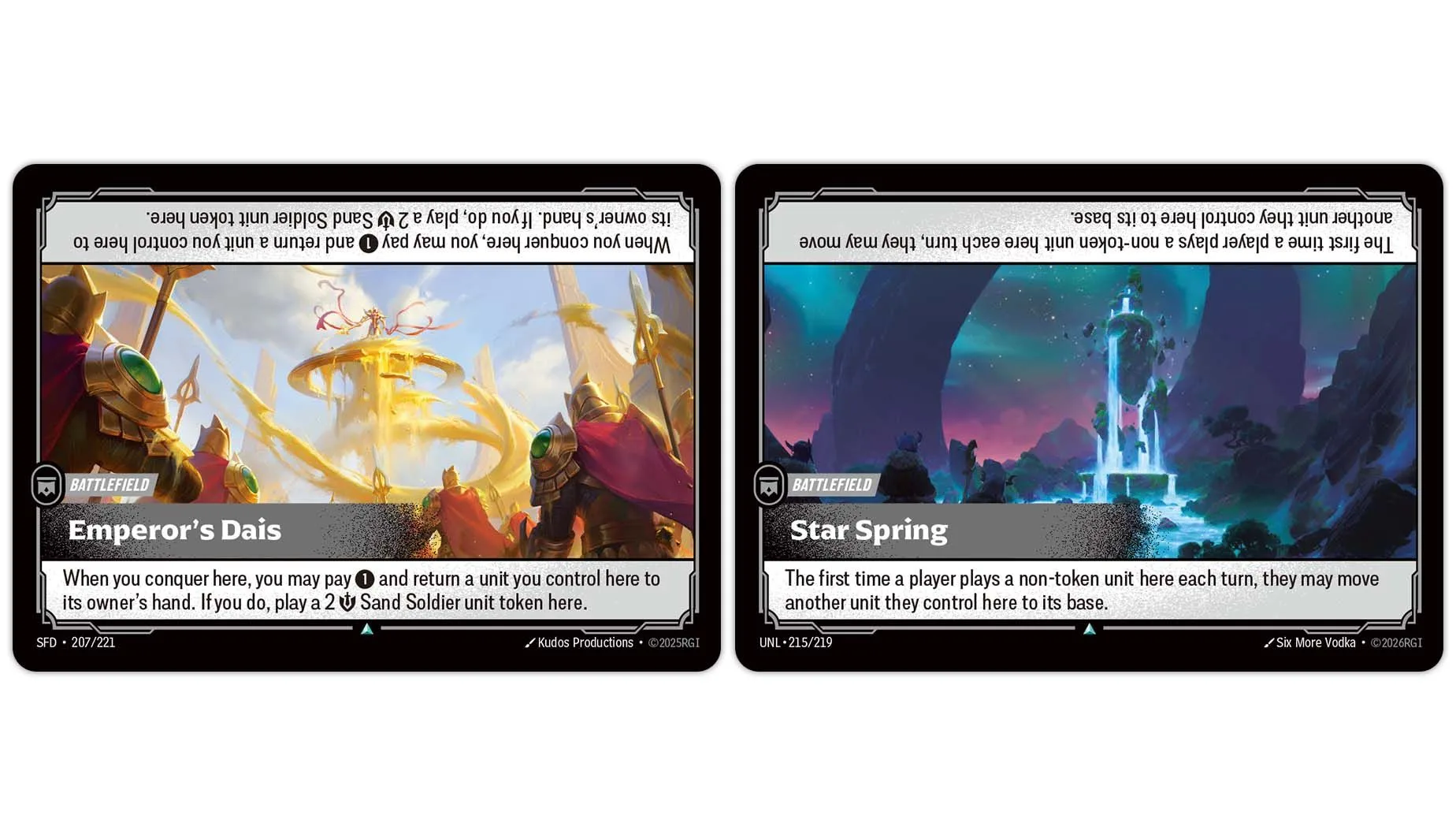
Emperor’s Dais can return a unit to its owner’s hand after you conquer and produce a Sand Soldier in its place. Star Spring can move another friendly unit back to base when a non-token unit is played there for the first time that turn. Both can spare important units from the usual consequences of capturing a battlefield.
Riot compared this kind of safe conquering to the older Reaver’s Row problem: units can score without being left in a vulnerable position. The bans force players to weigh whether to keep defenders in place, retreat or expose a valuable unit when planning battlefield control. The printed Star Spring card can be used by either player, so the issue was not exclusive to Riven even though Riven exploited it particularly well.
Kennen loses Nocturne, Horrifying and Rhasa the Sunderer
Kennen survived Riven’s dominance at the European Regional Championship. Riot reported about 15% of registered decks were Kennen, three Top 8 spots belonged to Kennen, and ASC Evansrhim won the tournament with Kennen. Riot’s European Championship deck breakdown identifies the winner and provides the field by Legend. Kennen’s Legend ability and signature spell made the deck especially good at finding explosive early combinations.
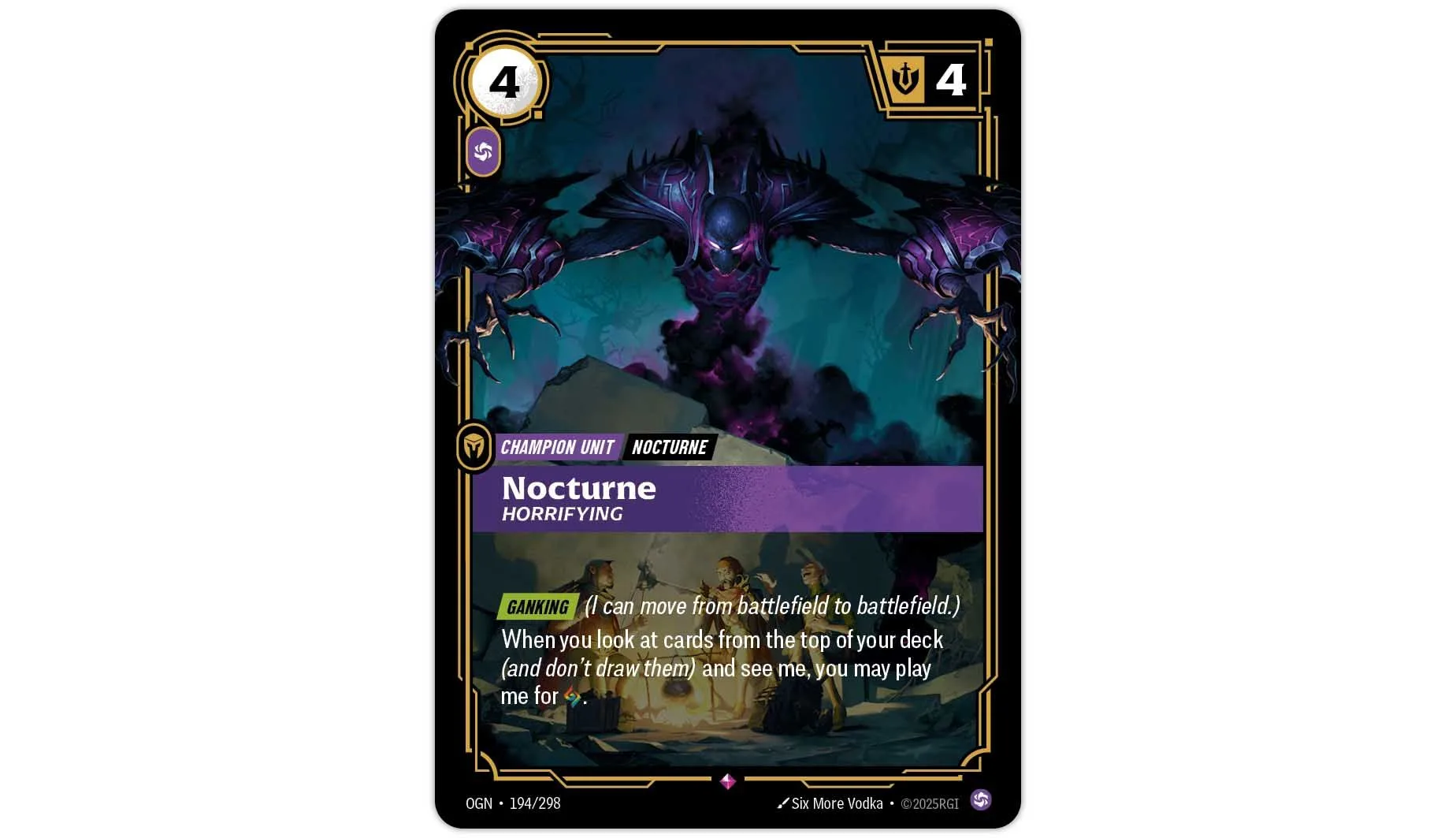
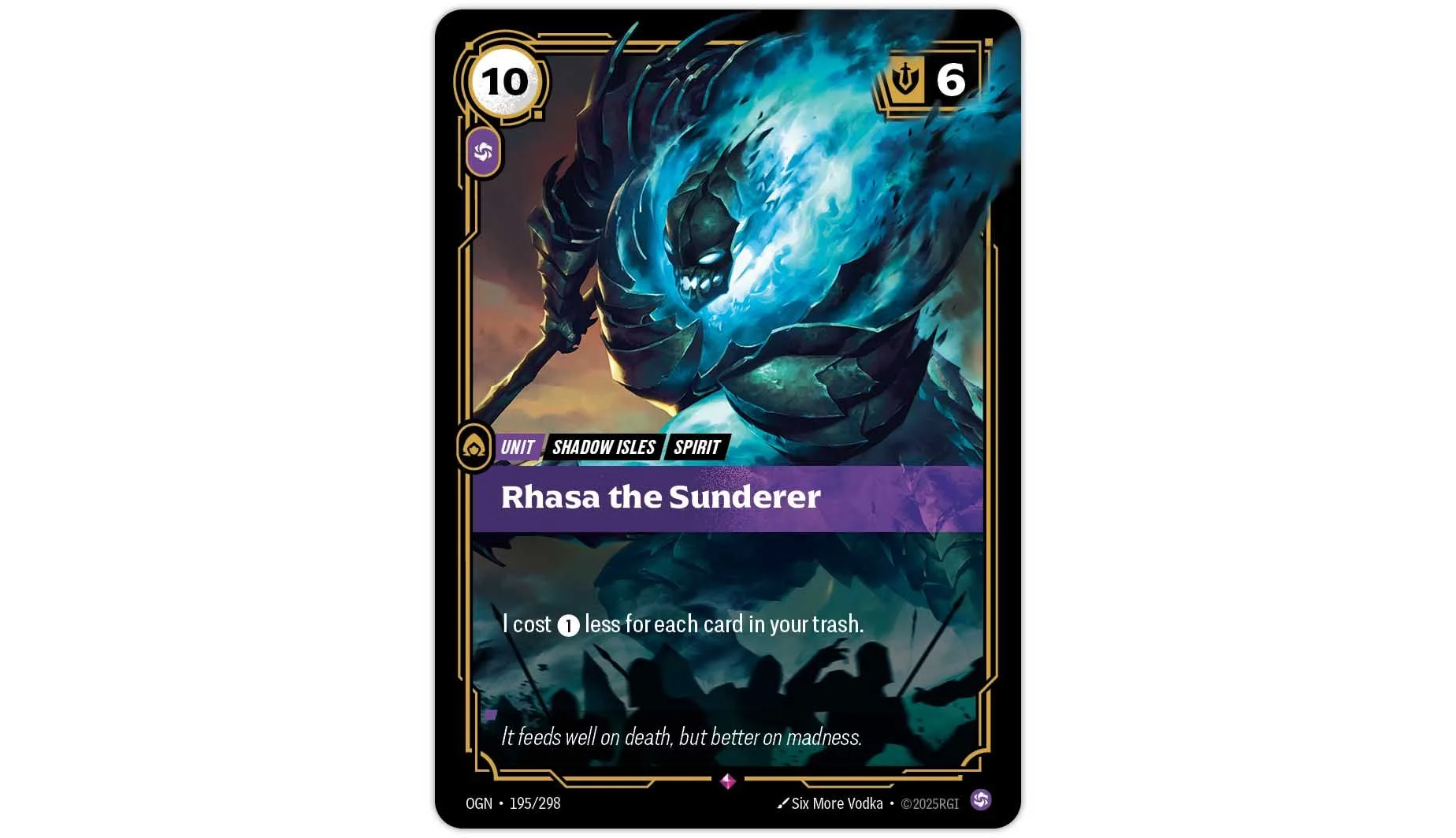
Nocturne, Horrifying: zero-Energy early battlefield pressure
Nocturne, Horrifying is a four-Energy champion unit with Ganking, but its text offers a much more dangerous route onto the board: when an effect looks at the top of the deck without drawing those cards and finds Nocturne, the player may play it for zero Energy. Kennen’s deck selection could reveal multiple Nocturnes very early, creating pressure that would normally be impossible to pay for.
Removing Nocturne weakens Kennen’s highest-impact early turns and reduces the incentive to stack several top-of-deck reveal effects for free units. Ganking itself remains a mechanic; the restriction applies to this exact champion unit.
Rhasa the Sunderer: a repeatedly discounted finisher
Rhasa the Sunderer normally costs ten Energy, but costs one less for each card in its controller’s trash. Kennen can fill the trash rapidly, reducing a six-Might threat to little or no Energy and then reuse it through recursion. Riot’s concern was that any future card that efficiently filled the trash would make this already-strong interaction easier. Rhasa’s original printing and number can be cross-checked in the Origins card checklist.
Without Rhasa, Kennen decks have to pay more meaningful costs for a large recurring unit or choose different finishers. This does not establish that Kennen is dead: his core draw and signature-spell engine remain, and his tournament results will need to be assessed after the actual ban date.
Kai’Sa decks and the Brynhir Thundersong ban
Kai’Sa was another meaningful presence in Stuttgart even though Riven and Kennen drove most of the discussion. Brynhir Thundersong was Riot’s main concern in Kai’Sa-related strategies, particularly when timing tricks turned a strong defensive effect into an opponent-turn lockout.
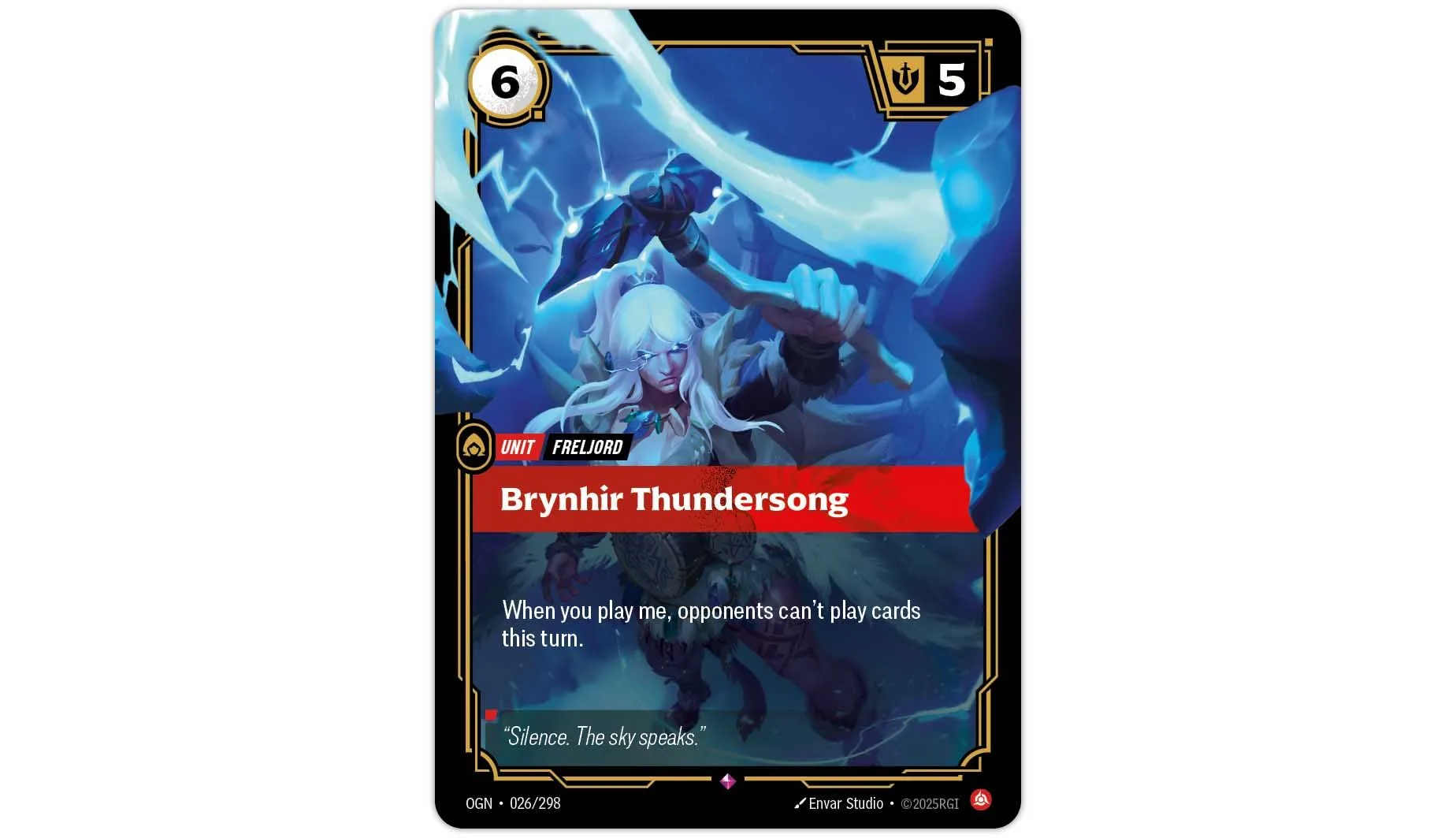
Brynhir’s on-play text prevents opponents from playing cards for the rest of that turn. On your own turn, it can protect a move into battle. But when an effect allows Brynhir to be played during an opponent’s Beginning phase, it can prevent that opponent from playing cards through much of their own turn. Riot also singled out combinations with offensive blink effects such as Temporal Breach, which banish a unit and allow it to be replayed, as a removal route that covered a Kai’Sa weakness against very large units.
Deckbuilding consequence: Kai’Sa strategies lose a powerful way to shut off interaction and a complicated means of removing oversized enemies. They are not barred from running other Freljord units or from using blink effects generally; this is a ban on Brynhir Thundersong.
Dazzling Aurora and Baited Hook: free-unit effects Riot would not leave unchecked
The final two gear bans address the future health of the game rather than only November tournament representation. Both can put expensive threats into play while bypassing their normal Energy costs, but they do it in different ways.
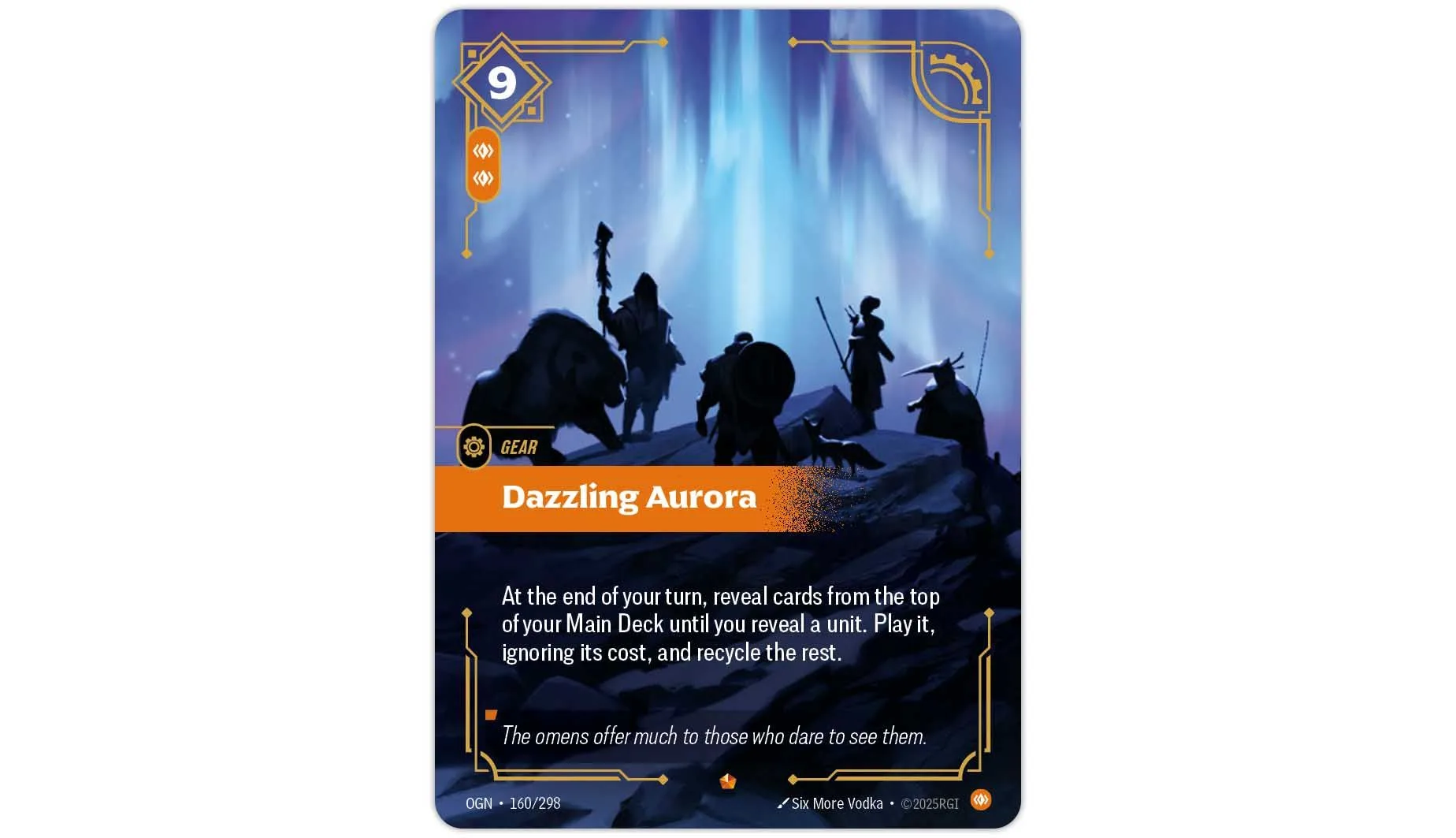
Dazzling Aurora: ramp decks were converging on the same payoff
At the end of its controller’s turn, Dazzling Aurora reveals cards until it finds a unit and plays that unit ignoring its cost. Aurora into Elder Dragon is the prominent example Riot discussed. Energy-ramp strategies are meant to reward players for reaching large resource totals; Aurora bypasses that exchange and can repeat the payoff with almost any sufficiently powerful unit the deck chooses to play.
Riot argued that Body-domain ramp decks increasingly had a reason to become Aurora decks rather than explore different large-unit plans. The ban removes the repeatable free-unit engine, not Energy ramp or large creatures as a category. Other high-cost units remain options when they are paid for or enabled by legal cards.
Baited Hook: Might is not the same as Energy cost
Baited Hook kills a friendly unit, looks at the top five cards of the main deck and can play a unit whose Might is up to one greater than the sacrificed unit, ignoring that new unit’s cost. This lets a deck turn a moderately strong unit into something expensive without paying the resource cost normally attached to it.
Unlike Aurora, Baited Hook had limited competitive representation when Riot acted. Riot said its internal testing raised concerns about interactions with cards in upcoming sets, including Legacy. The ban was preventive ahead of the January World Showcase, not evidence of a publicly demonstrated Legacy combo. No unpublished card effects have been confirmed by that explanation.
Riftbound ban list history: March to November 2026
Four separate Riot announcements built the list. The dates below are effective dates, not necessarily publication dates. The first Standard ban wave was announced March 30, July’s update July 17, September’s update September 15, and the Radiance wave November 13.
| Effective date | Standard additions | Battlefields | 2v2-specific change | Riot announcement |
|---|---|---|---|---|
| March 31, 2026 | Called Shot; Draven, Vanquisher; Fight or Flight; Scrapheap | The Dreaming Tree; Obelisk of Power; Reaver’s Row | 2v2 list not yet introduced | First bans |
| July 24, 2026 | Stealthy Pursuer | The Arena’s Greatest; Aspirant’s Climb | 2v2 list launches with Standard bans plus Master Yi, Wuju Bladesman Legend | July update |
| September 18, 2026 | Ekko, Recurrent; Stacked Deck | None | Both cards banned in 2v2 too | September update |
| November 23, 2026 | Eight cards, including Riven, Broken Blade, Nocturne, Horrifying and Dazzling Aurora | Emperor’s Dais; Star Spring | Same ten additions to 2v2; no extra Legend ban | Radiance announcement (above) |
In the first ban announcement, Riftbound Sets Design Lead Jon Moormann also explained why the initial wave focused on over-efficient draw, Draven pressure and low-interaction battlefields.
The March changes tried to rein in extremely efficient Chaos card selection, the overperforming Draven chosen champion and battlefields that made games too repetitive. July targeted a potential Recruit-token infinite and battlefields that rewarded turn order too much. September addressed Ekko, Recurrent in an infinite-style Lux combo and Stacked Deck in Kennen’s card-selection engine. These updates do not mean every affected Legend was banned.
The 2026 list is cumulative for the main circuit: none of the four cited announcements reverses an earlier main-circuit ban. That does not mean every historical restriction stays in force on the same date in every regional circuit under Riot’s new set-season policy.
Riftbound Standard and Constructed 2v2: which ban list applies?
Standard is Riftbound’s principal one-versus-one Constructed format. Constructed 2v2 uses teams of two and a separate legality list that began July 24. That list started with the Standard restrictions plus the Master Yi, Wuju Bladesman Legend ban; Riot’s September and November updates explicitly apply to both.
| Rule | Standard Constructed | Constructed 2v2 |
|---|---|---|
| Banned non-Legend cards and battlefields after Nov. 23 | All 22 entries listed above | Same 22 entries |
| Master Yi, Wuju Bladesman Legend | Legal unless changed by a later official notice | Banned since July 24, 2026 in the main circuit |
| Riven, Broken Blade champion unit | Banned from November 23 | Banned from November 23 |
| Riven, Kennen and Kai’Sa Legends | Not banned by the November update | Not banned by the November update |
| Regional applicability | Depends on competitive circuit and set releases | Also depends on competitive circuit and set releases |
| Other construction rules | Standard one-versus-one deck and battlefield requirements | Team-specific deck and play rules in tournament documents |
A banned card cannot be part of a registered legal main deck or sideboard in that format. A banned battlefield cannot be one of the registered legal battlefield selections. A banned Legend cannot be the deck’s selected Legend. The word “Riven” printed on different cards does not make them interchangeable: the November ban names Riven, Broken Blade, not the Riven Legend.
For a refresher on main-deck size, chosen champions, rune decks, scoring and team play, use RiftDaily’s Riftbound rules and deckbuilding guide.
Regional Riftbound ban lists: Korea and Traditional Chinese circuits
Riftbound does not have one identical ban list for every region from November 23, 2026. Riot now adjusts restrictions according to the competitive circuit and its local set-release season. The ten new Radiance-era bans take effect in the main circuit on November 23, but not in Korea or Traditional Chinese-region tournaments until those regions reach their own Radiance releases.
Korea temporarily lifts its earlier card and battlefield bans
Riot published a separate official Korean ban-list announcement alongside the November update. It provides a more specific rule than the general English-language notice: from November 23 until the Korean release of Spiritforged, the Korean circuit will have no banned cards or battlefields in its Origins-season constructed card pool. That means Korea is not merely delaying the ten new bans. It is also lifting its previously applicable card and battlefield restrictions for this interval.
The same Korean announcement says the Origins Korea Major on December 5–6, 2026 will be played without banned cards or battlefields. Spiritforged is scheduled to release in Korea after that event, although Riot did not specify a release date in the notice. When Spiritforged becomes legal, Korea is scheduled to reinstate the original March 31 group: Called Shot, Draven, Vanquisher, Fight or Flight, Scrapheap, The Dreaming Tree, Obelisk of Power and Reaver’s Row. Later seasons will be updated according to local releases. The Korean notice does not separately settle the legality of Master Yi, Wuju Bladesman in any locally offered 2v2 event.
How the November ban update differs by competitive circuit
| Region or circuit | Standard rules from November 23 | Constructed 2v2 | What happens next |
|---|---|---|---|
| Main circuit, including North America and Europe | 22 banned entries: 15 cards and seven battlefields | Same 22, plus Master Yi, Wuju Bladesman as a banned Legend | Follow new ban announcements and event addenda |
| Mainland China under the main release schedule | November update applies subject to event-specific rules | Check the organizer’s event format and addenda | Confirm the Guangzhou Regional Championship’s final legality rules |
| Korea | No banned cards or battlefields from Nov. 23 until its Spiritforged release, within the local legal set pool | Confirm any 2v2-only Legend restrictions with the local organizer | March’s seven original restrictions return when Spiritforged releases; later bans follow local set seasons |
| Traditional Chinese-region circuits | Ten November additions do not take effect until local Radiance release; earlier restrictions may change by set season | Region-specific list and any Legend restrictions must be checked locally | Wait for circuit-specific effective dates and set legality notices |
For Korea, this creates a practical distinction between legal because it is not banned and legal because the set has released locally. A card from an unreleased expansion does not automatically enter the Korean Standard card pool just because the temporary ban list is empty. Similarly, an English-language printing does not override a region’s set-based eligibility policy. The relevant question is the circuit and set legality, not the language on the individual card.
RiftDaily’s Riftbound Korea launch guide explains the local Origins release and Korean Standard format. For the broader sequence of expansions, check the Riftbound release calendar. Always defer to a local organizer’s latest published rules when an event uses a special effective date or card pool.
How the November bans could change competitive Riftbound decks
Riot’s Stuttgart percentages are measured tournament results. What happens after November 23 is a forecast, not an established tier list. The most credible early expectation is less free value and safer battlefield control, which could let decks that previously struggled to contest Riven or Kennen reach more interactive late games.
| Deck or strategy | Confirmed loss | Likely adjustment, not a measured result |
|---|---|---|
| Riven decks | Riven, Broken Blade; often Stellacorn Herder, Zhonya’s Hourglass and two battlefields | Choose another legal Riven champion; reassess combat safety and card draw |
| Kennen decks | Nocturne, Horrifying and Rhasa the Sunderer | Use paid threats and a slower reveal/trash payoff package |
| Kai’Sa decks | Brynhir Thundersong in lists that used it | Rely less on turn-lock and offensive blink pressure |
| Calm draw engines | Stellacorn Herder; Zhonya’s protection | Budget draw, mobility and defense as separate deck slots |
| Body-domain ramp | Dazzling Aurora | Win through other legal large-unit payoffs and actual Energy investment |
| Battlefield-focused tempo | Emperor’s Dais and Star Spring | More exposed conquers; rethink battlefield selection |
| Control or combo decks | Various free-resource and protection tools | More opportunities to interact, but also fewer universal defensive cards |
The first meaningful question for a replacement Riven deck is whether its new chosen champion can still influence a battlefield early without leaving a unit exposed. Kennen players need to determine whether card selection is worth as much without free Nocturne or discountable Rhasa. Kai’Sa pilots need another answer to huge threats once Brynhir no longer turns blink into a lockout.
Alternative Legends might gain space if they can punish the slower, more resource-conscious decks. But that could also help new combo engines: a ban does not guarantee a control-dominated format, and no reliable post-November win-rate data exists before the rules take effect. For a sense of how diverse events were before Radiance, compare RiftDaily’s Los Angeles Regional Qualifier results and decklists.
Tournaments and the November 23 effective date
Riot chose Monday, November 23 after weighing the tournament calendar. Its stated policy was to avoid making bans within two weeks of premier-level competitions when possible, giving players an opportunity to practice a known format. Events ending November 22 may therefore use the prior list, subject to their official rules; events beginning later must check their circuit’s policy.
| Tournament | Date | Location | Relevant ban-list or set question |
|---|---|---|---|
| Ningbo Minor / GenG Showdown | Nov. 20–22, 2026 | Ningbo / Los Angeles | Before the November bans take effect; verify each event’s local rules |
| Origins Korea Major | Dec. 5–6, 2026 | South Korea | Korean announcement specifies no banned cards or battlefields in the Origins-season local pool |
| North America Regional Championship | Dec. 11–13, 2026 | Las Vegas, USA | Main-circuit November bans scheduled to apply; Standard event |
| China Regional Championship | Jan. 2–3, 2027 | Guangzhou, China | Confirm main-circuit legality and organizer addenda |
| Riftbound World Showcase | Jan. 22–23, 2027 | Shanghai, China | Special three-deck Constructed event with early Legacy access; confirm final event rules |
The North America Regional Championship is especially relevant for the first major post-ban Standard results. Riot’s World Showcase format announcement also specifies that competitors will build three decks with non-overlapping domains, and will be given early access to Legacy cards despite Legacy releasing publicly on January 29. This is an event-specific card-pool exception, not a general rule that every Legacy card is automatically available to local tournaments before its release.
Why Riot bans cards, battlefields and Legends
Riot repeatedly identifies three reasons for intervening: unhealthy overrepresentation, a problem likely to worsen as more cards release, and unhealthy gameplay patterns. The ban can address a deck already dominating events, an interaction with little counterplay, or an effect that might make future sets harder to balance.
- Card ban: removes one exact card name, such as Riven, Broken Blade, without necessarily removing that champion’s other cards or Legend.
- Battlefield ban: prevents an especially influential location from appearing in the relevant constructed battlefield selection. Because battlefields can shape every game, a seemingly small location effect can warp deck choice.
- Legend ban: removes a whole deckbuilding starting identity in that format. That is why a Legend ban, such as Master Yi, Wuju Bladesman in 2v2, has a broader implication than removing one champion unit.
For owners of physical cards, a ban can be painful. It does not erase the card from packs or remove its artwork from collections, and market value can still reflect rarity and collectors’ interest. A tournament ban is not a promise of a future unban or a guaranteed change to resale prices. Riot has discussed exploring future formats in which players could use more of these cards, but has not established a universal new legality rule.
The ban list controls sanctioned Constructed play. Riot’s Tournament Rules, sections 601 and 602 distinguish that from Limited: a card banned in Constructed can be played in Draft or Sealed when it is in the provided pool and is not separately banned in that Limited format. For lower-level organized play, the same rules also make a narrow exception for an unchanged, preconstructed deck; adding cards or a sideboard removes that exception. In unsanctioned casual games, players can agree to play with banned cards, but should not assume that agreement applies to a Nexus Night or higher-level event.
Riot’s 2027 ban windows and possible 2v2 changes
Riot plans to be more predictable in 2027. It says its threshold for banning cards will be somewhat stricter, while its goals for a healthy game remain unchanged. If bans are announced, the target windows are the Friday two weeks before each Continental and the Friday two weeks after each Continental. A window is an opportunity to act, not a guarantee that cards will be banned.
That matters for collectors and competitive players: stable periods before major tournaments make it easier to commit to expensive cards, choose a Legend and practice the same field opponents will face. See RiftDaily’s 2027 set roadmap for the releases that will introduce new cards around those windows.
The November announcement also flags Yasuo as notably strong in Constructed 2v2, based on tournament results and player feedback. Riot was testing possible format changes and expected to share more in early 2027. That is not a Yasuo ban, and there was no additional 2v2-only ban in the November announcement.
How to check if your Riftbound deck is tournament legal
Start with the event, not an old screenshot of a decklist. The official Riftbound Rules Hub is the central rules reference, but its visible constructed ban lists still say last updated September 18, 2026. Riot’s newer November 13 announcement therefore provides the scheduled changes even if that page has not caught up yet.
- Confirm whether the event is Standard, Constructed 2v2, Draft or Sealed. These do not have identical legality rules.
- Confirm the competitive circuit and region. Korea temporarily removes card and battlefield bans from November 23 until its local Spiritforged release; other circuits have different lists.
- Check the effective date and the event’s own rules addendum, not just the announcement date.
- Check your chosen Legend separately from your chosen champion. Master Yi, Wuju Bladesman is a 2v2-only Legend restriction in the main circuit.
- Check every card in the main deck and sideboard, including same-name alternate artworks or promos.
- Check the registered battlefields: a banned location cannot be rescued by a legal deck list.
- Check the set pool for the event and any unusual early-access permissions, such as World Showcase Legacy cards.
- Before submission, review the latest Riot Riftbound news and ask the organizer or head judge if local rules and the public list differ.
A practical example: a Riven Standard list registered for Las Vegas in December cannot use Riven, Broken Blade as its chosen champion or use Star Spring as a battlefield. A Riven Legend remains legal under the November announcement, so the deck may be rebuilt around a different allowed champion unit and locations. For a November 22 event, check the then-applicable rules instead of prematurely applying the November 23 restrictions.
The official Riftbound card gallery helps identify the exact names and printings in a collection. Set names such as Origins, Spiritforged, Unleashed and Radiance matter for regional eligibility; they are not substitutes for the tournament’s ban list.
Frequently asked questions about Riftbound ban list
What cards are banned in Riftbound?
The main-circuit Standard list contains seven previously banned cards plus eight cards scheduled for November 23, 2026, and seven banned battlefields after that date. The complete named list is in the tables above; Constructed 2v2 additionally bans the Master Yi, Wuju Bladesman Legend.
What is the latest Riftbound ban list?
The newest announcement is Riot’s November 13, 2026 Radiance update, adding eight cards and two battlefields to both Standard and 2v2, effective November 23 in the main circuit.
When do the November 2026 Riftbound bans take effect?
November 23, 2026 in the main circuit. Korea and Traditional Chinese-region events adopt the ten additions with their local Radiance seasons. Korea also temporarily removes its earlier card and battlefield bans on November 23, under its separate official policy.
Is Riven banned in Riftbound?
The Riven Legend is not banned by this update. Riven, Broken Blade, the four-Energy chosen champion unit, is banned from November 23 in affected Constructed events.
Why was Riven, Broken Blade banned?
Riot cited its strong guaranteed early deployment, buff-powered readying and stunning, and low-risk conquers. The Riven deck also occupied 43% of registered European Championship decks.
Is Zhonya’s Hourglass banned?
Yes, from November 23, 2026 in the main-circuit Standard and 2v2 formats. Riot targeted its Hidden protection and powerful combinations, notably with Astral Heron.
Is Nocturne, Horrifying banned?
Yes, from November 23 in affected Constructed events. It enabled high-pressure zero-Energy plays through top-of-deck reveal effects, especially in Kennen decks.
Is Rhasa the Sunderer banned?
Yes, from November 23 in affected Constructed events. Its cost reduction through cards in the trash made repeated large threats too cheap and easy to recur.
Is Dazzling Aurora banned?
Yes, from November 23 in affected Constructed events. It repeatedly plays high-cost units for free, pushing energy-ramp decks toward the same game plan.
Which Riftbound battlefields are banned?
The main-circuit list after November 23 includes The Dreaming Tree, Obelisk of Power, Reaver’s Row, The Arena’s Greatest, Aspirant’s Climb, Emperor’s Dais and Star Spring.
Is Master Yi banned in Riftbound?
Master Yi, Wuju Bladesman is banned as a Legend in Constructed 2v2 in the main circuit. Riot has not placed that Legend on the Standard ban list.
Are the Standard and 2v2 ban lists the same?
Almost. After November 23, both share 22 banned cards and battlefields, but 2v2 also bans the Master Yi, Wuju Bladesman Legend.
Are Riftbound bans different in Korea?
Yes. Korea removes its existing card and battlefield bans from November 23 until its local Spiritforged release, then reinstates the seven original March bans. Its November ten-card-and-battlefield wave will not arrive until local Radiance. Traditional Chinese-region events also follow a delayed set-season schedule.
Can you play banned Riftbound cards casually?
In an unsanctioned game, players may agree to do so. Sanctioned Constructed events follow their ban rules, with a narrow documented exception for unchanged preconstructed decks in low-level organized play.
Can banned cards be used in Draft or Sealed?
Generally yes when those cards are in the event-provided Limited pool and are not also banned by that Limited event’s rules. A Constructed ban does not automatically apply to Limited.
Do banned Riftbound cards lose their collectible value?
Not necessarily. Tournament demand can change, but rarity, art, supply and collector interest still influence prices. A ban does not establish any fixed resale value.
When will Riot announce more bans?
For 2027, Riot plans announcement windows on the Fridays two weeks before and two weeks after each Continental. No ban is automatic in either window.
Where can I find the official Riftbound ban list?
Use Riot’s Rules Hub plus newer ban announcements. The Hub currently displays a September 18 update date, so the November 13 notice is necessary to check the upcoming November 23 additions.
Building a stronger Riftbound deck after the bans
The biggest adjustment is not simply swapping ten cards for ten substitutes. Riven loses a chosen champion, protection, draw and safe battlefield routes at once; Kennen loses two of its most explosive payoffs; Kai’Sa loses a potentially oppressive lockout; and ramp decks lose an easy way to ignore the costs of their best units. Those changes challenge the assumptions behind each deck’s curve, interaction package and chosen battlefield lineup.
Rebuild from the win condition outward: pick a legal Legend and chosen champion, identify which battlefields you can actually contest, count how much real Energy your threats require, then test whether your card draw and defense can sustain that plan. Test against several Legends rather than only a pre-ban Riven list. If a replacement looks promising, record actual post-ban match results before declaring it the new best deck.
The RiftDaily Riftbound hub brings together event results, set guides and future updates, while the earlier linked Rules Hub remains the place to confirm final tournament wording. The useful distinction to remember is simple: a banned name, a legal format and the correct competitive region must all line up before a deck is ready to register.