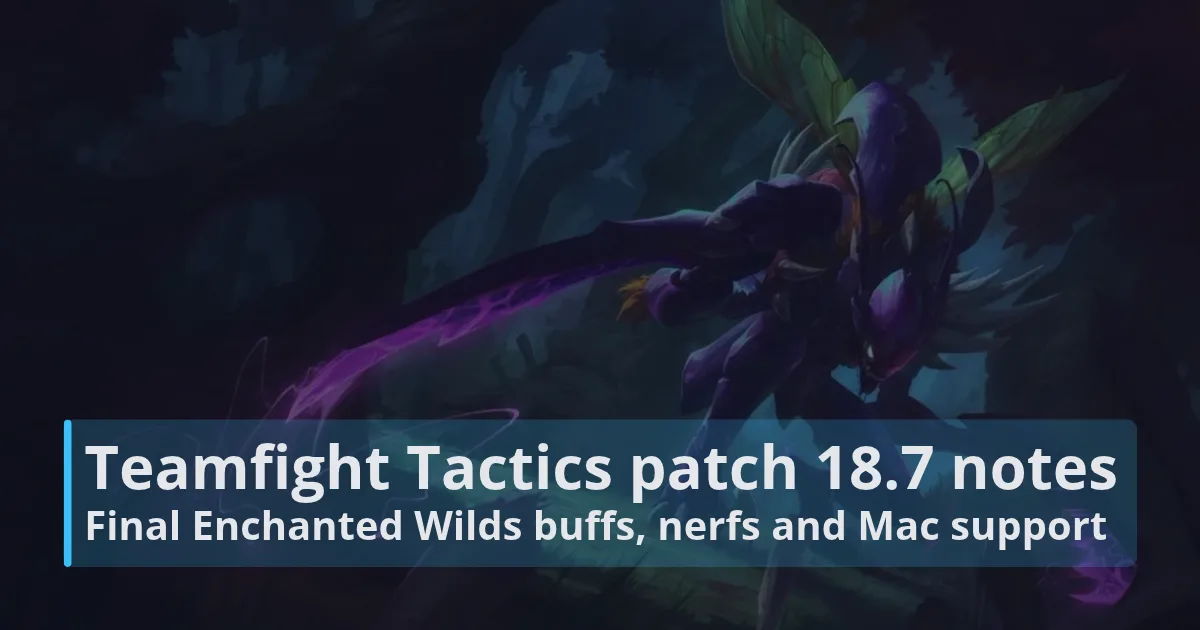
TFT patch 18.7 is the final Enchanted Wilds update before Teamfight Tactics Set 19: Prismatic Tour. Riot’s November 17, 2026 patch adds eight trait balance passes, adjustments to 16 units, new traits for Kennen, Ivern and Kruggs, a more predictable Reforger system, restored support for Apple Silicon Macs, mobile performance improvements and a large batch of converted cosmetics.
The last set 18 balance pass is unusually adventurous. Cinderling and Pebbles gain damage to encourage reroll boards, Ornn creates later Artifacts sooner, and three-star Kobuko gets more Health scaling. Coven, Inferno and Primal have stronger high-end incentives, while Elderwood and Sprykin trade some trait stats for easier late-game team building. Riot also says 476 cosmetics are scheduled for conversion, though its published category totals need clarification.
These are the final published Teamfight Tactics 18.7 patch notes, not PBE estimates. The changes to the standalone client and mobile settings are covered separately from Set 19 features, which do not become playable merely because they have been announced.
TFT patch 18.7 release date and overview
| Category | Confirmed update | Why it matters |
|---|---|---|
| Release | November 17, 2026 (official schedule, Pacific Time) | Final Enchanted Wilds patch; deployment may vary by region. |
| Publication | November 17, 2026 | Riot published the final notes the same date. |
| Set | Enchanted Wilds | Final patch before the music-themed Prismatic Tour. |
| Traits | Eight unique traits adjusted | Coven, Eclipse, Elderwood, Fae, Inferno, Primal, Riftbeast, Sprykin. |
| Units | 16 named unit entries | Tier 1 through tier 5, including three trait additions. |
| Augments | 12 named Augment entries | Economic, combat and functionality changes. |
| Items | Reforger behavior improved | Recent results are less likely to repeat across uses. |
| macOS | Native Apple Silicon / M-series support | TFT returns to Mac, including Retina display support. |
| Mobile | Auto quality mode and performance work | Visual quality, resolution and frame-rate defaults may change. |
| Cosmetics | Riot announces 476 conversions | Its itemized category counts total 458; full source inventory is linked below. |
| Next set | Set 19: Prismatic Tour, December 1, 2026 (scheduled) | New content launches in patch 19.1, not 18.7. |
Riot’s Official Teamfight Tactics Patch 18.7 Notes are the source for all balance values below. The official TFT patch schedule lists November 17, 2026, while publication and regional availability can follow different local times. Compare the previous TFT patch 18.6 and RiftDaily’s TFT patch 18.5 coverage to trace the end-of-set changes.

Riot also published a patch rundown with Riot Truexy. It accompanies the official notes and offers a way to see the planned balance direction while reviewing the detailed numerical changes below.
The video is listed by Riot under its November 17 game updates. The numerical values in this article come from the written notes, since the rundown’s public listing contains an inconsistent description referencing an older patch and a complete spoken transcript was not available to verify.
How TFT patch 18.7 changes the Enchanted Wilds meta
Reroll Cinderling and Pebbles are worth retesting
Riot is putting more power directly into the one-cost units while weakening the full seven-piece Riftbeast stat bonus. Cinderling’s AD-based spell and Pebbles’ AP-based spell both improve at every star tier. That gives players another reason to experiment with early copies and reroll economy without assuming that the entire vertical trait becomes stronger.
Three-star Kobuko and Ornn are the frontline experiments
Kobuko gains a larger maximum-Health contribution to his ability, a natural fit for Bruiser-heavy boards. Ornn’s first Artifact arrives at the same threshold, but his later thresholds are lowered, creating room for additional Artifacts in a successful long fight. These are high-investment strategies and neither should be treated as a guaranteed top-four composition.
The five-cost trait reshuffle opens new late-game boards
Giving Ivern the Elderwood trait and Kennen the Sprykin trait reduces the need for an Emblem in some late-game configurations. Because both verticals gain more accessible, high-cost units, Riot offsets the new team-building freedom with lower trait stats. The tradeoff between a stronger individual unit and a weaker raw breakpoint is the key decision.
New Summoner access makes Kruggs more flexible
Kruggs can now benefit from the Summoner trait, and his Kruglettes gain 15% maximum Health when summoned with the synergy. Their base Health at higher stars is reduced to compensate, so the important question is whether an additional Summoner is worthwhile in the context of the rest of your board.
High-end Coven, Fae, Inferno and Primal get more payoffs
Coven has a better final Essence-per-loss breakpoint, Fae’s final gold goal is reduced, Inferno’s upper tiers burn harder, and Primal Phoenix creates components faster and in larger quantities. These encourage ambitious boards during the final days of the set, but still depend on economy, timing and whether the lobby gives you the pieces to reach those breakpoints.
All TFT patch 18.7 trait buffs and nerfs
Coven
- Essence per loss at four breakpoints: 22 / 28 / 35 / 60 ⇒ 22 / 28 / 35 / 70.
Only the highest breakpoint increases, rewarding teams that reach a deep Coven cashout.
Eclipse
- Delay before Eclipse begins: 8 seconds ⇒ 9 seconds.
- Repeating kill interval: 3.5 seconds ⇒ 3 seconds.
The initial payoff arrives later, giving opponents another second before the first execute sequence. Once the trait activates, subsequent kills occur more quickly.
Elderwood
- 5 Elderwood bonus tree Health: 200 ⇒ 125.
- Deepwood Protector base Health: 450 ⇒ 375.
A smaller defensive stat budget offsets more accessible late-game Elderwood builds with Ivern. The summoned frontliner loses 75 base Health.
The new five-cost Elderwood unit is Ivern. This is a trait composition adjustment, not a direct damage nerf to every individual Elderwood unit.
Fae
- Final gold breakpoint: 888,888 ⇒ 720,000.
The highest cashout is still demanding but becomes achievable in more exceptional high-roll games.
Inferno
- Burn values: 1 / 1 / 3 / 4 ⇒ 1 / 1 / 4 / 5.
The upper two tiers become stronger while the opening tiers remain unchanged.
Primal
- Phoenix maximum item components generated: 4 ⇒ 6.
- Phoenix kills required per component: 14 ⇒ 12.
A successful Phoenix sequence can produce two more components over the course of a game. Component generation requires fewer kills.
Riftbeast
- Seven-unit bonus AD and AP: 5% ⇒ 4%.
The seven-piece raw stats are trimmed as Cinderling and Pebbles improve.
Sprykin
- Bonus Health at three breakpoints: 15 / 40 / 55% ⇒ 15 / 40 / 45%.
- Bonus Attack Speed at three breakpoints: 15 / 35 / 55% ⇒ 15 / 35 / 45%.
- Seven-piece bonus: 100% ⇒ 75%.
The highest tier loses Health. The highest tier loses Attack Speed. The seven-piece bonus is reduced to balance easy access with Kennen.
Kennen joins the trait at five cost. Riot says this makes the seven-piece board achievable without needing a Spatula item.
Riot’s original patch page repeats the Inferno burn entry twice with identical values. It is one unique adjustment, not two separate buffs.
| Trait | Changed effect | Previous | Patch 18.7 |
|---|---|---|---|
| Coven | Essence per loss at four breakpoints | 22 / 28 / 35 / 60 | 22 / 28 / 35 / 70 |
| Eclipse | Delay before Eclipse begins | 8 seconds | 9 seconds |
| Eclipse | Repeating kill interval | 3.5 seconds | 3 seconds |
| Elderwood | 5 Elderwood bonus tree Health | 200 | 125 |
| Elderwood | Deepwood Protector base Health | 450 | 375 |
| Fae | Final gold breakpoint | 888,888 | 720,000 |
| Inferno | Burn values | 1 / 1 / 3 / 4 | 1 / 1 / 4 / 5 |
| Primal | Phoenix maximum item components generated | 4 | 6 |
| Primal | Phoenix kills required per component | 14 | 12 |
| Riftbeast | Seven-unit bonus AD and AP | 5% | 4% |
| Sprykin | Bonus Health at three breakpoints | 15 / 40 / 55% | 15 / 40 / 45% |
| Sprykin | Bonus Attack Speed at three breakpoints | 15 / 35 / 55% | 15 / 35 / 45% |
| Sprykin | Seven-piece bonus | 100% | 75% |
TFT patch 18.7 Tier 1 unit buffs
Five low-cost units receive damage, scaling or Artifact-generation improvements. The tables provide a quick comparison, while each unit entry below explains the exact change and why it matters.
| Unit | Main adjustment | Practical effect |
|---|---|---|
| Cinderling | Higher spell AD damage at every star rank | More potential for early-cost reroll |
| Kobuko | Higher listed spell damage and Health scaling, with a disputed four-star value | More reward for upgraded Bruiser frontlines |
| Leona | Higher Armor coefficient on spell damage | More value from defensive itemization |
| Ornn | Second and third Artifact thresholds lowered | Additional Artifacts can arrive earlier |
| Pebbles | Higher AP spell damage at every star rank | Better offensive payoff from upgrading |
Cinderling
Riot is deliberately reviving this early reroll carry by raising the AD coefficient on its spell.
- Spell damage AD: 310 / 465 / 700 / 1,200 ⇒ 330 / 495 / 745 / 1,265.
All four star tiers gain damage. The benefit is strongest when you can stay economically healthy while upgrading multiple early units.
Kobuko
Kobuko becomes more rewarding to three-star and stack with bonus Health through a Bruiser frontline.
- Spell damage AP: 70 / 105 / 150 / 255 ⇒ 80 / 120 / 180 / 30 (as published).
- Spell damage maximum-Health scaling: 10% ⇒ 15%.
Riot’s published fourth-rank number reads 30, an unexplained drop after three increases. Do not assume it is 300 or another value until Riot corrects the note. The separate Health-scaling buff is unambiguous.
Leona
Leona receives stronger Armor-based damage on her spell.
- Spell damage Armor scaling: 1.5 / 2.7 / 4.06 ⇒ 1.8 / 3 / 4.36.
Armor investment can contribute a little more offense as well as durability. This portrait is official League champion artwork, not a claim that TFT uses the identical in-game model.
Ornn
Ornn keeps the first Artifact threshold but reaches additional Artifacts at lower accumulated progress.
- Artifact thresholds: 90,000 / 230,000 / 410,000 ⇒ 90,000 / 210,000 / 370,000.
The second threshold drops by 20,000 and the third by 40,000, rewarding longer Ornn uptime.
Pebbles
Pebbles receives the companion damage boost intended to restore Riftbeast reroll options.
- Spell damage AP: 160 / 240 / 360 / 615 ⇒ 170 / 255 / 385 / 655.
Each star tier gains spell damage, while the separate Riftbeast seven-piece bonus is reduced.
TFT patch 18.7 Tier 2 unit buffs and functionality changes
The two-cost changes combine straightforward damage buffs with unusual functionality upgrades. Scuttlecrab’s burrowed attacks and Teemo’s mushrooms are especially different from ordinary stat adjustments.
| Unit | Main adjustment | Practical effect |
|---|---|---|
| Elise | Higher spell AP damage | Improved early and midgame damage |
| Kayle | Higher on-hit AP damage | Better scaling with repeated attacks |
| LeBlanc | More reliable unit-printing behavior | Greater consistency from her mechanic |
| Teemo | Bigger mushrooms and higher printing chance | More frequent mushroom generation |
| Scuttlecrab | Can attack while burrowed; more base AD | Changes how the unit contributes in combat |
| Warwick | Higher bite damage at upper star ranks | More reward for upgrading |
Elise
The spider gains damage for a broader range of setups, including those built around her defensive potential.
- Spell damage AP: 35 / 50 / 80 / 110 ⇒ 40 / 60 / 90 / 130.
A stronger spell helps both conventional and experimental compositions; its effectiveness still depends on items and frontline survival.
Kayle
Kayle receives an on-hit spell increase, with the numerical change spread across all listed star values.
- On-hit spell damage AP: 65 / 97 / 110 / 115 ⇒ 68 / 102 / 115 / 120.
The improvement is incremental at each level, making her a slightly better damage contributor rather than changing her role.
LeBlanc
Riot adjusts a unit-generating interaction rather than supplying a new damage number.
- Unit-printing behavior: Previous consistency ⇒ Slightly improved.
Riot does not quantify the change. More reliable copies may matter to upgrade timing, but the published note does not promise a specific extra unit rate.
Teemo
Teemo brings back larger mushrooms and more frequent mushroom generation.
- Mushroom printing chance: 10 / 12 / 15% ⇒ 12 / 15 / 18%.
- Mushroom size: Smaller ⇒ Larger.
A stronger generator can improve his usefulness in boards that benefit from repeated deployables.
Scuttlecrab
The biggest functional change at tier two makes Scuttlecrab able to attack even while burrowed.
- Attack while burrowed: Disabled ⇒ Enabled.
- Base Attack Damage: 50 / 75 / 112.5 / 168.75 ⇒ 60 / 90 / 135 / 202.5.
This restores attack uptime and raises AD by 20% at every listed star value. Use an accurate TFT Scuttlecrab model when replacing the text label with artwork.
Warwick
Warwick receives a late-star bite improvement while the first two listed tiers stay unchanged.
- Bite damage: 230 / 345 / 535 / 910 ⇒ 230 / 345 / 560 / 950.
The third and fourth values increase, helping a highly upgraded Warwick remain relevant later in the game.
TFT patch 18.7 Tier 3 unit changes
Kha’Zix receives direct damage buffs while Kruggs gains a new Summoner trait connection. The latter is a team-building change as much as a balance adjustment.
| Unit | Main adjustment | Practical effect |
|---|---|---|
| Kha’Zix | Higher normal and isolated spell damage | More reward for reaching isolated targets |
| Kruggs | Summoner added; Kruglette Health redistributed | New trait breakpoints with adjusted summons |
Kha’Zix
Riot restores damage to a higher-execution carry after his earlier adjustments.
- Base spell damage AP: 230 / 310 / 450 ⇒ 240 / 325 / 480.
- Isolated spell damage AP: 250 / 350 / 530 ⇒ 260 / 360 / 540.
Both ordinary and isolated strikes deal more. Isolating a target remains central to his damage potential.
Kruggs
Kruggs gains access to the Summoner trait, widening the number of useful splash combinations.
- Trait: Not a Summoner ⇒ Summoner added.
- Summoned Kruglettes maximum Health via Summoner: No additional Summoner bonus ⇒ 15% additional maximum Health.
- Kruglettes base Health: 50 / 100 / 180 ⇒ 50 / 75 / 150.
At higher stars, the base Kruglette loses Health, but its summon can receive a percentage bonus from the newly added trait. Judge the overall result with the Summoner breakpoint active rather than relying on base stats alone.
Aphelios receives a Tier 4 damage buff
Aphelios
Aphelios gains base Lunar Blast damage at both published ranks.
- Lunar Blast damage: 450 / 675 ⇒ 500 / 750.
The increase helps direct spell damage, especially for players able to support him with enough frontline and consistent casts.
Kennen and Ivern gain new Tier 5 traits
| Five-cost unit | New trait | Balance context |
|---|---|---|
| Kennen | Sprykin | Sprykin seven-piece no longer depends on a Spatula, so its stats were reduced. |
| Ivern | Elderwood | Elderwood gains another legendary option, accompanied by lower tree and Protector Health. |
Kennen
Kennen gains the Sprykin trait alongside his existing set identity.
- Trait: Sprykin added to existing traits.
This helps players reach seven Sprykin without a Spatula and allows more late-game flexibility. The numerical nerfs to the trait itself are the compensation.
Ivern
Ivern is added to Elderwood as a legendary unit, expanding its late-game configurations.
- Trait: Elderwood added to existing traits.
The tradeoff is a weaker bonus tree and Deepwood Protector. Riot did not publish an individual spell-damage change for Ivern.
All TFT patch 18.7 Augment buffs, nerfs and fixes
| Augment | Changed property | Old | New | Impact |
|---|---|---|---|---|
| Advanced Loan | Gold granted | 20 | 22 | More immediate economy. |
| Comeback Story | Attack Speed per missing Health | 0.3% | 0.4% | Stronger comeback speed scaling. |
| Corrosion | Resistance reduction every two seconds | 4 | 3 | Slightly less repeated resistance shred. |
| Electrocharge II | Damage by stage | 80 / 110 / 140 | 65 / 90 / 120 | Reduced combat damage. |
| Expected Unexpectedness | Delay between dice rolls | Previous delay | Shorter delay | More frequent rolls; no exact interval published. |
| Focused Fire | Attack Damage gained per five seconds | 5% | 4% | Less delayed AD stacking. |
| Forged In Strength | Components | 2 | 3 | More item components. |
| Investment Strategy I | Health per interest | 9 | 8 | Lower reward per interest point. |
| Investment Strategy II | Health per interest | 12 | 10 | Lower reward per interest point. |
| NO SCOUT NO PIVOT | Tooltip | Previous wording | Updated wording | Text clarity, not a documented numerical balance change. |
| Pandora’s Items II++ | Starting gold | 6 | 7 | One additional gold. |
| We Stick Together | Attack Speed | 30% | 25% | Less teamwide speed. |
Investment Strategy I and II: Riot also fixed their bonus Health to interact correctly with percentage-Health sources. That functionality change accompanies the numerical Health-per-interest reductions, rather than replacing them.
Players should distinguish direct Augment buffs such as Advanced Loan and Forged In Strength from reduced damage or scaling on Corrosion and Electrocharge II. The published notes include no new numeric rate for LeBlanc’s printing or Expected Unexpectedness’s shorter delay, so those effects should not be assigned invented percentages.
Reforgers receive a useful system change
TFT patch 18.7 gives Reforgers an internal queue that prevents immediate repetition across multiple uses. Before this change, consecutive rerolls could undo the previous item change, wasting a valuable consumable and leaving players with an outcome they had intentionally moved away from.
Riot’s example is straightforward: if a Bow becomes a Sword, the next Reforger use cannot simply turn that Sword back into the Bow. This reduces frustrating reversals, but it does not guarantee a specific desired component or a permanently excluded item.
The improvement makes flexible item planning easier when your board changes direction late in a game. It is not described as a general boost to item quantity or drop rates.
TFT returns to macOS with Apple Silicon support
Native macOS support returns in patch 18.7 for Apple Silicon Macs, with Retina display support. Riot’s updated TFT PC requirements explicitly list Apple M1 hardware and say Intel Mac configurations are not supported.
| Hardware or setting | Minimum | Recommended |
|---|---|---|
| Processor | Apple M1 | Apple M1 |
| Graphics | Metal-capable GPU | Metal-capable GPU |
| Unified memory | 8 GB | 8 GB |
| Free storage | 40 GB HDD | 40 GB SSD |
| Operating system | macOS 12 | macOS 12 |
| Graphics preset | Low | High |
| Display resolution | 1680 × 1050 | 1680 × 1050 |
These are the requirements Riot published, not a promise that every Mac with an M-series chip will achieve a particular frame rate. Retina improvements affect display presentation; game performance also depends on graphics settings, resolution and other running applications.
To play on a supported Mac, install or update TFT through Riot’s official game experience, sign in, and allow the client to apply any required game updates. If the client fails to launch or the display options behave unexpectedly, compare the device against the support table and use Riot’s support channel rather than relying on unofficial compatibility patches.
TFT mobile visual quality and performance improvements
Auto settings now manage performance choices
Riot moved all players to Auto settings in 18.7. The mode can adapt effects quality, resolution quality and frame-rate caps to the device, and Riot may tune these choices again between patches. Players who want to manage those tradeoffs manually can select Custom instead.
Auto does not control every setting. Riot specifically excludes mobile options such as battery saver and performance mode, which remain separate choices.
Some Android devices get clearer rendering at 30 FPS
A previous issue made selected devices render at unnecessarily low resolution. Riot is improving those defaults, especially on some Android devices, but has also set certain affected devices to 30 FPS. The tradeoff prioritizes readable visuals over a higher target frame rate in those cases.
This is not a universal upgrade to 60 FPS or native resolution. Riot says the visual improvements are delivered automatically to users on Auto, while existing Custom settings remain untouched.
Resolution quality is separate from effects quality
Players can adjust resolution quality independently of general graphics quality. A 100% resolution setting does not necessarily mean the display’s native resolution, so evaluate actual image clarity alongside thermal and frame-rate behavior.
OpenGL and frame pacing receive additional work
Riot highlights reduced hitching and smoother performance, with particular improvements for OpenGL devices. Even with that work, performance can vary widely by phone, tablet, operating system and background activity.
- Start in Auto if a mobile update unexpectedly changes image quality or frame rate.
- Move to Custom only when you want to prioritize smoothness or clarity yourself.
- Remember that a 30 FPS cap can be an intentional visual-quality choice on some devices.
- Check TFT Follow the Fix for current stability investigations and acknowledged issues.
Standalone TFT client: what is confirmed and what was planned
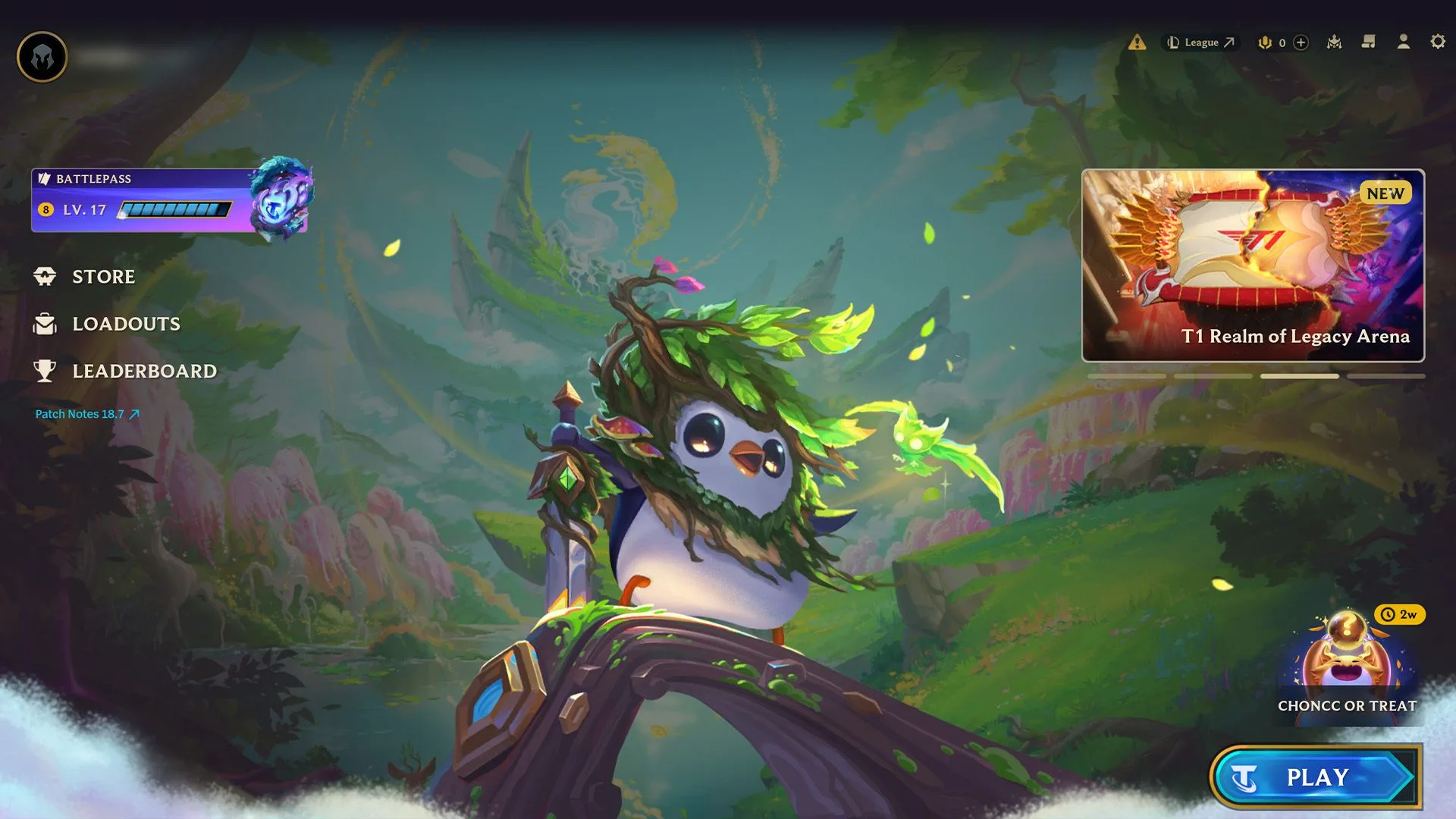
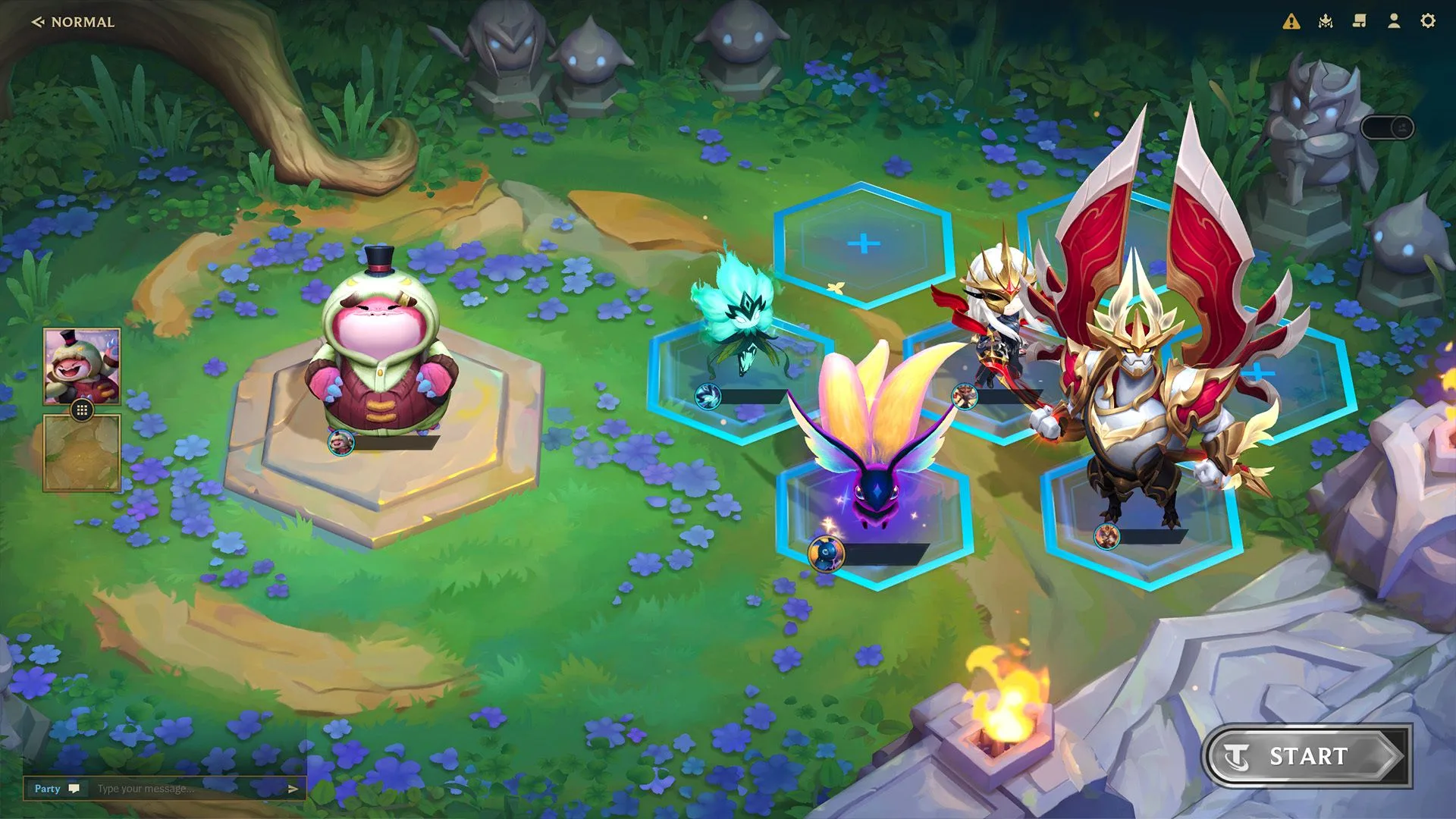
The standalone client arrived in patch 18.6. Riot previously named several 18.7 targets, including leaderboards, easier party creation and queue switching, but the 18.7 notes do not individually confirm every one of those features as shipped. Treat the earlier roadmap as a plan until it is visible in the client or separately confirmed by Riot.
| Client feature | Earlier Riot plan | What 18.7 notes confirm |
|---|---|---|
| Standalone PC client | Released in patch 18.6 | Already introduced in 18.6, not new to 18.7. |
| Leaderboards | Targeted return in 18.7 | Not separately enumerated in 18.7 written patch notes. |
| Adding friends to lobbies | Targeted ease-of-use improvement | Not separately enumerated in the final notes. |
| Switch between solo and party queues | Targeted for 18.7 | Not separately enumerated in the final notes. |
| End-of-game comp and team-code sharing | Described as future opportunity | No launch confirmation in 18.7 notes. |
| UI scaling on larger displays | Longer-term investigation | No committed 18.7 date. |
| Auto mobile performance settings | Feature documented for 18.7 | Confirmed in official 18.7 notes. |
| Mac support and Retina | Patch 18.7 return | Confirmed in official 18.7 notes. |
Riot also confirmed that future cross-game cosmetics rules begin with Set 19: newly released Little Legends cannot follow you into ARAM from patch 19.1, and newly released emotes separate from League starting in 19.2. Existing older shared cosmetic content is treated differently. Read RiftDaily’s TFT Set 19 Prismatic Tour guide for the next-set transition.
Every TFT patch 18.7 bug fix
Combat, item and Augment corrections
- Seeker’s Armguard no longer gains stacks from non-gameplay champion takedowns such as Elderwood plants.
- Banked mana no longer incorrectly persists between separate combats.
- Slightly Magic Roll’s Hugify effect now works against ghost armies.
- Magic Roll’s golden egg works as intended.
- Another Nesting Anvils edge case has been corrected.
Armory and interface corrections
- Pressing Escape cancels an Armory selection that has not been confirmed.
- Opponent Health totals update correctly after a win.
- Arena layouts are better centered.
- Dialog windows close more consistently.
- Augment descriptions use more consistent text boundaries.
- The stage 4-2 Augment Armory no longer fails to open when an Anvil Armory times out just as the Augment round begins.
- Coven’s cashout Armory displays 500 correctly rather than incorrectly saying 450.
Visual and stability fixes
- Golden Gamble now displays its coin-flip visual effect.
- Riot also lists various crash fixes and additional performance work.
For investigations beyond the fixed list, consult the official TFT Follow the Fix tracker and RiftDaily’s TFT Follow the Fix explainer. A listed issue on the tracker should not be assumed fixed unless Riot marks it accordingly.
TFT patch 18.7 restores hundreds of cosmetics
Riot says 476 cosmetics will be converted in patch 18.7 as part of the restoration process following TFT’s engine and client migration. Conversion means support for previously released content is being brought into the new experience; it does not mean that all these items are newly released or free to claim.
| Cosmetic category | Official listed count | Examples |
|---|---|---|
| Legendary Booms | 28 | Death Lotus, Divine Judgment, Trueshot Barrage, Noxian Guillotine. |
| Mythic Booms | 1 | Dark Star Obliterate. |
| Base Chibis | 22 | Ahri, Akali, Jinx, Kai’Sa, Riven, Sona, Yasuo, Zoe. |
| Base Unbound | 4 | Senna, Thresh, Darius, Pyke. |
| Standard Booms | 19 | Cat-ling Gun, Missile Party, Super Mega Death Rocket. |
| Standard Portals | 10 | Enter the Cyberspace, Event Horizon, Porcelain Bloom. |
| Little Legends | 374 | Baron, Ao Shin, Dango, Choncc-related and many themed variants. |
| Sum of listed categories | 458 | The headline says 476. The 18-item difference is not explained in the official list. |
The complete individual names are published in Riot’s Patch 18.7 converted cosmetics inventory, including the 374 named Little Legends. That source is the most accurate full appendix because several names in the official list have missing commas or run together, so copying them into a new list could create false item names.
Base Chibis included in the restoration
- Chibi Ahri, Chibi Akali, Chibi Amumu, Chibi Ashe, Chibi Blitzcrank, Chibi Janna, Chibi Jinx, Chibi Kai’Sa, Chibi Kayle, Chibi Lillia, Chibi Miss Fortune.
- Chibi Morgana, Chibi Neeko, Chibi Riven, Chibi Sona, Chibi Syndra, Chibi Tristana, Chibi Vex, Chibi Yasuo, Chibi Yunara, Chibi Yuumi and Chibi Zoe.
Unbound tacticians included in the restoration
- Senna Unbound
- Thresh Unbound
- Darius Unbound
- Pyke Unbound
Portals and Booms included in the restoration
All ten Standard Portals listed by Riot are Enter the Cyberspace, Event Horizon, Latte Link, Porcelain Bloom, Reforged, Rush of Riches, Shan Hai Sunrise, Sinking Shadows, The Way of the K.O., and Way to Immortality. The Mythic Boom is Dark Star Obliterate. For the complete individual Legendary and Standard Boom lists, use the official inventory linked above.
The headline-to-category mismatch is important for collectors: 28 + 1 + 22 + 4 + 19 + 10 + 374 = 458, not 476. RiftDaily is retaining Riot’s announcement number while making the unreconciled count clear rather than fabricating another category.
TFT Set 19 Prismatic Tour is the next update
After the final Enchanted Wilds patch, Set 19: Prismatic Tour is scheduled to begin with patch 19.1 on December 1, 2026. Riot is promoting a global music theme with more than 20 genres and a roster of 94 champions. True Damage is among the confirmed musical connections.
New gameplay, the Tour Collection experience, appreciation missions and related set launches belong to patch 19.1 rather than 18.7. The earlier standalone-client announcement also previews 500 Treasure Tokens after one game and a special Mythic Chibi reward path after 20 games in Set 19, subject to the published eligibility rules.
For the full next-set breakdown, visit RiftDaily’s TFT Set 19 Prismatic Tour coverage. The complete set schedule appears on Riot’s TFT patch calendar. More Teamfight Tactics news and guides are available on RiftDaily.
What TFT players should try before Enchanted Wilds ends
- Test Riftbeast reroll: Cinderling and Pebbles spells hit harder at every rank, but seven Riftbeast gives less AD and AP.
- Try three-star Kobuko: Prioritize understanding the stronger Health ratio, and check whether Riot clarifies the inconsistent final spell-damage number.
- Protect Ornn: Later Artifacts require less accumulated progress, so fight duration can directly affect your item economy.
- Explore Elderwood Ivern: One more legendary option changes how you reach high-value boards, even with weaker tree and Protector Health.
- Experiment with Sprykin Kennen: Seven Sprykin is easier to reach without a Spatula, but the trait offers less top-end Health and Attack Speed.
- Consider Summoner Kruggs: The extra synergy adds maximum Health to summoned Kruglettes while their higher-star base Health is reduced.
- Revisit Kha’Zix: Both regular and isolated spell damage increase, creating another late-set option for a precision-focused carry.
- Try Aphelios again: Lunar Blast deals more at both published ranks, increasing reward from supported backline play.
- Compare high-end Coven and Fae: Both offer more accessible or higher reward ceilings, though demanding economy still limits them.
- Use Reforgers with intention: Their new queue removes immediate backtracking, giving item pivots a little more predictability.
The final patch is designed for experimentation, and that is a useful way to approach the last games of Enchanted Wilds. Prioritize stable economy and the units actually offered by your shop over forcing a meme composition every game. The next major ruleset belongs to Prismatic Tour, so it is worth treating these last balance changes as opportunities to explore the current set rather than permanent foundations for Set 19.
Frequently asked questions about TFT patch 18.7
When did TFT patch 18.7 release?
Riot’s official 2026 patch schedule lists November 17, 2026 in Pacific Time. The patch notes were also published on November 17. Regional deployment times may differ.
Is TFT patch 18.7 the last Enchanted Wilds patch?
Yes. Riot describes patch 18.7 as the final Enchanted Wilds update before Set 19: Prismatic Tour.
What changed in TFT patch 18.7?
Eight traits, 16 named units and 12 Augment entries receive adjustments, alongside Reforger improvements, macOS support, mobile performance changes, bug fixes and cosmetics conversions.
Which TFT traits were buffed in 18.7?
Coven’s highest cashout, high-tier Inferno burn and Primal Phoenix components are buffed. Fae’s final reward threshold is also lowered. Eclipse is a mixed timing adjustment.
Which traits were nerfed?
Elderwood, the seven-unit Riftbeast stat bonus and higher-tier Sprykin bonuses are reduced. Eclipse has a slower initial trigger but faster repeated kills.
Which TFT units received buffs?
Cinderling, Kobuko, Leona, Ornn, Pebbles, Elise, Kayle, Teemo, Scuttlecrab, Warwick, Kha’Zix and Aphelios receive numeric or functional improvements. Kruggs has a trait addition and compensation nerf.
Is Kobuko stronger in patch 18.7?
His spell’s maximum-Health scaling rises from 10% to 15%, and the first three listed spell values increase. Riot’s published fourth value is inconsistent and remains unverified.
Is Kha’Zix buffed in TFT 18.7?
Yes. Base spell damage rises from 230/310/450 to 240/325/480, and isolated damage from 250/350/530 to 260/360/540.
Is Kennen now a Sprykin?
Yes. Riot adds Sprykin to Kennen in 18.7, making a seven-piece board easier to assemble without an Emblem.
Is Ivern now an Elderwood?
Yes. Ivern gains Elderwood, while the trait’s tree and Protector Health are reduced to compensate.
Is Kruggs now a Summoner?
Yes. Kruggs gains the Summoner trait. His Kruglettes gain 15% maximum Health through the summon interaction, while higher-star base Health is lowered.
What changed with Reforgers?
Consecutive Reforger uses now use an internal queue so the same item result does not immediately recur. This does not guarantee a particular desired item.
Which Augments changed in 18.7?
The notes list Advanced Loan, Comeback Story, Corrosion, Electrocharge II, Expected Unexpectedness, Focused Fire, Forged In Strength, Investment Strategy I and II, NO SCOUT NO PIVOT, Pandora’s Items II++ and We Stick Together.
Can you play TFT on Mac again?
Yes. Native support returns in 18.7 for Apple Silicon Macs, with Retina display improvements. Intel Macs are explicitly unsupported in Riot’s published requirements.
Does TFT support Apple Silicon Macs?
Yes. Riot lists an Apple M1 processor, 8 GB unified memory, a Metal-capable GPU, macOS 12 and 40 GB free storage as minimum requirements.
What changed in TFT Mobile?
Auto settings, revised resolution controls, clearer rendering on selected devices, performance fixes and reduced hitching are included. Some devices are capped at 30 FPS by default.
What does the new Auto Settings mode do?
It adjusts effects, resolution quality and frame-rate caps to the device. Players can switch to Custom settings; battery saver and performance mode are separate.
Are TFT leaderboards back?
Riot targeted a leaderboard return in the standalone client for 18.7, but its published 18.7 notes do not independently confirm that every planned social feature shipped.
How many cosmetics were restored?
Riot announces 476 conversions. However, the seven published category totals add to 458, an unresolved difference of 18 items.
What is TFT Follow the Fix?
It is Riot’s public tracker for bug fixes, performance issues, quality-of-life work and cosmetics restoration after the engine transition.
When does TFT Set 19 Prismatic Tour release?
Patch 19.1 is scheduled for December 1, 2026, according to Riot’s official patch schedule.
What comes after patch 18.7?
The next scheduled set patch is 19.1 for Prismatic Tour, followed by 19.2 on December 15, 2026.
A final chance to explore the Enchanted Wilds
TFT patch 18.7 closes the set with more than ordinary numerical tuning. Reroll carries regain damage, legendary trait additions change late-game planning, and improved Reforgers make equipment decisions a little less punishing. At the same time, Apple Silicon support and mobile performance work address access and reliability beyond the board.
For players choosing where to spend the last games of Set 18, the useful experiments are clear: Cinderling and Pebbles, Kobuko, Ornn, Elderwood Ivern, Sprykin Kennen, Summoner Kruggs and Kha’Zix. Those possibilities are worth testing without treating them as proven best-in-slot compositions. Keep an eye on the latest game updates, patch notes archive, and Riot Games and League of Legends news for confirmed follow-up changes. Our TFT Follow the Fix guide tracks the work still underway, while the Prismatic Tour preview covers what comes next.