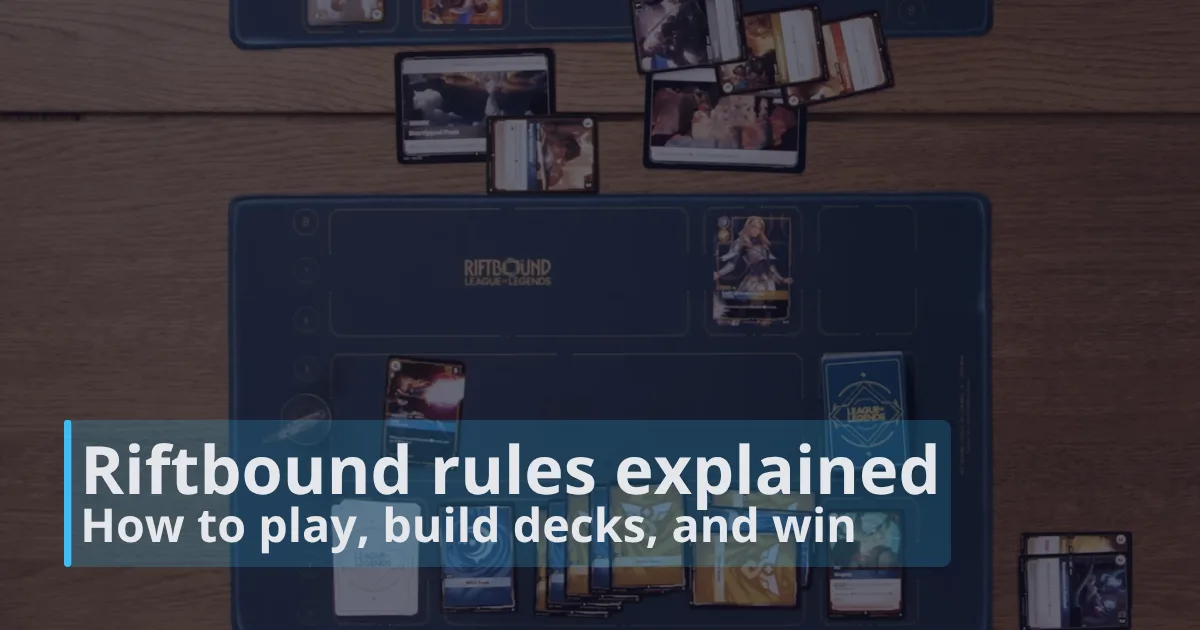
Riftbound rules are much easier to understand once you strip them down to the game’s core loop. In most games, each player builds around a champion legend, channels runes for resources, sends units to battlefields, and scores by conquering or holding those battlefields until someone reaches the target point total.
If you are looking for how to play Riftbound TCG without wading through every edge case first, this guide gives you the plain-English version. It covers the Riftbound TCG rules that matter most in actual play, then expands into deck construction, multiplayer formats, sideboards, sealed events, and equipment so you can move from your first game to a confident rules reference.
Riftbound rules at a glance
- You normally bring a champion legend, a main deck of at least 40 cards, a rune deck of 12 runes, and battlefields based on the format.
- You draw 4 cards to start and may mulligan up to 2 of them.
- Your turn follows a simple ABCD rhythm: Awaken, Beginning, Channel, Draw, then your Action phase.
- Units fight for battlefields, spells give one-time effects, and gear stays in play to provide ongoing value.
- You score by conquering a battlefield or by holding one at the start of your turn, but the final point has special restrictions.
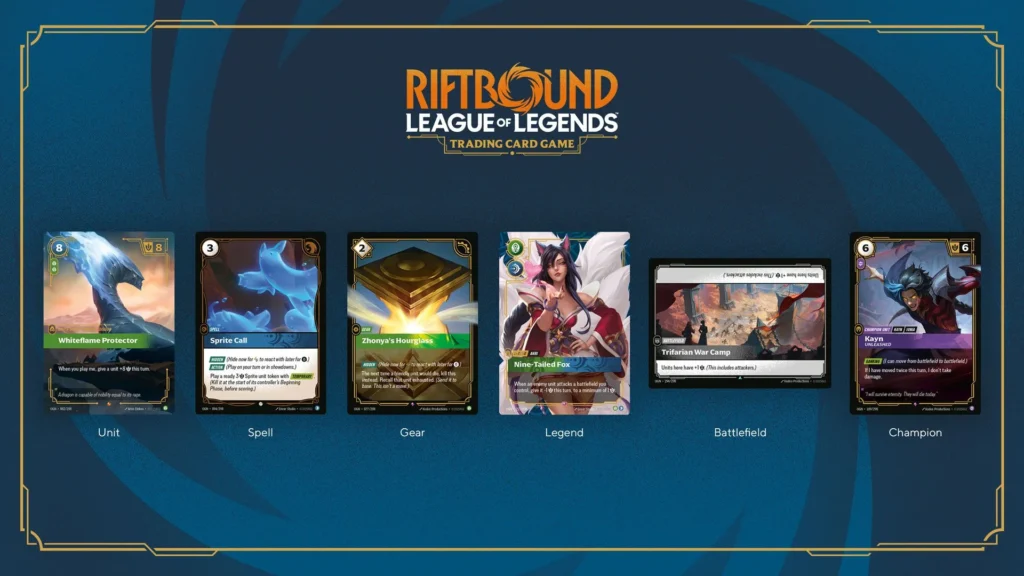
That short version is the heart of Riftbound rules explained. Everything else, including timing, targeting, and advanced interactions, exists to support those five ideas. For broader background on the game’s release and overall structure, this Riftbound overview is a useful supplement before you dive into the finer rules.
How to play Riftbound, from setup to your first turn
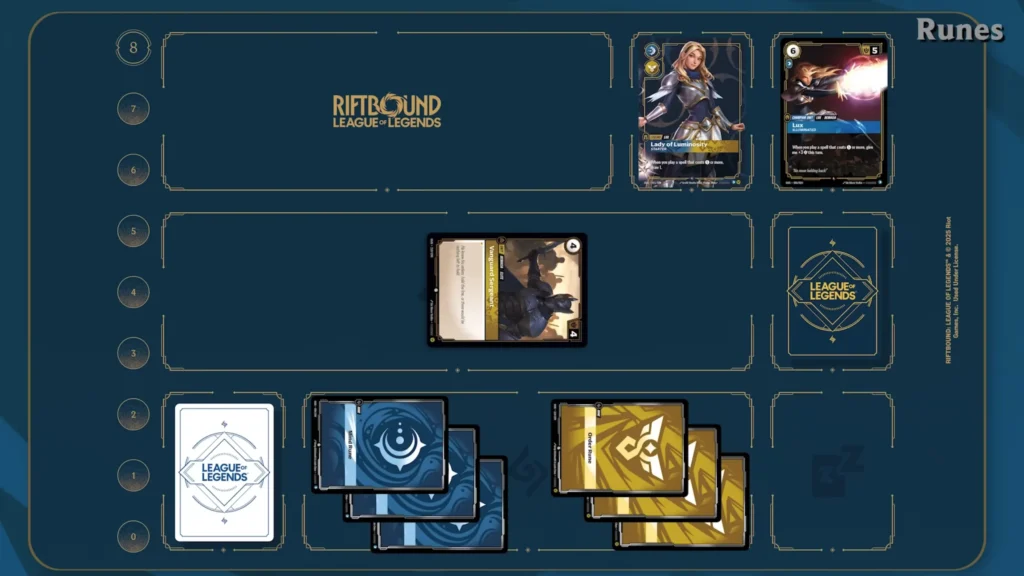
To start a game, place your legend in the legend zone, your chosen champion in the champion zone, your main deck and rune deck in their spaces, and the active battlefields between players. Your base is where your units and gear sit before they head into battle. Your chosen champion starts available to be played later, but it is not automatically in play.
Each player draws 4 cards. The Riftbound mulligan rules are generous enough for a quick tune-up but not a full redraw: you may recycle up to 2 cards from your opening hand to the bottom of your main deck, then draw the same number. In a normal 1v1 duel, the player going second gets an extra rune on their first channel step to balance the first turn. If you want the clean beginner version straight from the source, the official how to play guide matches this opening flow well.

The ABCD turn structure
The cleanest way to learn Riftbound rules is to memorize the start of turn sequence. First you Awaken exhausted cards that can ready. Then your Beginning phase checks start-of-turn effects and any points you get for holding battlefields. After that you Channel runes from the top of your rune deck, usually 2 each turn. Then you Draw 1 card from your main deck.
Once ABCD is done, you enter your Action phase. This is where you play units, spells, and gear, activate abilities, and move ready units. Most units enter your base exhausted, so they usually cannot attack right away. Gear, by contrast, enters ready unless the card says otherwise. When you want the exact wording for timing, costs, and zone definitions at the table, keeping a printable Core Rules PDF nearby is far more helpful than trying to remember every clause from memory.
Seeing the board once makes the Riftbound rules much easier to remember, especially if you are learning with starter decks or teaching a new table.
This longer learn-to-play video is especially helpful for visualizing the board, battlefields, and the rhythm of a full turn cycle in multiplayer as well as 1v1.
Riftbound battlefield rules, conquer rules, and combat
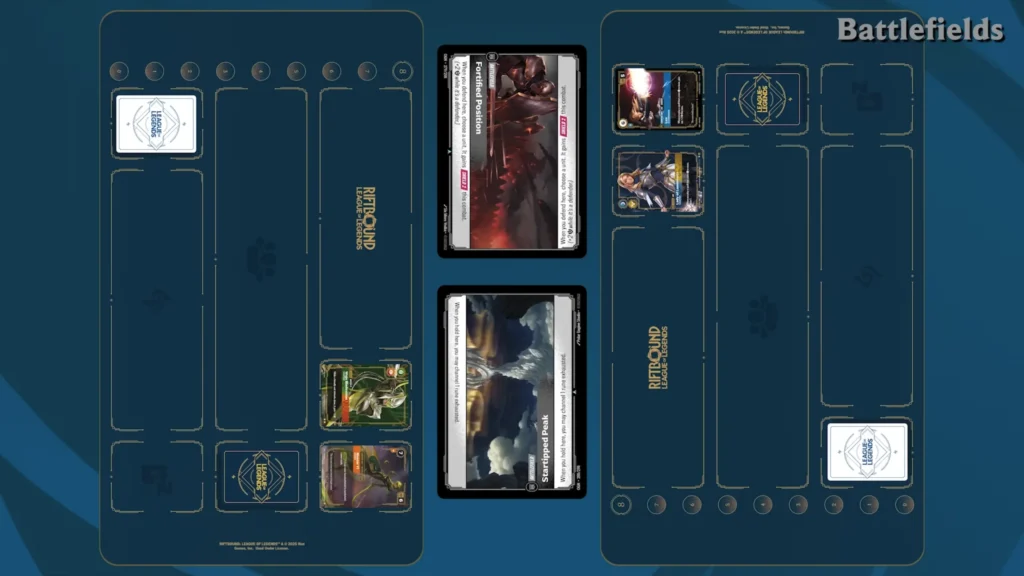
The most important Riftbound battlefield rules are about movement and control. A ready unit can use its standard move to go from your base to a battlefield, or from a battlefield back to your base, and the move exhausts that unit. If the unit has Ganking, it also gains battlefield-to-battlefield movement as part of that same standard move. That matters because battlefields are how you score, not just where you fight.
When you move onto an empty battlefield you start a showdown without combat. Other players may still respond with legally timed spells and abilities before control is settled. When you move onto a battlefield an opponent already controls, you trigger combat. That is where Might does the heavy lifting. A unit’s Might is both its attack and its durability, so a 4 Might unit hits for 4 and dies once it has 4 damage marked on it. The official gameplay guide is worth reading if you want extra combat examples beyond the basics.
Damage in Riftbound does not stick around forever. Units heal at the end of combat and at the end of each turn. That means chip damage matters inside one combat or one spell chain, but it does not become permanent attrition across several turns unless a card says otherwise. It also means the defender can survive by forcing a tie, because a tied combat usually leaves the attacker without a point. If you want product pages, announcements, and beginner resources in one place while you learn, the official Riftbound site is the easiest hub to keep open in another tab.
How conquer and hold actually score points
Riftbound conquer rules are simple once you separate control from scoring. You conquer a battlefield when you take control of one you did not already control and have not already scored that turn. That gives you 1 point. You hold a battlefield when you still control it at the start of your turn, which also gives you 1 point.
The tricky part of Riftbound rules is the final point. In most formats you need 8 points to win, and in 2v2 you need 11. But you cannot usually win your last point by conquering only one battlefield while the other scoring battlefield is still unscored that turn. In practice, if you are on 7 in a duel and conquer just one battlefield, you draw a card instead of winning. You either need to already have scored the other battlefield that turn, or you need to win by holding at the start of your next turn.
If you want a faster visual refresher on how showdowns, combat, and scoring fit together, this shorter walkthrough is a good companion to the written guide.
Use it when you already know the card types and just need the duel sequence, the last-point rule, and the timing windows to click into place.
Riftbound deck building rules and signature spell basics
The core Riftbound deck building rules start with your legend. Your champion legend defines the domains your deck can use, so domain identity comes first and card choice comes second. In normal constructed play, your main deck must have at least 40 cards, your rune deck must have exactly 12 runes, and your chosen champion must be a champion unit whose champion tag matches your legend.
You may include up to 3 copies of the same named card in a normal constructed main deck, and that limit includes extra copies of your chosen champion. Signature cards are their own extra restriction: your deck may contain only 3 total signature cards with the same champion tag as your legend. If you are comparing lists through our Riftbound hub, that is the framework every legal constructed deck starts from. If your focus is the launch environment, our Origins guide helps connect those rules to the earliest deckbuilding choices players actually faced.
Riftbound signature spell rules matter because signature cards often pull your entire strategy into focus. In Origins, each legend is tied closely to a signature spell, and most decks want to consider the full three-copy cap unless there is a strong reason not to. The practical question is not just whether a signature card is strong, but whether it advances your legend’s main plan often enough to deserve one of those precious three slots.

Runes, energy, and power
Runes are the engine of Riftbound rules. You can exhaust a rune to generate energy for the gray numeric part of a cost, and you can recycle a rune to the bottom of your rune deck to generate power for a domain symbol cost. A key beginner rule is that an exhausted rune can still be recycled for power in the same turn, which makes expensive cards much easier to sequence than they first appear.

Riftbound equipment rules, in plain English
Many players search for Riftbound equipment rules, but the broader card type is gear. Gear is played to your base and normally enters ready. Equipment is a subset of gear that has Equip, which means you pay its equip cost to attach it to a unit you control. Once attached, the equipment’s effect text and any Might bonus apply through the equipped unit.
This creates two useful shortcuts for reading the board. First, unattached gear belongs in your base, not at a battlefield. Second, if equipment ends up sitting at a battlefield without remaining properly attached, it gets recalled to its controller’s base on cleanup. Some equipment also has Quick-Draw, which lets it be played and attached with reaction timing, turning it from a slow value card into a combat trick.
Riftbound multiplayer rules: 3-player, 4-player, and 2v2
Riftbound multiplayer rules stay surprisingly close to the duel rules, but the scoring map and first-turn adjustments change. The biggest practical difference is that there are more battlefields to monitor, more chances for table politics inside showdowns, and more ways to get denied your last point.
| Mode | Players | Points to win | Battlefields in play | First-turn tweak | What changes most |
|---|---|---|---|---|---|
| Duel | 2 | 8 | 2 | Second player channels 1 extra rune | Fastest way to learn how to play Riftbound |
| Match | 2 | 8 per game, best of 3 | 2 per game | Second player channels 1 extra rune | You choose new battlefields each game and cannot repeat used ones |
| Skirmish | 3 | 8 | 3 | First player skips first draw, last player channels 1 extra rune | Riftbound 3 player rules add more table interaction during showdowns |
| War | 4 | 8 | 3 | First player skips first draw, last player channels 1 extra rune | Riftbound 4 player rules use only three battlefields even with four players |
| Magma Chamber | 2v2 | 11 | 3 | First player skips first draw, last player channels 1 extra rune | Riftbound 2v2 rules alternate team turns and change what “friendly” means |
In both 3-player and 4-player free-for-all, combat at a battlefield still resolves between only two players at a time. A third player can influence the showdown with legal plays, but not by creating a three-sided combat. That is one of the most important Riftbound multiplayer rules to remember when a crowded board gets messy.
Riftbound 2v2 rules add a few unique twists. Teams alternate turns, friendly can include your ally, and teammates may play spells during each other’s turns. At the same time, control is not shared. You cannot hide cards at a battlefield your teammate controls, you cannot standard move your teammate’s units, and you and your ally cannot both occupy the same battlefield. Team games also need 11 points, so tempo still matters, but sustained control matters even more.
Riftbound sideboard rules, side deck rules, and sealed rules
Riftbound sideboard rules only matter in formats that actually allow a sideboard, so always read the event structure first. There is not one universal sideboard size baked into the core game. Instead, the competition format tells you whether sideboards are allowed and how large they can be. What stays consistent is the process: between games of a match, sideboard cards are exchanged 1 for 1 with main deck cards, and your main deck must still meet the format’s size rules after sideboarding.
In constructed play, a sideboard can also affect your chosen champion. You may switch to a legal chosen champion from your main deck or sideboard between games, but you normally cannot change your runes, legend, or battlefields after deck registration. So if someone asks about Riftbound side deck rules, the practical answer is that your flex slots are real, but your deck’s backbone is locked once the event begins. Because sanctioned play details can shift with patch notes and tournament policy, the live Rules Hub should always be your first stop for the newest official documents.
Riftbound sealed rules work very differently. In sealed, players build from a limited pool rather than a prebuilt constructed list. Sealed decks need at least 25 main-deck cards, the normal copy limits do not apply, and your unused sealed pool becomes your sideboard. Between games, you can usually change far more than in constructed, including your domain identity, rune deck, legend, and chosen champion, as long as the resulting deck still satisfies the event’s sealed construction rules.
That flexibility is what makes Riftbound sealed rules so interesting. You are not just tuning a few slots for one matchup, you are often rebuilding your whole plan around the best domains and champions you opened. For edge cases, clarified interactions, and older wording questions around hidden cards, scoring, and timing, the archived FAQ rulings are still useful background, even though current live documents take priority. It also helps to watch the latest Riftbound news and track our Riftbound release date guide so format prep lines up with new products and rules updates.
Frequently asked questions about Riftbound rules
What are the Riftbound mulligan rules?
You draw 4 cards, then you may recycle up to 2 of them to the bottom of your main deck and draw the same number of replacements. It is a partial mulligan, not a full redraw.
Can you recycle an exhausted rune to pay power?
Yes. A rune can be exhausted for energy and later recycled in that same turn for power. That interaction is one of the most important resource shortcuts in Riftbound rules.
Do gear and equipment enter ready?
Regular gear enters ready in your base. Units usually enter exhausted. Equipment is gear with Equip, so you first play it as gear, then attach it to a unit by paying its equip cost.
What happens to your chosen champion after it dies?
Once you play your chosen champion from the champion zone, it behaves like a normal main-deck card. If it dies, it goes to the trash rather than returning to the champion zone.
Can more than two players be in the same combat?
No. In multiplayer, showdowns can involve more than two players contributing spells or reactions, but combat itself still resolves between exactly two players at a battlefield.
How do hidden cards work?
You may hide a card with Hidden face down at a battlefield you control by paying one power of any domain. You cannot use it that same turn. Beginning on the next turn, you may play it with reaction timing while ignoring its base cost, and some of its choices may be restricted to the battlefield where it was hidden.
What are the biggest differences between sideboard rules and sealed rules?
Constructed sideboarding is usually narrow and keeps your legend, runes, and battlefields fixed after registration. Sealed sideboarding is much broader because your unused sealed pool becomes your sideboard, and you can often rebuild your domains, legend, chosen champion, and rune mix between games.
From first game to confident rules calls
The best way to learn Riftbound rules is to move in layers. First, learn the scoring loop and ABCD turn order. Next, get comfortable with runes, movement, and combat math. After that, add multiplayer, sideboarding, and hidden or equipment interactions. That is when Riftbound rules explained starts to feel less like memorization and more like pattern recognition.
For the next step, spend time with our Riftbound hub, keep an eye on the latest Riftbound news, revisit our Origins guide if that is your starting card pool, and use the Riftbound release date guide to track when new sets and updates might change the way you build or play. That combination will keep your understanding of Riftbound rules current, practical, and ready for real games.