Riot Games has launched TFT Follow the Fix, a public progress tracker addressing the troubled Unreal Engine migration in Teamfight Tactics. In an October 13, 2026 developer update, the studio apologized for the problems introduced with Set 18, Enchanted Wilds, and acknowledged that it knowingly released the game with unfinished features and unresolved bugs.
The problems extend beyond occasional crashes. Players have encountered lower frame rates, delayed shop inputs, inconsistent champion movement, missing interface features, and cosmetics they already own but cannot currently equip. Riot says it underestimated both the impact of those problems and the time required to resolve them.
The new tracker provides a clearer picture of what has been fixed, what remains under investigation, and which improvements are planned for upcoming patches. Riot has also confirmed that it is preparing unspecified thank-you initiatives for TFT Set 19.
Riot takes responsibility for TFT's Unreal Engine problems
In the latest developer video, TFT executive producer Geoff addressed one of the biggest questions surrounding the transition: why Riot proceeded with Enchanted Wilds when the team knew the game was not fully ready.
Geoff explained that while developers had warned leadership about remaining issues, the decision to launch was ultimately made by those responsible for directing the game. He accepted responsibility for that decision rather than attributing the problems to individual developers.
Riot originally expected the transition to cause some temporary disruption. What it failed to anticipate was how many problems would appear simultaneously once Unreal Engine reached the wider range of PCs and mobile devices used by the community.
Performance on the Public Beta Environment (PBE) had given the team too much confidence. After release, crashes, memory issues, delayed inputs, and inconsistent frame rates proved more widespread and difficult to resolve than expected.
Several patches have already brought improvements, but Riot acknowledges that the game has not fully returned to its previous standard. The studio's latest message is accompanied by a new way to track the work, rather than another general assurance that fixes are coming.
What is TFT Follow the Fix?
TFT Follow the Fix is Riot Games' official public tracker for major Teamfight Tactics problems following the Unreal Engine migration. It lists completed fixes, ongoing investigations, and planned improvements across gameplay, performance, visual clarity, client features, and cosmetics. Riot intends to update the dashboard approximately every two weeks.
The official Follow the Fix website divides the work into five main categories:
- Performance & Stability: Crashes, frame-rate drops, memory problems, input delays, and mobile update issues.
- In-Game: Champion movement and targeting, shop interactions, combat information, pings, repositioning, and gameplay responsiveness.
- Visuals & Clarity: Blurry icons, animations, visual effects, interface readability, and missing or unclear information.
- Client & Social: Menus, settings, matchmaking lobbies, chat, friends lists, and the dedicated TFT client.
- Cosmetics: Conversion progress for previously released Tacticians, Arenas, Booms, Portals, and other cosmetic content.
Issues are labeled Fixed, In progress, Investigating, or Pending. Some also include a targeted patch number, although Riot makes clear that these are development targets rather than guaranteed delivery dates.
The first published snapshot is dated October 7 and corresponds to Patch 18.4, even though the initiative was announced publicly on October 13.
Follow the Fix is not intended to list every TFT bug. Its emphasis is on problems affecting the overall experience, while routine Enchanted Wilds gameplay fixes and balance changes remain part of the regular patch notes.
Which TFT bugs are being fixed, and when?
Riot's priorities include game stability and the small, familiar interactions that affect decision-making during a match. These are particularly important in TFT, where buying a champion, rearranging a board, or making a last-second change often comes down to a fraction of a second.
The following table highlights some of the most significant issues listed in the October 7 Follow the Fix snapshot.
| Issue | Status | Details or target patch |
|---|---|---|
| Game crashes | In progress | Ongoing work to reduce crashes that interrupt matches |
| Frame-rate drops | In progress | Improving performance and frame pacing across devices |
| Delayed shop and repositioning inputs | In progress | Reducing delays when buying or moving champions |
| Champion movement and targeting | Investigating | Restoring expected combat behavior |
| Missing pings | In progress | Reintroducing and improving the ping feature |
| Last-second champion changes | In progress | Targeting Patch 18.6 |
| Incorrect opponent matchup indicators | Fixed | Fixed in Patch 18.4 |
| Memory leaks | Fixed | Several issues fixed in Patch 18.1 |
| Mobile champion selling indicators | Pending | Targeting Patch 18.7 |
| Mobile infinite update loops | Pending | No confirmed patch target |
Performance and input responsiveness remain priorities
Crashes and inconsistent performance remain ongoing projects rather than problems Riot considers resolved. The developer is working on frame pacing, overall stability, and the responsiveness of everyday gameplay actions.
Input delays are especially noticeable when purchasing champions or moving them around the board. A command that registers late can disrupt a planned roll-down or prevent a player from completing a positioning change before combat begins.
The tracker also identifies champion placement accuracy, sluggish Tactician movement, and slow Armory selections as areas requiring attention.
Champion targeting and repositioning need more work
Not every outstanding problem is purely visual or performance-related. Riot is investigating champion movement and targeting to ensure units behave as intended and maintain the consistency established in previous sets.
One planned improvement targets the short window immediately before combat, when players previously had more freedom to field, upgrade, or reposition champions. Riot aims to restore that behavior in Patch 18.6.
That is separate from individual champion bugs, which are still addressed through patch notes as they are discovered and resolved.
Pings and missing interface features are also on the list
Riot is working to restore TFT's ping functionality following the removal of the old minimap. The feature was expected to require changes during the transition, but it remains unavailable in its previous form.
Visual clarity is another area of concern. The tracker includes plans for sharper champion portraits and item icons, clearer shop highlights, improved round timers, and more readable interface elements.
Other planned changes address the Team Planner, combat recap information, scouting visuals, and mobile controls. These may appear minor individually, but they contribute to the consistency of the overall experience.
What Riot has already fixed in TFT Patch 18.4
Some recovery work has already reached the live game. Riot's official TFT Patch 18.4 notes document improvements to stability, combat behavior, and several issues introduced or exposed during the transition.
Among the changes are fixes for multiple server crashes, lingering visual effects during scouting, and a problem that could prevent a last-second champion placement when network latency was high.
Previous patches also addressed memory leaks, incorrect default graphics settings, missing hotkey assignments, and situations where players could become stuck in games that had already ended.
Patch 18.4 additionally resolved problems with opponent matchup indicators and certain champion movement or targeting interactions. However, the tracker continues to list broader performance and targeting work as unfinished.
That distinction is important. Fixing a specific crash or combat bug does not mean every problem within the same category has been eliminated.
Why Riot released Enchanted Wilds before the migration was ready
Riot's October 13 explanation provides unusually direct insight into the decisions that shaped the Unreal Engine launch.
TFT moved from Hextech, the technology it previously shared with League of Legends, to Unreal Engine on August 26, 2026, alongside the release of Set 18, Enchanted Wilds.
The transition was intended to address limitations that had developed over years of expanding the game. Riot wanted greater independence from League of Legends technology, more flexibility to build new features, and a way to avoid duplicating some development work between PC and mobile.
But the project had already encountered delays before launch.
Delaying Enchanted Wilds created problems for Space Gods
Riot initially postponed the Unreal Engine transition by moving Enchanted Wilds back an entire set. That required the preceding set, Space Gods, to arrive earlier than planned.
According to Geoff, this reduced the time available to refine Space Gods' central mechanic and set design. Riot believes those compromises contributed to the set being less popular with players.
The Enchanted Wilds PBE period was subsequently delayed as well, allowing additional development time. However, another delay to the live release would have introduced a different problem.
Space Gods had already been available for an extended period, the community was expecting new content, and Riot had no completed alternative set ready to launch on the previous engine.
Leadership ultimately chose to release Enchanted Wilds with outstanding bugs and unfinished cosmetic conversions. The team expected to address many of those issues over the first few patches.
What Riot misjudged was the scale of the disruption after launch and how long the recovery would take. Problems that appeared manageable during testing became far more serious across the wider range of hardware used by the live player base.
The explanation does not change the condition in which Enchanted Wilds launched, but it clarifies that the decision was a deliberate trade-off made by leadership rather than an issue that went unnoticed during development.
TFT missing cosmetics: More than 900 conversions remain
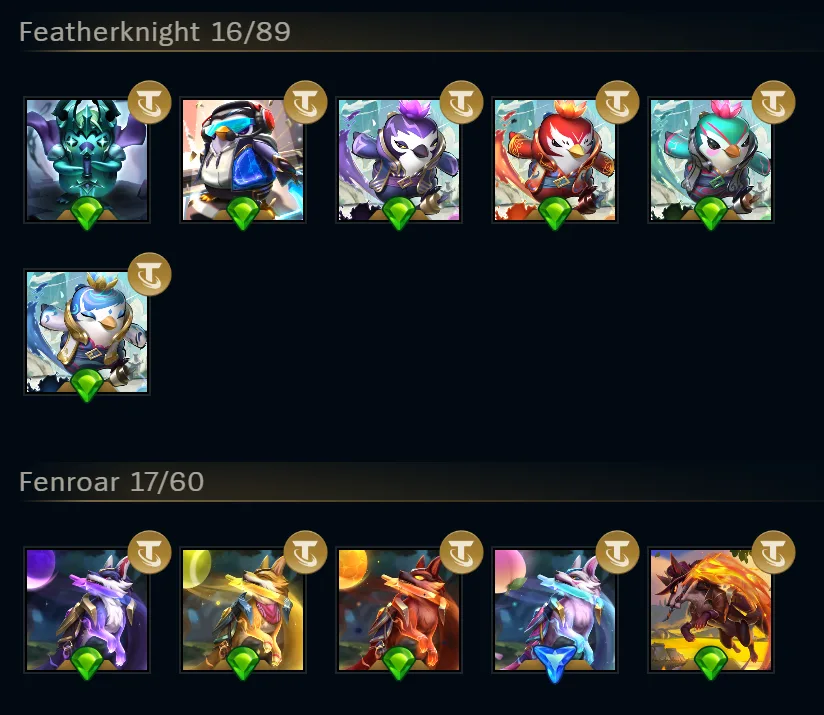
Missing cosmetics remain one of the most visible consequences of the Unreal Engine migration, particularly for players who have spent money collecting rare Arenas, Chibis, Little Legends, and other items.
According to Riot's October 7 Follow the Fix snapshot, 2,661 of 3,573 cosmetics have been converted to Unreal Engine. That represents approximately 74.5% of the tracked collection, leaving 912 conversions outstanding.
Progress differs considerably between categories:
| Cosmetic category | Converted | Remaining |
|---|---|---|
| Prestige Chibis | 10 of 13 | 3 |
| Mythic Chibis | 58 of 72 | 14 |
| Base Chibis | 23 of 48 | 25 |
| Little Legends | 165 of 796 | 631 |
| Mythic Arenas | 6 of 36 | 30 |
| Legendary Arenas | 19 of 44 | 25 |
| Legendary Portals | 2 of 24 | 22 |
| Standard Portals | 2 of 41 | 39 |
| Prestige Booms | 10 of 10 | 0 |
Although Little Legends account for a large share of the outstanding conversions, Riot says they are generally faster to transfer than some other cosmetics. They have been assigned a lower priority while work continues on more complex categories.
Mythic Arenas present a different challenge. Riot has identified performance problems associated with some of these Arenas and is addressing those issues before increasing the rate of conversions.
Patch 18.4 restored 41 cosmetics, with 63 targeted for Patch 18.5
Riot's Patch 18.4 notes list 41 cosmetics for restoration, including 12 Mythic Chibis, 12 Mythic Booms, two Mythic Arenas, seven Mythic Unbound Tacticians, and several other items.
Examples include Chibi Coven Morgana, Chibi Spirit Blossom Sett, Chibi Star Guardian Lulu, Lux's Demacian Daydream Arena, and Pengu's 6th Anniversary Arena.
For Patch 18.5, Riot is aiming to restore another 63 cosmetics, including additional Chibis, Little Legends, Arenas, Booms, and Portals. Among the targeted items are Chibi Arcane Caitlyn, Chibi Firelight Ekko, Chibi Star Guardian Lux, and the K/DA in the Convergence Arena.
Those Patch 18.5 additions are planned rather than confirmed live releases. Future conversion totals will depend on whether the targeted items pass the necessary testing and optimization work.
Are missing TFT cosmetics permanently gone?
No. Riot states that previously purchased or earned cosmetics remain attached to players' accounts. An item being temporarily unavailable does not mean ownership has been removed.
The studio's Unreal cosmetics FAQ explains that some items appear with a Work in Progress (WIP) badge, indicating that further polishing is needed. Others receive a Disabled badge because they are not currently ready to use.
As a temporary measure, Riot has also made a selection of converted cosmetics available for players to borrow while missing content is restored. The selection is designed to offer alternatives during the transition and is not a permanent addition to every account.
There is still no confirmed deadline for completing the entire cosmetic collection. Riot says that after the conversions are finished, further work will continue on animations, visual effects, and overall functionality.
The dedicated TFT client and macOS support are still in progress
Follow the Fix also covers work beyond the matches themselves, including Riot's dedicated Teamfight Tactics client.
The new client is part of the broader effort to make TFT more independent from League of Legends. However, the tracker still lists its launch as an ongoing project, alongside numerous improvements to menus, settings, friends lists, cosmetic previews, and other interface features.
Some of the planned changes are relatively straightforward, such as clearer search controls, more responsive social panels, and better spacing throughout the interface.
Other work includes restoring Streamer Mode, improving PC display scaling, and making cosmetic loadouts easier to manage.
The dashboard also confirms that macOS support remains in progress. Riot has not provided a confirmed completion date through Follow the Fix.
These features may not attract the same attention as crashes or combat issues, but their inclusion shows that the recovery effort extends across the entire TFT experience rather than only the in-game engine.
Riot confirms plans to thank players during TFT Set 19
Beyond the immediate repair work, Riot revealed that it is preparing a couple of initiatives around TFT Set 19 as a gesture of appreciation for players who have remained with the game throughout the troubled transition.
Geoff mentioned those plans near the end of the developer video but offered no specifics about their contents or timing.
Riot has not confirmed whether the Set 19 initiatives will include free cosmetics, in-game currency, or any particular form of compensation. Eligibility requirements and distribution details are also unknown.
The studio says it will provide additional information when the plans are ready to announce.
For now, the confirmation is limited to Riot working on ways to recognize player patience. It should not be treated as an announcement of specific rewards.
How players can report TFT issues and follow future fixes
Riot is encouraging players to continue reporting problems, including those that appear to have been addressed on paper but still affect actual matches.
Players can review issue statuses through Follow the Fix and use the feedback option to report problems. Technical difficulties, account questions, and cosmetic concerns can also be submitted through the official Teamfight Tactics support center.
Regular patch notes remain important because they provide the details of changes delivered to the live game. Follow the Fix offers a broader view of Riot's priorities, while patch notes show what has actually changed in each release.
For ongoing developments, RiftDaily's Teamfight Tactics coverage follows the game's sets, updates, and major announcements. Further announcements from Riot Games can also be found through the site's latest gaming news.
Frequently asked questions about TFT Follow the Fix
What is TFT Follow the Fix?
TFT Follow the Fix is Riot Games' public tracker for major bugs and quality-of-life problems following Teamfight Tactics' Unreal Engine migration. It provides information about completed fixes, ongoing investigations, planned changes, and cosmetic conversion progress.
Why did Riot apologize for the TFT Unreal Engine update?
Riot apologized because the August 2026 engine migration introduced more performance problems, crashes, delayed inputs, and missing cosmetics than anticipated. Leadership acknowledged that it knowingly launched Enchanted Wilds with outstanding issues and underestimated their impact.
When will Riot fix TFT performance and input lag?
There is no confirmed date for resolving every performance and input delay issue. Riot is continuing to improve stability and responsiveness across patches, with certain features targeted for Patch 18.6 and Patch 18.7.
How many TFT cosmetics are still missing?
As of Riot's October 7, 2026 tracker snapshot, 912 of the 3,573 tracked cosmetics had not yet been converted to Unreal Engine. A total of 2,661 were listed as converted, representing approximately 74.5% of the collection.
Have players lost their purchased TFT cosmetics?
No. Riot confirms that previously purchased and earned cosmetics remain attached to players' accounts. Some cannot currently be equipped because they still require conversion or further work to function properly in Unreal Engine.
How often will Follow the Fix be updated?
Riot plans to update the Follow the Fix website approximately every two weeks. The tracker includes issue statuses and potential patch targets, which may change as development progresses.
Will TFT return to its old engine?
Riot has announced no plans to return TFT to Hextech. The studio continues to believe Unreal Engine is the right long-term foundation for Teamfight Tactics and is prioritizing improvements to the current experience.
Will TFT Set 19 include free rewards or compensation?
Riot has confirmed that it is working on initiatives around Set 19 to thank players for their patience. However, no specific rewards, compensation details, or eligibility requirements have been announced.
The next TFT patches will show whether Riot's recovery is working
Follow the Fix is a meaningful change in how Riot communicates the state of Teamfight Tactics. Instead of relying exclusively on general developer updates, the company is now making its repair priorities and unresolved issues easier to follow.
Several problems have already been addressed, but the remaining work is substantial. Performance, input responsiveness, champion behavior, missing cosmetics, and client functionality continue to require attention.
Patch 18.5's targeted cosmetic conversions, the quality-of-life changes planned for Patch 18.6, and subsequent updates will provide important opportunities to judge that progress. Further announcements about Set 19 and the dedicated TFT client will also help establish where the game goes next.
Riot remains committed to Unreal Engine and believes the technology will support TFT for years to come. But after the difficult Enchanted Wilds launch, the immediate priority is more straightforward: making the game feel reliable, responsive, and familiar again. The success of Follow the Fix will ultimately be determined by what changes in the live game.