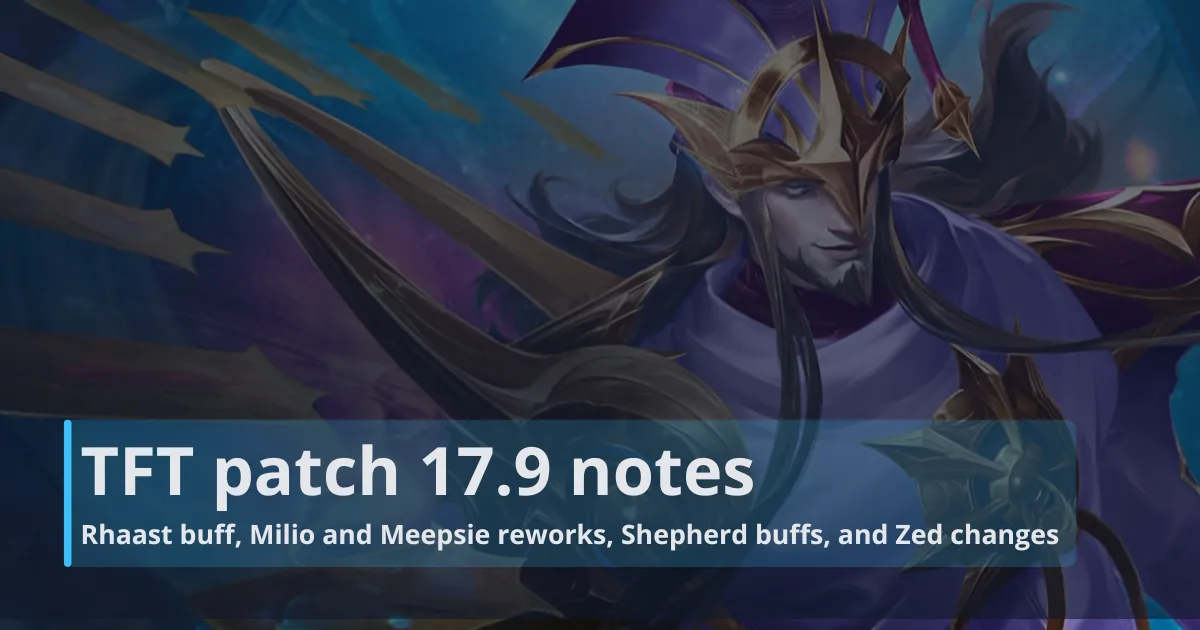
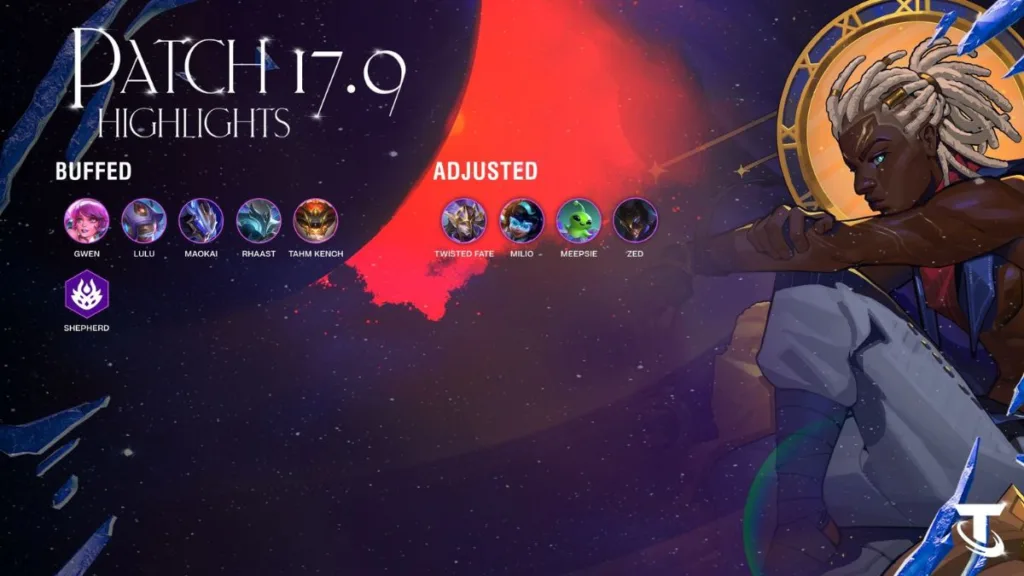
TFT patch 17.9 is the final dedicated Space Gods update before Enchanted Wilds, giving Rhaast a huge damage buff, reworking Milio and Meepsie, strengthening Shepherd, improving several economy options, and adding Zed to the normal champion roster.
This is a short patch by raw change count, but several adjustments are much larger than they first appear. Twisted Fate becomes more volatile, Milio gains an extra-cast mechanic, Meepsie changes from a Magic Tank into a Magic Fighter, Rhaast gets dramatically more spell damage, and Zed is no longer locked behind his Invader Zed Augment.
TFT patch 17.9 overview and biggest changes
TFT patch 17.9 is less about trimming the strongest meta boards and more about giving Space Gods a memorable final dedicated balance pass. The most important changes increase carry ceilings, create new reroll incentives, and make previously conditional units easier to build around.
| Patch area | Main change | Why it matters |
|---|---|---|
| Shepherd | Lower mana, stronger Tail Sweep scaling, and a much stronger Shepherd (7) wave | The summon can cast more often and becomes more threatening at higher trait and star levels. |
| Twisted Fate | Much weaker low rolls, much stronger high rolls, plus new outcomes on rolls of 1 and 9 | Twisted Fate becomes a more volatile carry with a substantially wider range of fight outcomes. |
| Milio | 40% chance to cast again at another target, with lower base spell damage | His ceiling shifts toward additional casts and spreading damage instead of relying on one stronger cast. |
| Meepsie | Magic Fighter rework with 0/55 mana and Big Bang becoming the base spell | Meepsie is now designed to get active quickly instead of functioning primarily as a magic tank. |
| Rhaast | Spell damage jumps from 120/180/300 AD to 400/600/1000 AD | This is the largest raw damage increase in TFT patch 17.9 and makes Rhaast an immediate carry test. |
| Economy | Lulu drops more Medallion gold and Tahm Kench's Oracle generates more gold per round | Several reroll and economy-oriented lines gain extra late-game value. |
| Zed | Invader Zed Augment removed, Zed enters the base roster, health drops to 1100 | Zed becomes broadly accessible instead of depending on a specific Augment roll. |
| Enchanted Wilds | The next TFT set launches August 26 | Patch 17.9 closes the dedicated Space Gods cycle while preparing players for Set 18. |
Riot's official Teamfight Tactics patch 17.9 notes contain the complete numerical list. This RiftDaily breakdown focuses on what those values change in practice, which units deserve another look, and where players should be cautious about reading a large number as an automatic meta takeover.
For more coverage around the patch, visit the RiftDaily TFT hub, follow the latest TFT news, browse our patch notes archive, and track smaller follow-up changes through game updates.
Patch timing and the end of the dedicated Space Gods cycle
Riot published the TFT patch 17.9 notes on August 11, 2026, with Rodger "Riot Prism" Caudill and Katie "Riot Ukime" Guo credited as authors. The important context is that this is the final patch dedicated specifically to Space Gods before Enchanted Wilds takes over as the newest set.
Enchanted Wilds goes live on August 26, at the end of the TFT patch 17.9 cycle. Riot has also confirmed that Space Gods will remain playable for a limited period after Enchanted Wilds launches, so the current set does not disappear the instant Set 18 arrives.
That makes these changes more than a one-week farewell experiment. Players who enjoy Space Gods will still have time to explore the new Twisted Fate variance, Milio chains, Meepsie fighter setup, reroll Lulu economy, Rhaast damage profile, and easier access to Zed.

The broader transition also matters for how TFT patch 17.9 should be judged. Riot does not need every altered unit to become a permanent long-term balance target. The patch can afford to push unusual carries and high-variance mechanics harder while players finish exploring Space Gods.
For information about Riot beyond individual game patches, visit Riot Games. Players dealing with account, purchase, installation, mobile, or technical problems can use the official TFT support hub.
The official TFT Patch 17.9 Rundown provides a quick visual pass through the same balance update, which is useful before getting into the individual numbers below.
The main takeaway after seeing the changes together is that TFT patch 17.9 rewards experimentation. Instead of dismantling a long list of existing boards, the update creates several new reasons to reconsider champions that may have been secondary options earlier in Space Gods.
Shepherd changes in TFT patch 17.9
Shepherd is the only trait with a dedicated balance section in TFT patch 17.9. Riot's goal is to make the Shepherd summon more active and more threatening as fights continue, particularly when players reach the seven-Shepherd breakpoint.
- Mana: 0/50 to 0/40.
- AP per cast: 15 to 10.
- Summon shield duration: 4 seconds to 3 seconds.
- Tail Sweep damage: 200/230/275 AP to 200/300/400 AP.
- Shepherd (7) wave damage: 220 AP to 300 AP.
This is not a simple buff to every number. The summon casts with a lower mana requirement, but each cast grants less AP and the shield lasts one second less. The offensive payoff comes from substantially stronger Tail Sweep damage at two and three stars, plus a major increase to the Shepherd (7) wave.
For players, that means the most interesting TFT patch 17.9 Shepherd boards are likely to be the ones that can keep the summon active long enough for repeated casts and stronger late-fight damage to matter. Simply seeing the trait on a board does not guarantee the full value of the adjustment.
Unit changes in TFT patch 17.9
The champion section is where TFT patch 17.9 gets much more experimental. Every cost tier receives a change, but the direction ranges from straightforward buffs to full mechanical adjustments and accessibility changes.
| Cost | Champion | Direction | Key TFT patch 17.9 change | Early read |
|---|---|---|---|---|
| 1-cost | Twisted Fate | Adjustment | Higher maximum damage, much lower minimum damage, new effects on rolls of 1 and 9 | More volatile, with a significantly higher ceiling and harsher low rolls. |
| 2-cost | Gwen | Buff / adjustment | Groove threshold 40% to 50%, primary target damage increased | More primary-target pressure and renewed carry potential. |
| 2-cost | Milio | Rework | 40% chance for an additional cast at another target, base spell damage reduced | More multi-target upside, but less guaranteed damage per individual cast. |
| 2-cost | Meepsie | Rework | Magic Fighter role, 0/55 mana, Big Bang as the base spell | A fundamental shift from tanking toward frequent spell-driven combat. |
| 3-cost | Lulu | Buff | Medallion gold becomes 1/4/7 | Two-star and three-star Lulu generate more economy value. |
| 3-cost | Maokai | Buff | Attack Speed 0.6 to 0.7, N.O.V.A. max-health damage 8% to 12% | More frequent attacks and much better percentage-health damage. |
| 3-cost | Rhaast | Major buff | Spell damage 120/180/300 AD to 400/600/1000 AD | A dramatic burst increase despite the spell duration dropping to one second. |
| 4-cost | Tahm Kench | Buff | Oracle gold per round increased | More economy value when the Oracle version is active. |
| 5-cost | Zed | Roster change / nerf | Added to base roster, Invader Zed removed, health 1300 to 1100 | Much easier to access, with lower durability as compensation. |
Twisted Fate gets bigger jackpots and worse misses
Twisted Fate may be the purest high-roll change in TFT patch 17.9. His minimum spell damage falls sharply, while his maximum damage climbs at every star level.
- Rolling a 9 now always grants gold, regardless of Twisted Fate's star level.
- Rolling a 1 makes Twisted Fate take 15% of his maximum health as true damage.
- Minimum damage: 200/305/460/800 AP to 30/45/70/120 AP.
- Maximum damage: 450/675/1015/1725 AP to 680/1020/1550/2650 AP.
The result is a much wider gap between the best and worst outcomes. A high roll can produce substantially more damage and a 9 guarantees an economy reward, while a 1 can actively punish Twisted Fate through self-damage. Players should expect individual fights to feel less predictable even when the board itself does not change.
Gwen gets more primary-target damage
Gwen receives a smaller TFT patch 17.9 adjustment than Milio or Meepsie, but the direction is clearly intended to make her a stronger damage option.
- Groove threshold: 40% to 50%.
- Primary target damage: 145/220/410 AP to 155/235/440 AP.
The direct damage increase is modest compared with Rhaast's numbers, but it gives Gwen more pressure against the unit she is actively trying to cut through. That can matter in fights where removing one frontline or carry target a cast earlier changes the entire board state.
Milio trades guaranteed damage for extra-cast potential
Milio receives one of the most interesting mechanical changes in Teamfight Tactics patch 17.9. He now has a 40% chance to cast an additional time at another target, and that new cast can bounce to further targets.
- Additional cast chance: 40%.
- Primary spell damage: 255/380/575 AP to 200/300/470 AP.
- Bounce damage: 85/130/190 AP to 60/90/150 AP.
The lower damage values are the price for that extra-cast mechanic. Milio's normal cast is weaker than before, but successful additional casts can spread pressure across more of the enemy board. That makes him less about one reliable damage package and more about how often the new 40% effect converts into extra targets.
For early TFT patch 17.9 testing, Milio is a unit to judge across several games rather than one fight. A chance-based repeat cast naturally creates more variance, so a spectacular round or a quiet round can both give a misleading first impression.
Meepsie becomes a Magic Fighter with Big Bang
Meepsie gets the deepest rework of the patch. The unit changes from Magic Tank to Magic Fighter, starts at zero mana with a much lower maximum, attacks faster, and receives the Champion Augment's Big Bang ability as the normal spell.
- Role: Magic Tank to Magic Fighter.
- Mana: 50/100 to 0/55.
- Base AD: 65 to 20.
- Base Attack Speed: 0.55 to 0.65.
- Spell: replaced with the Champion Augment's Big Bang.
- Passive damage: 40/60/90 AP to 30/45/70 AP.
- Spell damage: 240/360/560 AP to 180/270/425 AP.
- Bonus passive damage per Meep: 60% to 50%.
- Stun duration: 1.25/1.5/1.75 seconds to 1/1/1.5 seconds.
Reading only the damage nerfs misses the point. TFT patch 17.9 changes how Meepsie functions. The 0/55 mana profile and higher Attack Speed are built around getting the new spell online quickly, while the lower AD, lower individual spell values, and shorter stun pull power away from the old tankier version.
The practical question is no longer whether Meepsie can simply absorb damage. It is whether a Magic Fighter setup can survive long enough to cycle Big Bang repeatedly and convert the much faster mana pattern into meaningful fight impact.
Lulu, Maokai, and Rhaast headline the 3-cost buffs
The 3-cost tier contains some of the clearest reasons to revisit old lines in TFT patch 17.9. Lulu makes more gold at higher star levels, Maokai gets both Attack Speed and percentage-health damage, and Rhaast receives the patch's most dramatic raw damage increase.
Lulu gets better Medallion economy
- Medallion gold dropped: 1/3/5 to 1/4/7.
One-star Lulu is unchanged, but two-star and three-star Lulu now return more gold. That makes the buff especially relevant to reroll lines where upgrading Lulu is already part of the plan. A three-star Lulu now drops seven gold instead of five, creating a stronger economy payoff for completing the unit.
Maokai gains Attack Speed and more max-health damage
- Base Attack Speed: 0.6 to 0.7.
- N.O.V.A. Selector max-health damage: 8% to 12%.
Maokai's N.O.V.A. percentage-health damage increases by half relative to its previous value, while the Attack Speed buff gives him a faster basic combat rhythm. Of the straightforward champion buffs in TFT patch 17.9, this is one of the easiest to evaluate: Maokai simply does more against high-health targets and attacks more frequently.
Rhaast gets the biggest raw damage buff
- Spell duration: 2 seconds to 1 second.
- Spell damage: 120/180/300 AD to 400/600/1000 AD.
Rhaast's spell damage is now more than three times its previous value at every star level. The spell duration is also cut in half, so the new version is built around delivering far more damage in a much shorter window.
That makes Rhaast the most obvious first-day carry experiment in TFT patch 17.9. The important caution is that a giant ratio does not automatically tell you the best items, positioning, frontline requirements, or whether the surrounding Rhaast board can consistently buy enough time for him to work. The number demands testing, but the board still has to function.
Tahm Kench's Oracle generates more gold
Tahm Kench is the only 4-cost changed in TFT patch 17.9. His Oracle gold per round is increased.
Riot does not provide a numerical before-and-after value in the patch notes, so there is no exact gold comparison to calculate from the published list. The practical effect is still clear: an Oracle Tahm Kench now has a stronger economy payoff over repeated rounds, increasing the reward for boards that can afford to keep that version active.
Zed joins the base champion roster
Zed's TFT patch 17.9 change is less about adding damage and more about removing the gate that previously controlled access to him.
- Invader Zed Augment: removed.
- Zed: added to the base champion roster.
- Base health: 1300 to 1100.
Players no longer need to hit Invader Zed to get access to the champion. The tradeoff is a 200-health nerf designed to account for that newfound availability. In practice, more lobbies should be able to consider Zed as a late-game option, but the unit is less durable once fielded.
Biggest winners and most important experiments in TFT patch 17.9
The safest way to approach TFT patch 17.9 is to separate clean buffs from mechanical experiments. Maokai and Lulu are easy to understand. They receive better numbers without fundamentally changing how their abilities work. Rhaast's numbers are also straightforward, even if the scale of the damage buff means players will need to relearn exactly what an itemized Rhaast can kill.
Milio, Meepsie, Twisted Fate, and Zed require more context. Milio's lower base damage competes with his new chance to cast again. Meepsie's entire role and spell cadence change. Twisted Fate can produce both much stronger and much weaker outcomes. Zed is easier to find but enters fights with less health.
| Priority test | Reason to try it | Main risk |
|---|---|---|
| Rhaast carry | Spell damage increases from 120/180/300 AD to 400/600/1000 AD | The surrounding board still needs enough frontline and positioning to let Rhaast connect. |
| Milio damage boards | A 40% additional cast can create much more multi-target pressure | Base primary and bounce damage are lower, so failed extra casts hurt more. |
| Meepsie Magic Fighter | 0/55 mana and Big Bang create a completely different combat pattern | Damage, AD, passive scaling, and stun duration are all lower than before. |
| Reroll Lulu | Two-star and three-star Medallion Lulu drop more gold | Extra economy matters only if the reroll board remains strong enough to stabilize. |
| Maokai | More Attack Speed and 12% max-health N.O.V.A. damage | He still needs an appropriate shell rather than being forced into every board. |
| Shepherd (7) | Wave damage rises from 220 AP to 300 AP | Reaching the breakpoint is expensive, while AP per cast and shield duration are lower. |
| Zed | Available from the normal roster without Invader Zed | Base health falls from 1300 to 1100. |
How to play TFT patch 17.9 in ranked
TFT patch 17.9 should reward players who test the new ceilings without blindly forcing them. Several buffs are large enough to attract immediate attention, which means the most obvious Rhaast, Lulu, or Shepherd lines may also become heavily contested.
Start with your opener rather than the patch-note headline. If your shops, items, and Augments naturally support Rhaast, the spell buff gives you a strong reason to follow that direction. If Lulu appears early and uncontested, the improved Medallion economy adds another reason to explore reroll. If you have a Shepherd setup that can realistically reach the deeper breakpoint, the 300 AP wave is worth testing.
With Twisted Fate, account for volatility. His best casts are substantially better, but the low end is deliberately worse. A board that depends on every Twisted Fate cast producing stable damage may feel less consistent even when the average ceiling looks exciting.
Milio and Meepsie deserve a different evaluation. Their TFT patch 17.9 changes alter how they generate value, so copying old item and positioning assumptions without testing the new mechanics can lead to bad conclusions. Milio wants successful repeat casts to compensate for his lower individual spell values. Meepsie now needs to be assessed as a Magic Fighter cycling Big Bang, not as the old Magic Tank.
Finally, do not ignore economy. Lulu and Tahm Kench both receive gold-generation improvements. Combat buffs attract more attention on patch day, but extra gold can alter leveling windows, reroll timing, and late-game board caps over several rounds.
What got riskier in Teamfight Tactics patch 17.9
Not every TFT patch 17.9 change is free power. Several champions give something up in exchange for their new ceiling. Recognizing those costs is important when deciding whether a familiar line is actually stronger.
Twisted Fate is the clearest example. His maximum damage rises sharply, but the minimum collapses and a roll of 1 now deals true damage to Twisted Fate himself. He is intentionally less dependable at the bottom end.
Milio loses both primary spell damage and bounce damage to pay for the 40% additional-cast mechanic. Meepsie loses substantial base AD and several damage, passive, and crowd-control values while moving into the faster Magic Fighter profile. Zed loses 200 base health in exchange for becoming generally available.
Shepherd also contains internal tradeoffs. Lower mana and stronger high-star damage are attractive, but AP gained per cast falls from 15 to 10 and the summon shield lasts three seconds instead of four. TFT patch 17.9 therefore rewards players who understand where the extra power moved rather than treating every listed line as a buff.
Frequently asked questions about TFT patch 17.9
What is the biggest change in TFT patch 17.9?
Rhaast has the biggest raw numerical buff, with spell damage increasing from 120/180/300 AD to 400/600/1000 AD. Milio and Meepsie have the biggest mechanical changes, while Zed's addition to the base champion roster is the most important accessibility change.
Is Rhaast buffed in TFT patch 17.9?
Yes. Rhaast's spell damage increases to 400/600/1000 AD from 120/180/300 AD. His spell duration is reduced from two seconds to one second, giving the ability a much shorter and more explosive damage window.
What changed for Milio in Teamfight Tactics patch 17.9?
Milio now has a 40% chance to cast an additional time at another target, and that cast can bounce onward to new targets. His primary spell damage falls to 200/300/470 AP and bounce damage falls to 60/90/150 AP to compensate for the new mechanic.
What is the Meepsie rework?
Meepsie changes from a Magic Tank to a Magic Fighter, moves from 50/100 mana to 0/55, gains higher base Attack Speed, and has the Champion Augment's Big Bang replace the old base spell. Several individual damage and stun values are reduced as part of the rework.
Is Zed easier to get in TFT patch 17.9?
Yes. Invader Zed is removed and Zed is added to the base champion roster, so he is no longer dependent on that Augment. His base health is reduced from 1300 to 1100 as compensation.
Is Shepherd buffed in TFT patch 17.9?
Shepherd receives an overall power adjustment aimed at more frequent casting and stronger damage. Mana falls from 50 to 40, Tail Sweep scales much harder at two and three stars, and Shepherd (7) wave damage increases from 220 AP to 300 AP. AP per cast and shield duration are reduced, so not every individual value is stronger.
When does TFT Set 18 Enchanted Wilds release?
Enchanted Wilds goes live on August 26, 2026, at the end of the TFT patch 17.9 cycle.
Can you still play Space Gods after Enchanted Wilds launches?
Yes. Riot says Space Gods will remain playable for a limited period after Enchanted Wilds goes live. The patch notes do not give a specific end date for that additional availability.
What to test first before Enchanted Wilds arrives
TFT patch 17.9 gives Space Gods a final dedicated shake-up without burying players under dozens of small balance changes. Rhaast is the clearest raw-damage experiment, Milio and Meepsie need to be relearned around their new mechanics, Twisted Fate is more volatile, Lulu and Tahm Kench offer more economy, Maokai gets a clean combat buff, and Zed is finally available without Invader Zed.
For ranked, test the large changes when your opener actually supports them. Do not force Rhaast only because his ratio is enormous, and do not judge Milio from a single lucky extra-cast chain. The strongest TFT patch 17.9 discoveries will come from pairing the new numbers with sensible items, economy, scouting, and positioning.
With Enchanted Wilds arriving August 26, there is a clear window to explore the final dedicated Space Gods changes. Keep up with RiftDaily through the TFT hub, follow breaking TFT news, compare updates in the patch notes archive, and check ongoing game updates if Riot makes any follow-up adjustments during the patch.