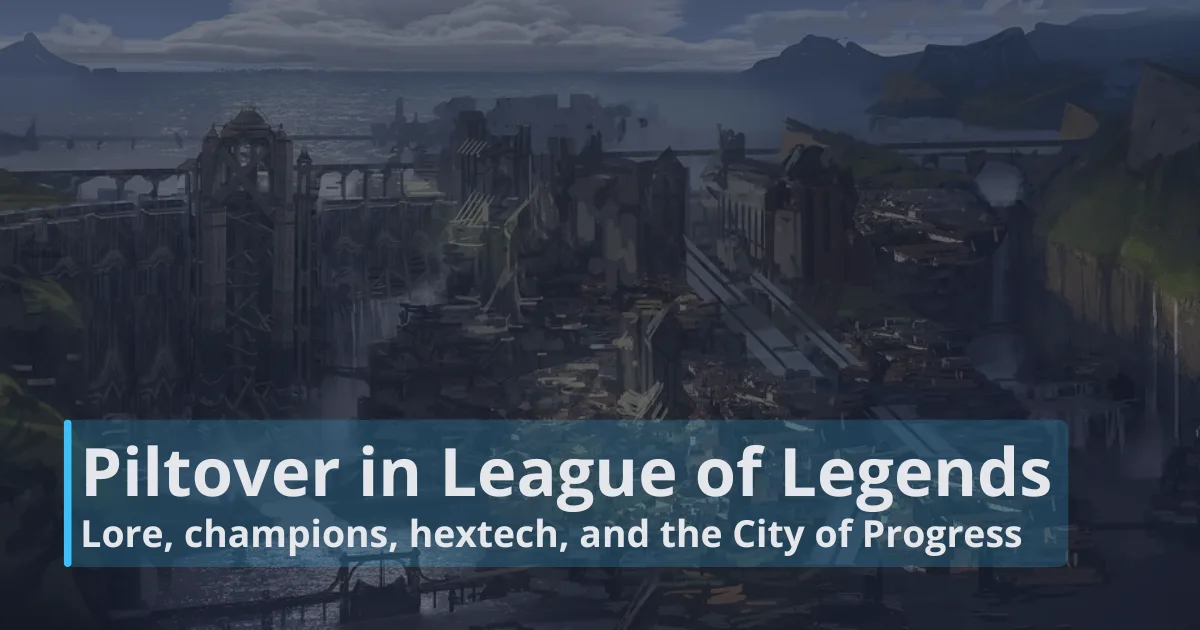
Piltover is the City of Progress in League of Legends, a wealthy coastal metropolis where trade, invention, hextech, and ambition shape almost every part of life. It looks bright, polished, and civilized from above, but Piltover becomes much more interesting once you see the pressure underneath its golden image.
At its best, Piltover rewards brilliance, craftsmanship, discovery, and self-made success. At its worst, it hides inequality behind marble, turns invention into status, and treats progress as proof that the city deserves its power. That tension is why Piltover lore works so well, especially beside Zaun, its darker twin below.
If you want the short version, Piltover is a trade-rich city-state built on invention, merchant clans, hextech, and control of the routes between Valoran and Shurima. That one idea connects almost everything important in the region, from Caitlyn and Jayce to Camille, Ezreal, Heimerdinger, Orianna, Seraphine, Vi, and the city’s uneasy relationship with Zaun.
Piltover at a glance
- What Piltover is: a wealthy city-state known as the City of Progress, built around trade, invention, culture, and hextech.
- What Piltover is known for: hextech, merchant clans, Progress Day, the Sun Gates, the Hexgates, elite workshops, and the upper city above Zaun.
- What drives Piltover lore: the conflict between idealized progress, class division, technological ambition, and the cost paid by those below.
- Why Piltover matters: it turns invention into politics, making the city one of the clearest examples of how progress can inspire and exploit at the same time.

Piltover champions
The fastest way to understand Piltover is through its champions. Each one shows a different side of the city, from law and invention to aristocratic control, celebrity culture, exploration, and the blurred line between human and machine. For official champion bios and profiles, the League of Legends site is the cleanest place to start.
| Champion | Role in Piltover | Why the champion matters |
|---|---|---|
 Caitlyn | Sheriff of Piltover and elite investigator | Caitlyn represents Piltover’s law-and-order ideal, but her stories also expose how hard justice becomes when power protects itself. |
 Camille | Clan Ferros enforcer and hextech aristocrat | Camille shows the hidden blade behind Piltover’s elegance, where family interest, secrecy, and technology merge into one weapon. |
 Ezreal | Explorer, artifact hunter, and Piltovan celebrity | Ezreal turns Piltover’s curiosity outward, linking the city to ancient ruins, distant regions, and the risks of treating history like treasure. |
 Heimerdinger | Yordle inventor and scientific institution figure | Heimerdinger reflects Piltover’s intellectual confidence, but also the caution needed when innovation moves faster than wisdom. |
 Jayce | Inventor, defender, and public face of progress | Jayce is one of Piltover’s clearest symbols, brilliant, proud, useful, and often trapped between invention and responsibility. |
 Orianna | Clockwork girl shaped by sacrifice and illness | Orianna gives Piltover its most delicate body-and-machine story, where compassion and technology become impossible to separate. |
 Seraphine | Pop star who hears the city’s emotional noise | Seraphine shows Piltover through culture, performance, and empathy, especially the emotional distance between topside and the undercity. |
 Vi | Enforcer with deep Zaunite roots | Vi is one of the best bridges between Piltover and Zaun, because her fists serve the law while her past complicates every badge she wears. |
Other champions related to Piltover
Not every important Piltover connection comes from being a Piltovan champion. Some characters haunt the city, protect it, steal from it, exploit it, or reveal how tightly Piltover and Zaun are bound together.
| Champion | Connection to Piltover |
|---|---|
| Akali | Tracked Jhin through Piltover and Zaun, showing how the twin cities can become a stage for foreign conflicts. |
| Blitzcrank | Protects people across the twin cities and gives Piltover’s technology a more compassionate contrast. |
| Graves | Helped pull off a famous Piltover heist and connects the city’s vaults to the criminal confidence of Bilgewater-style rogues. |
| Janna | Protects people around Piltover and Zaun, especially through the older disaster that reshaped the connected cities. |
| Jhin | Carried out a mission in Piltover and Zaun, bringing Ionian violence into the City of Progress. |
| Jinx | Is one of Piltover’s most famous criminals and a direct challenge to Caitlyn, Vi, and the city’s sense of control. |
| Shen | Also pursued Jhin through the twin cities, tying Piltover to wider Kinkou responsibilities. |
| Shyvana | Was born in Piltover before her story moved toward Demacia and its fear of unnatural power. |
| Soraka | Visited Piltover in the past, adding another quiet celestial-adjacent thread to the city’s wider contacts. |
| Tahm Kench | Became more active around Piltover and Zaun after trade expanded, proving that wealth attracts monsters as easily as merchants. |
| Twisted Fate | Joined Graves in robbing Piltover’s secure vaults, exposing how even the city’s confidence can be picked apart. |
| Vex | Came to Piltover and Zaun during Ruination-era events, tying the city loosely to the Shadow Isles. |
| Viktor | Is central to Piltover’s scientific and moral contrast with Zaun, especially through his connection to Jayce and the future of techmaturgy. |
| Ziggs | Met Jinx through shared explosive chaos, giving Piltover a loose but loud link to Bandle City. |
| Zed | Tracked Jhin through Piltover and Zaun, adding shadow-war tension to a city that prefers polished order. |
Piltover lore, hextech, and the promise of progress
Piltover lore begins with a promise: the future can be built. The city believes in invention, trade, research, and visible achievement. A clever mind, a wealthy patron, and the right workshop can change a family’s standing, reshape a market, or move goods across continents. That is the dream Piltover sells to itself.
The problem is that progress in Piltover is never neutral. The city’s greatest inventions are tied to merchant clans, protected research, global trade, and materials taken from beyond its borders. Hextech makes Piltover dazzling, but it also raises uncomfortable questions about who owns power, who benefits from innovation, and who pays the hidden cost.
That is why Piltover works best when read beside Runeterra as a whole. It is not a sealed science city. It sits between continents, pulls wealth through trade, funds expeditions into older lands, and turns distant discoveries into civic pride. The city’s beauty is real, but so is the machinery beneath it.
That mix of genius, ambition, and civic polish is easy to see when Piltover and Zaun share the same stage. Invention can look playful, chaotic, and brilliant all at once, especially when the city’s rules cannot quite contain the people making the future.
The story captures one of Piltover’s sharpest contradictions: the city loves brilliance, but brilliance does not always behave neatly inside expensive walls.
Piltover history, from the Sun Gates to hextech
Piltover’s history is inseparable from Zaun. Before the modern divide became so visually obvious, the connected cities were shaped by an engineering catastrophe that opened a sea route and changed trade across the world. That disaster helped create the conditions for Piltover’s rise, while Zaun bore much of the physical and human damage.
The Sun Gates became the defining symbol of that older history. By controlling the passage between eastern and western seas, Piltover gained access to money, shipping power, and political relevance far beyond its size. Trade with Shurima, routes toward Noxus, and shipping preyed upon by Bilgewater all became part of the city’s wider importance.
Then came hextech. The discovery and development of hex-crystal technology pushed Piltover from wealthy trade city into technological beacon. Clan Ferros, Jayce, Heimerdinger, Camille, and the wider workshop culture all show how tightly invention and social power are connected. In Piltover, a breakthrough is never just a breakthrough. It is also patronage, reputation, competition, and leverage.
Progress Day makes this public. It celebrates the city’s achievements, its trade systems, its inventors, and its belief that tomorrow can be engineered better than today. But Progress Day also reveals the city’s vulnerability. Noxian spies, Jinx’s attacks, vault heists, and political maneuvering all show that Piltover’s confidence attracts enemies from inside and outside its walls.
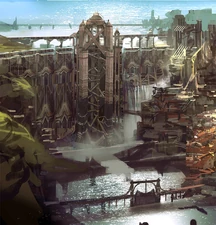
Modern audiences often meet Piltover through the Hexgates, where hextech becomes more than a private invention. It becomes infrastructure, politics, and the city’s claim to a global future.
Once hextech becomes part of trade and transport, Piltover’s story stops being only about inventors. It becomes a question of who gets to direct the future of the entire region.
Piltover and Zaun, the city above and the city below
Piltover cannot be understood without Zaun. The two cities are often described as separate, but that separation is partly a convenient fiction. They share history, geography, trade, family lines, technology, crime, pollution, and resentment. Piltover rises because Zaun exists beneath it, and Zaun keeps reinventing itself in the shadow of Piltover’s wealth.
The upper city likes to present itself as clean, rational, and forward-looking. Zaun reveals what that image leaves out: chemical industry, black markets, dangerous experimentation, and people who cannot afford to pretend progress is gentle. That does not make Piltover fake, but it does make its story incomplete without the undercity.
| Theme | How Piltover presents it | What Zaun reveals |
|---|---|---|
| Progress | Innovation, elegance, civic pride, and breakthrough technology | Unsafe experiments, pollution, smuggling, and people excluded from official success |
| Wealth | Merchant clans, trade routes, grand architecture, and cultural prestige | Labor, survival markets, chemical industry, and the underside of prosperity |
| Law | Wardens, investigators, courts, and protected property | Crime networks, vigilantism, chem-baron power, and distrust of topside authority |
| Technology | Hextech as controlled progress and refined craftsmanship | Chemtech, black-market invention, and riskier forms of practical survival |
| Identity | Piltovan confidence, status, and the belief in upward achievement | Zaunite resilience, resentment, improvisation, and refusal to disappear |
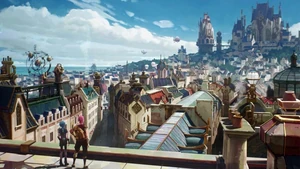
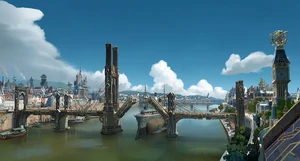
This contrast is also why Piltover connects so strongly to guides and deeper lore reading. The city is not hard to describe, but it is easy to oversimplify. Piltover is not only good, and Zaun is not only bad. Together, they form one of the richest political settings in League of Legends.
Major locations in Piltover
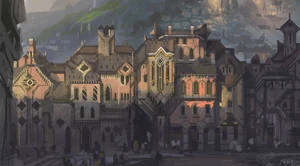
Piltover’s locations tell you what the city values. It has elite neighborhoods, guarded clan compounds, secure vaults, research workshops, museums, docks, theaters, and massive trade infrastructure. Every important place seems to say the same thing: success should be visible.
Bluewind Court and the clan districts
Bluewind Court is where Piltover’s ruling class feels most visible. The great mercantile families keep mansions, workshops, and guarded compounds there, including names tied to Clan Ferros, Clan Kiramman, Clan Medarda, and other power brokers. These clans do not merely own property. They shape what the city researches, funds, protects, and celebrates.
Jayce’s laboratory, Heimerdinger’s workshop culture, the Kiramman and Ferros networks, and the social world of the merchant elite all reinforce Piltover’s central truth: invention needs money, and money wants control.
Vaults, markets, docks, and the Sun Gates
Piltover’s banks and vaults show its confidence. The city believes wealth can be protected by design, engineering, and reputation. That is why heists by Graves, Twisted Fate, and Jinx matter so much. They are not only crimes. They are humiliations against the city’s belief that polished systems cannot be beaten.
The docks and Sun Gates show the city at its most global. Ships from countless ports pass through, carrying accents, goods, rumors, military supplies, and stolen opportunities. Piltover is not a military empire like Noxus, but it does not need to be one. Control of movement can be its own kind of power.
The Boundary Markets and conveyors complicate the idea of a clean divide between Piltover and Zaun. They are places where wealth, labor, invention, and desperation brush against each other. The city above depends on the city below, even when Piltovans prefer not to say that too loudly.
The same is true of newer Arcane-facing locations like the Bridge of Progress, Stillwater Hold, the University of Piltover, and the Hexgates. These places make the city feel more immediate, political, and emotionally charged, especially for readers who entered the setting through the show.

Piltover culture, government, and the clans
Piltover culture is built around self-improvement, craft, competition, and the belief that a person should aspire to do better. The city loves visible success, whether that means a brilliant invention, a secured trade route, a beautiful district, a famous performance, or a prestigious family name. It is optimistic, but not innocent.
The ruling structure is aristocratic and commercial. Power sits with influential clans, wealthy patrons, and councils rather than kings or warlords. That makes Piltover feel more refined than regions like Freljord or Noxus, but not necessarily more equal. A Piltovan with the right backing can change the world. A person without backing may spend their life looking up from below.
Clan Ferros is especially important because it ties Piltover’s wealth to hex-crystals, synthetic alternatives, and the ethical cost of commodifying magical power. Clan Kiramman gives the city law, status, and Caitlyn’s place in its elite structure. Clan Medarda connects Piltover to politics, trade ambition, and the wider world, including uncomfortable links to foreign power.
These families make the city feel less like a neutral laboratory and more like a polished battlefield. Compared with regions shaped by old magic like Targon, hidden civilizations like Ixtal, or apocalyptic threats like the Void, Piltover’s danger is more familiar. It is the danger of people believing their success proves their virtue.

Piltover's relations with other regions
Piltover makes the most sense when viewed as a crossroads. It does not dominate the world through armies, but through access, trade, research, maps, artifacts, and the constant movement of goods. That gives the city connections almost everywhere.
| Region | Piltover's relationship | Why it matters in lore |
|---|---|---|
| Zaun | Twin city, rival, undercity, and hidden foundation | This is Piltover’s most important relationship. The two cities are divided by wealth and status, but tied together by history, technology, labor, and resentment. |
| Shurima | Source of ancient artifacts, trade routes, and exploited resources | Piltover’s explorers and clans look to Shurima for discovery and profit, which makes the desert part of the city’s technological rise. |
| Noxus | Strategic trade partner and looming threat | Noxus relies on Piltover’s position, but that usefulness also attracts spies, pressure, and possible future aggression. |
| Bilgewater | Pirate pressure on Piltovan trade | The same routes that enrich Piltover help Bilgewater thrive as ships become targets for piracy, smuggling, and black-market trade. |
| Demacia | Relatively friendly but cautious | Demacia can respect Piltovan expertise, but the city’s comfort with magical technology creates obvious cultural tension. |
| Ionia | Distant cultural contrast and occasional story overlap | Piltover’s engineered progress contrasts sharply with Ionia’s spiritual balance, especially when Ionian conflicts reach the twin cities. |
| Shadow Isles | Indirect threat through Ruination-era events and Sentinels ties | Piltover is not defined by undeath, but global crises can still reach the city’s champions and criminal networks. |
| Black Rose | Indirect intrigue through Noxian influence | Whenever Noxian politics touch Piltover, hidden networks and spycraft become part of the city’s vulnerability. |
Other regions matter more as comparisons. Camavor and Icathia show what happens when power and obsession collapse into catastrophe. Piltover is not there, but its stories keep asking whether progress without humility could someday move in that direction.
Where to start with Piltover lore
A smart reading path starts with the region overview, then moves to Caitlyn, Vi, Jayce, Camille, Orianna, Heimerdinger, Ezreal, and Seraphine. After that, read Jinx, Viktor, Blitzcrank, and Janna from the Zaun side so the twin-city conflict feels complete instead of one-sided.
Start with the official Piltover region page on Universe. Then use RiftDaily’s broader lore hub and practical guides to connect Piltover to the rest of the setting. Official support questions belong on the League of Legends support site, not in lore archives.
For a broader recap, follow the city’s full arc from trade hub to hextech capital, then compare that polished public story with what Zaun reveals underneath.
Once you understand the trade routes, clans, hextech, and Zaun connection, Piltover stops being just a shiny city and becomes one of Runeterra’s most politically loaded settings.
Frequently asked questions about Piltover
What is Piltover in League of Legends?
Piltover is the City of Progress, a wealthy city-state known for trade, invention, culture, hextech, and powerful merchant clans. It sits above and beside Zaun, which makes the two cities impossible to fully separate in lore.
Why is Piltover called the City of Progress?
Piltover earns that title through its inventions, trade infrastructure, scientific culture, and obsession with improvement. The phrase also carries irony, because the city’s progress often creates or ignores problems beneath the surface.
Who are the main Piltover champions?
The main Piltover champions are Caitlyn, Camille, Ezreal, Heimerdinger, Jayce, Orianna, Seraphine, and Vi. Together, they cover the city’s law, invention, aristocracy, celebrity culture, exploration, and connection to Zaun.
What is hextech in Piltover lore?
Hextech is magical technology refined into tools, weapons, infrastructure, and inventions. In Piltover lore, it represents both the city’s brilliance and the danger of turning rare magical power into a commodity.
How are Piltover and Zaun connected?
Piltover and Zaun are twin cities with shared history, geography, technology, trade, and social tension. Piltover is the wealthy upper city, while Zaun is the undercity shaped by industry, chemtech, pollution, and survival.
What are the most important places in Piltover?
The Sun Gates, Hexgates, Bluewind Court, Boundary Markets, Piltover’s elite workshops, the Bridge of Progress, the University of Piltover, and major vaults all matter because they show the city’s mix of trade, invention, class, and control.
Is Piltover good or bad?
Piltover is not simply good or bad. It is ambitious, creative, wealthy, and culturally impressive, but it is also unequal, self-protective, and often blind to the cost of its progress. That complexity is what makes Piltover lore interesting.
Why Piltover still feels ahead of the curve
Piltover lasts as a region because it turns progress into a story conflict. The city is beautiful, inventive, and genuinely important, but it is never as clean as it wants to appear. Its champions give you investigators, inventors, performers, aristocrats, explorers, and enforcers, all trying to live inside a system that rewards brilliance while protecting power.
The best way to read Piltover is not as a perfect city of science or a shallow symbol of privilege. Read it as a place where every breakthrough creates a new question. Who funded it? Who controls it? Who benefits from it? Who was ignored so the city could call it progress? That is what makes Piltover champions and Piltover lore worth revisiting, whether you continue through RiftDaily’s guides, the wider lore hub, or the deeper twin-city story around Zaun.