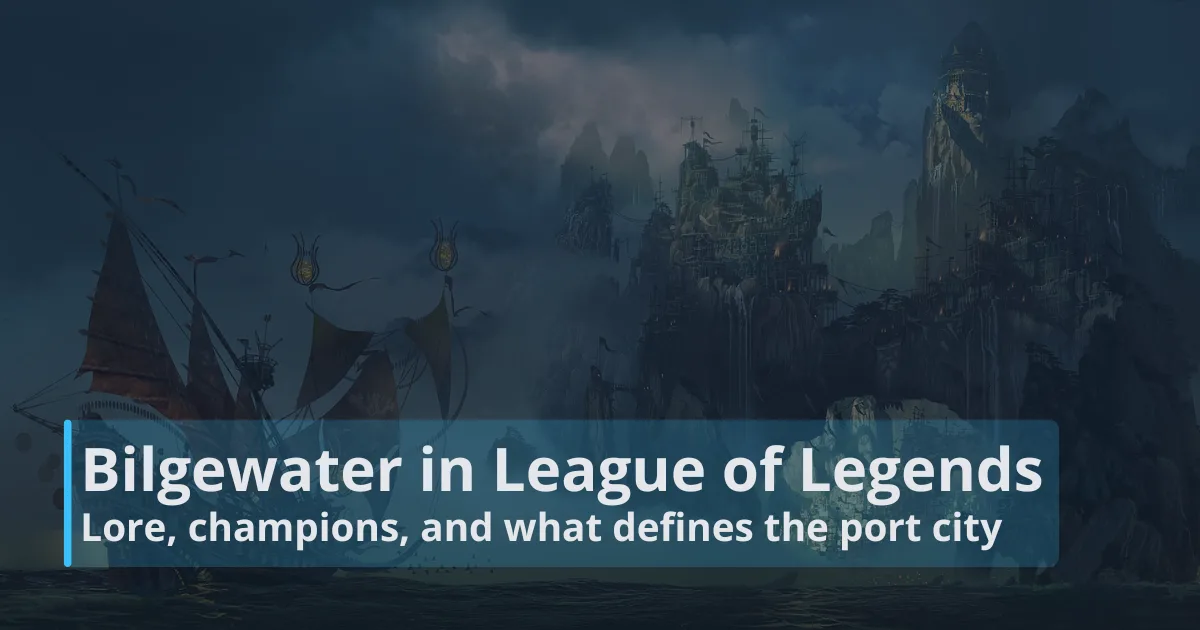
Bilgewater is League of Legends' lawless pirate port, a city of monster hunters, smugglers, crime lords, and second chances built on the dangerous waters of the Serpent Isles. It looks like a simple haven for thieves and captains at first, but Bilgewater becomes much more interesting once you see how survival, trade, faith, and violence all shape the same place.
At its best, Bilgewater rewards nerve, adaptability, and ambition in ways more rigid regions never could. At its worst, it turns every alley, dock, and deal into a test you might not survive. That contradiction is why Bilgewater lore works so well. It is chaotic on the surface, but it still has a real identity underneath the gunpowder and saltwater.
If you want the short version, Bilgewater is a pirate-run port city where wealth, danger, sea-monster hunting, and black-market trade all collide. That one idea connects almost everything important in the region, from Miss Fortune and Gangplank to Illaoi, Pyke, Twisted Fate, Graves, and the yearly fear of the Harrowing.
Bilgewater at a glance
- What Bilgewater is: a lawless port city in the Serpent Isles where captains, gangs, traders, and hunters compete for power and profit.
- What Bilgewater is known for: pirate crews, slaughter docks, sea-monster hunting, black markets, Buhru influence, and shifting criminal alliances.
- What drives Bilgewater lore: the clash between opportunity and brutality, especially after Gangplank's fall and Miss Fortune's rise.
- Why Bilgewater matters: it turns a classic pirate setting into one of Runeterra's most lived-in and politically unstable regions.
Bilgewater champions
The fastest way to understand Bilgewater is through its champions. Together they show the city as a hunting ground, a crime hub, a religious crossroads, and a place where charisma can matter just as much as firepower. For official champion bios and profiles, the League of Legends site is the cleanest place to start.
| Champion | Role in Bilgewater | Why the champion matters |
|---|---|---|
 Fizz | Ancient trickster tied to Bilgewater's waters | Fizz adds old magic and unpredictable danger to a region that already lives on the edge of the sea. |
 Gangplank | Dethroned reaver king and old ruler of the port | Gangplank is central to Bilgewater lore because the city's modern power struggle begins with his downfall and survival. |
 Graves | Outlaw gunslinger and street-level survivor | Graves keeps Bilgewater grounded in scams, grudges, and the kind of personal chaos that can ignite city-wide trouble. |
 Illaoi | Kraken priestess of Nagakabouros | Illaoi matters because she ties Bilgewater to the Buhru and gives the region a spiritual core stronger than its pirate image suggests. |
 Jack | Pit-fighter and dockside power broker | Jack represents Bilgewater's bruising underworld, where prizefights, gambling, and local muscle can turn into real influence. |
 Miss Fortune | Bounty hunter and claimant to rule Bilgewater | Miss Fortune is the clearest face of modern Bilgewater, a ruler shaped by revenge, ambition, and the need to hold a lawless city together. |
 Nautilus | Titan of the deep and terror of the harbor | Nautilus makes Bilgewater feel older and more mythic, where unpaid debts can sink into something supernatural. |
 Tahm Kench | Demon of greed and ruin in Bilgewater's waterways | Tahm Kench captures the region's appetite for bad deals, indulgence, and danger disguised as opportunity. |
 Pyke | Undead harpooner stalking the docks | Pyke shows the city at its most paranoid, where betrayal never really stays buried and the sea keeps its own list of names. |
 Twisted Fate | Cardsharp swindler and high-stakes opportunist | Twisted Fate embodies Bilgewater's talent for reinvention, where style, nerve, and deceit can be worth more than loyalty. |
Other champions related to Bilgewater
Not every important Bilgewater connection comes from citizenship. Some champions defend the port, haunt its waters, or pass through it because no other city in the world offers the same mix of danger and access.
| Champion | Connection to Bilgewater |
|---|---|
| Ahri | Traveled to Bilgewater with Yasuo while following clues tied to the Vesani and the Shadow Isles. |
| Braum | Washed ashore in Bilgewater during his search for a cure and became tied to the Ruined King story. |
| Camille | Learned grappling techniques from natives of the Serpent Isles, giving Bilgewater a quiet link to her past. |
| Hecarim | Attacked Bilgewater during the Harrowing and helped make Grey Harbor one of the region's grimmest places. |
| Janna | Protects sailors around the Serpent Isles and adds another layer to Bilgewater's maritime mythology. |
| Kalista | Her vengeance myth reaches Bilgewater, where betrayal is common enough to keep her legend alive. |
| Karthus | Attacked Bilgewater shipping and reinforces the port's vulnerability to undead terror. |
| Lucian | Defended Bilgewater against the Black Mist and links the city directly to the Sentinels of Light. |
| Olaf | Fought in Bilgewater during the Harrowing and fits naturally into the port's monster-hunting culture. |
| Ryze | Visited Bilgewater while searching for passage east during his hunt for the World Runes. |
| Swain | Has a lasting grudge against Gangplank after the theft of the Leviathan. |
| Thresh | Struck Bilgewater during the Harrowing and later played a key role in the Ruined King storyline. |
| Yasuo | Reached Bilgewater alongside Ahri and became part of its Shadow Isles conflict. |
| Yuumi | Traveled through Bilgewater during her search for Norra, which suits the city's role as a crossroads. |
| Zed | Holds a grudge against Gangplank after the pirate ransacked the Temple of the Jagged Knife in Ionia. |
What Bilgewater is in lore
Bilgewater is one of the clearest examples of how a region can feel free and predatory at the same time. It is a place where laws barely matter, but reputation matters a lot. A captain, hunter, gambler, or smuggler can build a new life there, yet that same freedom means nobody is guaranteed safety for long.
That is what makes Bilgewater more than a pirate cliché. It is not just a city of ships and crime. It is also a marketplace, a monster-hunting economy, a religious crossroads, and one of the most culturally mixed corners of Runeterra. Bilgewater absorbs people from everywhere because almost anything can be sold there, and almost anyone can vanish there.
Bilgewater lore also works because the city has no simple moral center. Miss Fortune is not purely heroic. Gangplank is not the only source of cruelty. Even the city's strongest traditions mix practical survival with opportunism. That gives Bilgewater a rougher, more believable texture than many fantasy ports.
That unstable mix of swagger, suspicion, and opportunity is exactly what this Bilgewater short captures so well.
Bilgewater stories almost never stay simple for long. Every favor, grudge, and deal usually hides one more move behind it.
Bilgewater history, from the Serpent Isles to Burning Tides
Bilgewater did not begin as a pirate capital. Long before the modern port took shape, the wider Serpent Isles were home to the Buhru, whose spiritual life and knowledge of the sea still define the region more than outsiders usually realize. That older layer matters because Bilgewater was built on top of something deeper than crime, a sacred maritime culture with its own gods, rituals, and understanding of motion, fate, and strength.
Over time, traders, outcasts, raiders, and fortune-seekers turned the harbor into a city where legal order mattered less than leverage. Ships moving between continents made Bilgewater profitable, and monster hunting made it indispensable. That is how Bilgewater grew into the most infamous port in the world, part frontier, part marketplace, part slaughterhouse.
The most important modern turning point is still Burning Tides. Gangplank looked untouchable until Miss Fortune set in motion the revenge she had planned for years. His ship exploded, his power network fractured, and the city rushed into a new era of gang war and unstable leadership. Bilgewater lore becomes much easier to follow once you understand that almost every current power struggle traces back to that moment.
That chaos did not stay local. The Harrowing from the nearby Shadow Isles repeatedly turned Bilgewater into the first line of defense against the Black Mist, and the later return of Viego dragged the port even deeper into the legacy of Camavor. Bilgewater is one of the best places to see how a supposedly local pirate story can expand into a world-scale crisis.
If you want a longer recap before you dive into the individual stories, this overview helps connect Bilgewater's crime politics, sea culture, and champion arcs into one timeline.
Bilgewater history is easier to remember once Gangplank, Miss Fortune, the Harrowing, and the port's sea-monster economy are all tied together.
Major locations in Bilgewater
Bilgewater feels richer once you stop imagining it as one generic pirate dock. The region is a cluster of markets, slums, bridges, slaughter yards, grave waters, hidden grottos, sacred temples, and black-market inlets that all serve different parts of the same brutal economy.
Bilgewater Bay, Rat Town, and the Slaughter Docks
Bilgewater Bay is the heart of the city, but Rat Town and the Slaughter Docks are where the place really explains itself. Rat Town channels Bilgewater's crowded, half-rotting urban energy, while the Slaughter Docks show the economic engine underneath it all. Every night fleets head out to hunt monsters. If they return, those creatures are rendered into meat, oil, bone, armor, and profit.
Butcher's Bridge, Fleet Street, Cutpurse Square, the black market grottos, MacGregan's Killhouse, White Wharf, and the old site of Gangplank's warehouses all add texture to the port. These are not decorative names. Each one tells you something about Bilgewater's values, commerce without restraint, spectacle without mercy, and death treated as another part of city traffic.
Grey Harbor matters too. Lost to the Mist years ago, it sits at the edge of Bilgewater's overlap with the dead. It reminds you that the city is not only threatened by pirates and captains, but also by the supernatural geography around it.

Buhru and the Temple of the Mother Serpent
Buhru is essential if you want more than the tourist version of Bilgewater. The Serpent Isles were never just a pirate playground. They were, and still are, shaped by the people whose knowledge of the sea made survival possible there in the first place. The Temple of the Mother Serpent, dedicated to Nagakabouros, gives the region a spiritual center that the docks alone cannot explain.
That contrast matters. Bilgewater thrives on opportunism, but Buhru faith is about motion, strength of will, and not being trapped by fear or stagnation. Illaoi makes far more sense once you place her against the port around her. She is not a random priestess in a pirate town. She is a reminder that Bilgewater still sits inside a much older cultural world.
Bilgewater culture, monster hunting, and the Buhru
Bilgewater culture is built on hustle, violence, improvisation, and survival. People carry weapons because they expect trouble. Captains build authority because nobody else will do it for them. A good day can make you rich, and a bad one can leave you floating in the harbor by morning. That constant pressure is part of the region's appeal. Bilgewater does not pretend life is fair.
Monster hunting is the clearest expression of that worldview. Bilgewater does not only fear the sea. It profits from it. Huge creatures become dock work, trade goods, weapons, iconography, and status. Even the look of the city, with bones, hooks, hulls, harpoons, and trophies everywhere, comes from that relationship.
The Buhru complicate the picture in the best way. Their influence means Bilgewater is not spiritually empty. Nagakabouros, the Mother Serpent, gives the region a philosophy of motion and testing that feels very different from the heavenly symbolism of Targon or the clean legal certainty associated with Demacia. Bilgewater can be crude, but it is not shallow.
It is also one of the most mixed places in the setting. Traders from Shurima, raiders with roots in the Freljord, smugglers moving illicit hextech from Piltover and contraband from Zaun, and wanderers from stranger places all pass through the same docks. That is part of why Bilgewater feels so alive. It is always absorbing someone else's problem and turning it into local business.
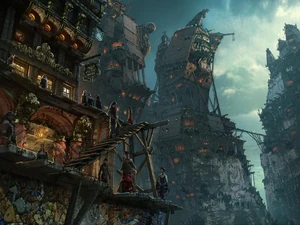
The city also loves stories, omens, tavern myths, and dangerous bargains. That is why Tahm Kench feels so natural there. Bilgewater is the kind of place where a demon of appetite would not only survive, but become part of local language.
Bilgewater's relations with other regions
Bilgewater becomes much easier to understand once you compare it with the rest of the world. It is not organized enough to behave like a classic nation-state, but it still has clear regional patterns. Some places feed its trade, some threaten it, and some define Bilgewater by contrast.
| Region | Bilgewater's relationship | Why it matters in lore |
|---|---|---|
| Shadow Isles | Nearest supernatural threat | Bilgewater is usually the first major region hit by the Harrowing, which makes undead danger part of local memory rather than distant myth. |
| Noxus | Shaky maritime enemy and occasional business partner | Gangplank's theft of the Leviathan made the relationship personal, but Bilgerat captains will still work with Noxians when profit outweighs loyalty. |
| Ionia | Region wounded by Bilgewater opportunism | Bilgewater pirates exploited the chaos of the Ionian war, and that history left bitterness that goes beyond ordinary raiding. |
| Piltover | Source of illicit technology and trade opportunity | Bilgewater's black markets thrive on stolen or outlawed goods moving through routes tied to Piltover and the Sun Gates. |
| Zaun | Natural contraband partner | Bilgewater's anything-for-sale economy makes it a logical destination for Zaunite inventions, chemicals, and morally questionable goods. |
| Freljord | Trade contact and occasional source of hard travelers | Bilgewater sees Freljordian fishers, warriors, and drifters often enough that the northern link feels practical, not theoretical. |
| Ixtal | Older cultural echo and dangerous frontier | The Serpent Isles preserve traces of older westward migration, and Bilgewater treasure-seekers still disappear when they push too far toward Ixtal. |
| Demacia | Useful moral opposite | Demacia values public order and inherited law, while Bilgewater runs on improvisation, reputation, and survival. The contrast makes both places clearer. |
Some connections are looser, but still useful. Bilgewater hears stories and sees goods from all across Runeterra, including relic rumors tied to Icathia, whispered horror about the Void, and schemes that may intersect with networks as secretive as the Black Rose. It also attracts strange travelers from Bandle City, which suits a port where the unbelievable usually gets treated as one more business opportunity.
Where to start with Bilgewater lore
A good reading path starts with the region overview, then moves into Miss Fortune, Gangplank, Illaoi, Pyke, Twisted Fate, Graves, and Nautilus. That sequence gives you Bilgewater's power struggle, religion, street-level survival, supernatural terror, and seafaring mythology without losing the thread.
Start with the official Bilgewater region page. Then use your own guides and broader lore hub to connect Bilgewater to monster-hunting stories, the Harrowing, and the wider world.
Frequently asked questions about Bilgewater
What is Bilgewater in League of Legends?
Bilgewater is a lawless port city in the Serpent Isles known for piracy, monster hunting, black-market trade, and brutal competition between gangs and captains. It is one of the most dangerous and opportunity-rich regions in the setting.
Who rules Bilgewater?
Bilgewater does not have a stable state government in the usual sense. Gangplank once dominated the city's power structure, and Miss Fortune later claimed rule, but Bilgewater is still shaped by captains, gangs, and shifting alliances.
Who are the main Bilgewater champions?
Miss Fortune, Gangplank, Illaoi, Pyke, Twisted Fate, Graves, Nautilus, Tahm Kench, and Fizz are the best starting points. Together they cover Bilgewater's politics, faith, scams, supernatural danger, and life at sea.
Why is Bilgewater so important in lore?
Bilgewater matters because it connects many parts of the setting at once. It is a major trade port, a monster-hunting economy, a Harrowing target, a refuge for criminals, and the center of the Burning Tides storyline.
What is the Harrowing in Bilgewater?
The Harrowing is when the Black Mist rolls out from the Shadow Isles and attacks the living. Bilgewater is usually hit first because of its location, which is why undead threats are part of everyday fear in the city.
What is the role of the Buhru in Bilgewater?
The Buhru are the indigenous people of the Serpent Isles and the spiritual heart of the region. Their faith in Nagakabouros, their seafaring knowledge, and their traditions shape Bilgewater more deeply than many outsiders realize.
Where can I check official support information related to League content?
For account help, event questions, and live game support, use the official Riot support site rather than lore pages or fan summaries.
Why Bilgewater keeps stealing the spotlight
Bilgewater keeps working as a region because it mixes pirate fantasy with real tension. It gives you monster hunts, revenge stories, religious force, black-market energy, and one of the sharpest local power struggles in the setting. Very few places feel this lively while still feeling this dangerous.
The best way to read Bilgewater is not as a city without rules, but as a city with harsher rules than most people notice at first. Strength, luck, timing, fear, and reputation all matter there. That is what makes Bilgewater lore and Bilgewater champions worth revisiting, whether you continue through RiftDaily's guides or explore more through the site's broader lore coverage.