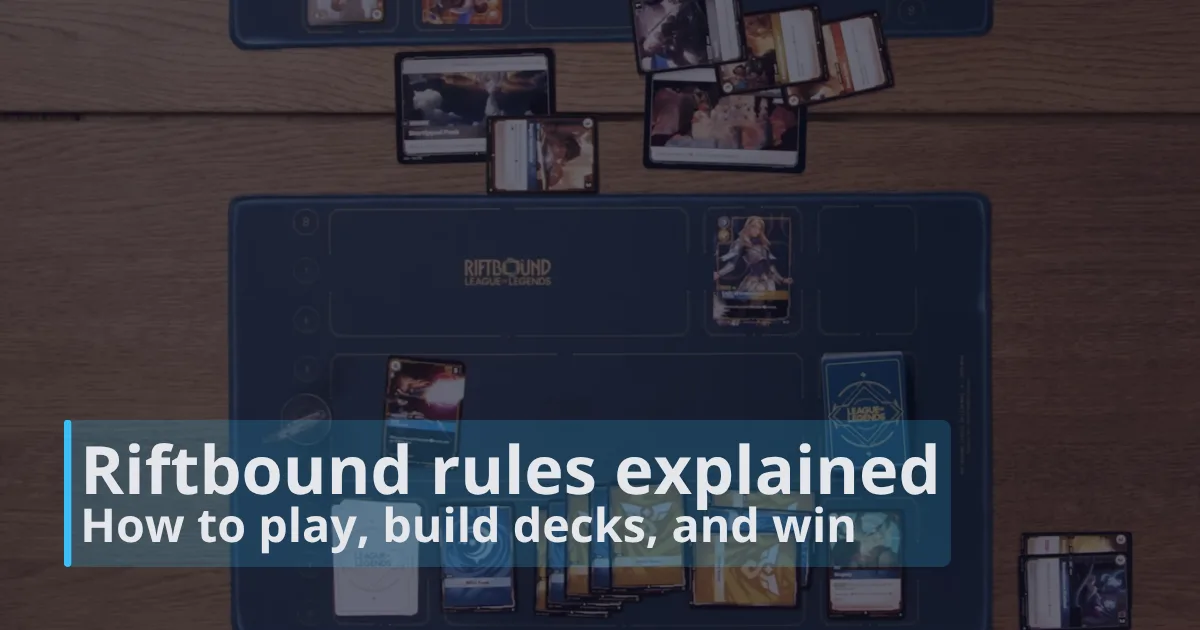
Riftbound rules are easier to learn when you understand the core loop: build around a champion legend, channel runes to pay for cards, send units to battlefields, and score by conquering or holding those locations. The game is about controlling battlefields, not reducing an opponent’s life total.
This beginner-friendly guide explains how to play Riftbound, then covers combat, deckbuilding, champion abilities, keywords, multiplayer, equipment, sealed play, and official card interactions. For exact technical wording, use the official Riftbound Rules Hub and its Core Rules document.
Riftbound rules at a glance
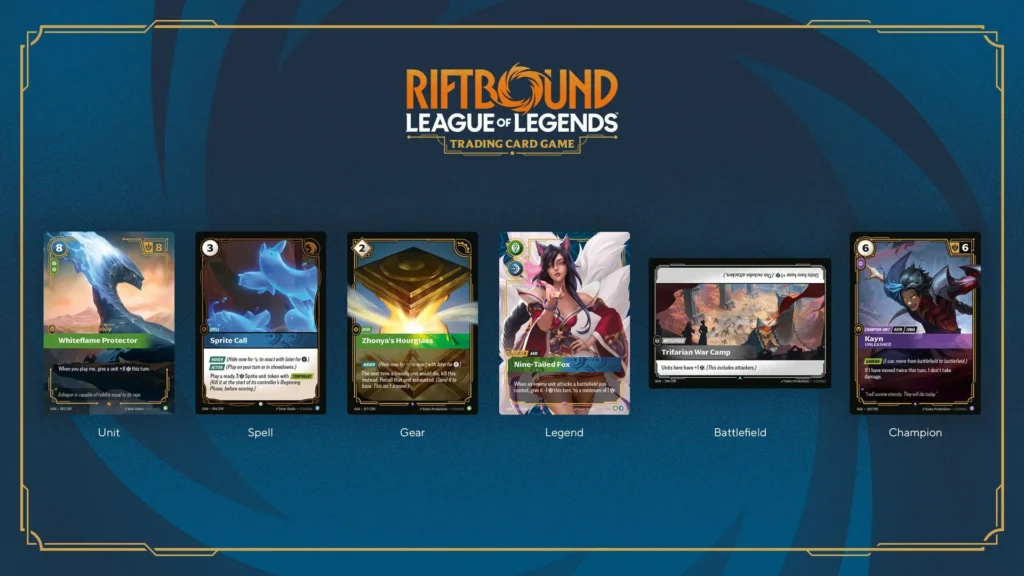
- Build a deck with one champion legend, a 12-card rune deck, a main deck, a chosen champion, and the battlefields required by your format. Casual Core Rules allow at least 40 main-deck cards; sanctioned Constructed tournaments require exactly 40.
- Start with four cards. You may set aside up to two, draw that many replacements, and then recycle the set-aside cards.
- Begin each turn with Awaken, Beginning, Channel, Draw (ABCD), followed by the Main Phase.
- Use ready units to move to battlefields, fight for control, and trigger conquer or hold scoring.
- The normal victory target is eight points. In 2v2 Magma Chamber, teams play to eleven. The final point from conquering has an extra condition.
Quick answer: In Riftbound, players score points by taking control of battlefields or keeping control until their Beginning Phase. You usually win at eight points, but a conquer that would give the final point only awards that point after you have scored every battlefield that turn. Otherwise, you draw a card instead.
How to play Riftbound, from setup to your first turn
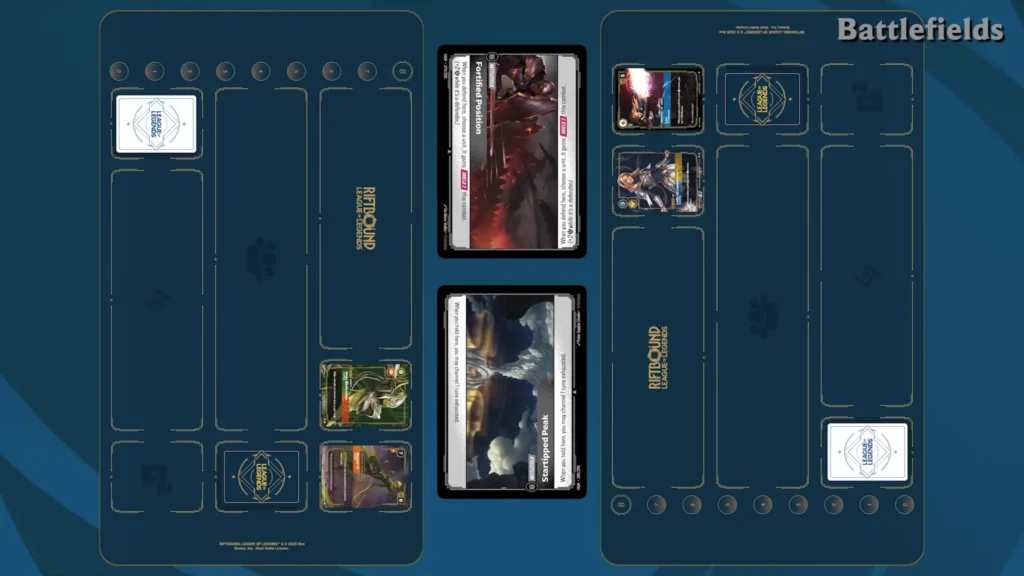
Place your champion legend in the Legend Zone and your chosen champion in the Champion Zone. Shuffle the main deck and rune deck separately. Set out the battlefields selected by the game mode, then determine turn order. Your base is where your runes and most newly played gear live, and where units usually begin before moving into battle.
Your chosen champion is not automatically on the board. It starts in its own zone and can be played when you can pay its cost. Once it leaves that zone, it follows the normal rules for cards in play and in other zones.

Opening hand and mulligan rules
- Draw four cards from your main deck.
- Choose zero, one, or two cards from your opening hand and set them aside.
- Draw the same number of replacement cards before recycling the set-aside cards.
- Recycle the cards you set aside to the bottom of the main deck, following the normal recycle procedure.
The order matters. You do not first put the unwanted cards on the bottom and then draw replacements. In a standard 1v1 game, the second player also channels one extra rune during their first Channel Phase. Riot’s official learn-to-play guide is a useful visual companion.
The ABCD turn structure
| Step | What happens | What beginners should remember |
|---|---|---|
| Awaken | Ready game objects you control that can be readied. | Ready means available; exhausted means already spent. |
| Beginning | Resolve start-of-Beginning effects, then hold battlefields you control during the scoring step. | You can score for keeping a battlefield before you channel or draw. |
| Channel | Channel two runes from the rune deck, if available. | Runes enter your base and pay card and ability costs. |
| Draw | Draw one card from your main deck. | If your deck is empty, apply the Burn Out rules. |
| Main Phase | Play cards, activate abilities, and standard move units when legal. | Your actions can open showdowns, combat, and reaction windows. |
| Ending Phase | Resolve end-of-turn procedures and effects. | Damage is healed from surviving units at the proper cleanup. |
Ordinary units enter exhausted unless a card changes that rule. Ordinary gear enters ready. You may perform several legal actions in your Main Phase, but a standard move is not allowed during an ongoing showdown or combat. For a reference beyond the ABCD mnemonic, consult the Core Rules, sections 314–317.
This learn-to-play walkthrough is helpful when you want to see the card zones, battlefield layout, and action flow in motion.
Riftbound battlefield rules, conquer rules, and combat
Battlefields are both your main objectives and your combat locations. A ready unit may make a standard move from your base to a battlefield or from a battlefield back to your base. Doing so exhausts it. A unit with Ganking also has the option to standard move from one battlefield to another; Ganking does not grant a free extra move.
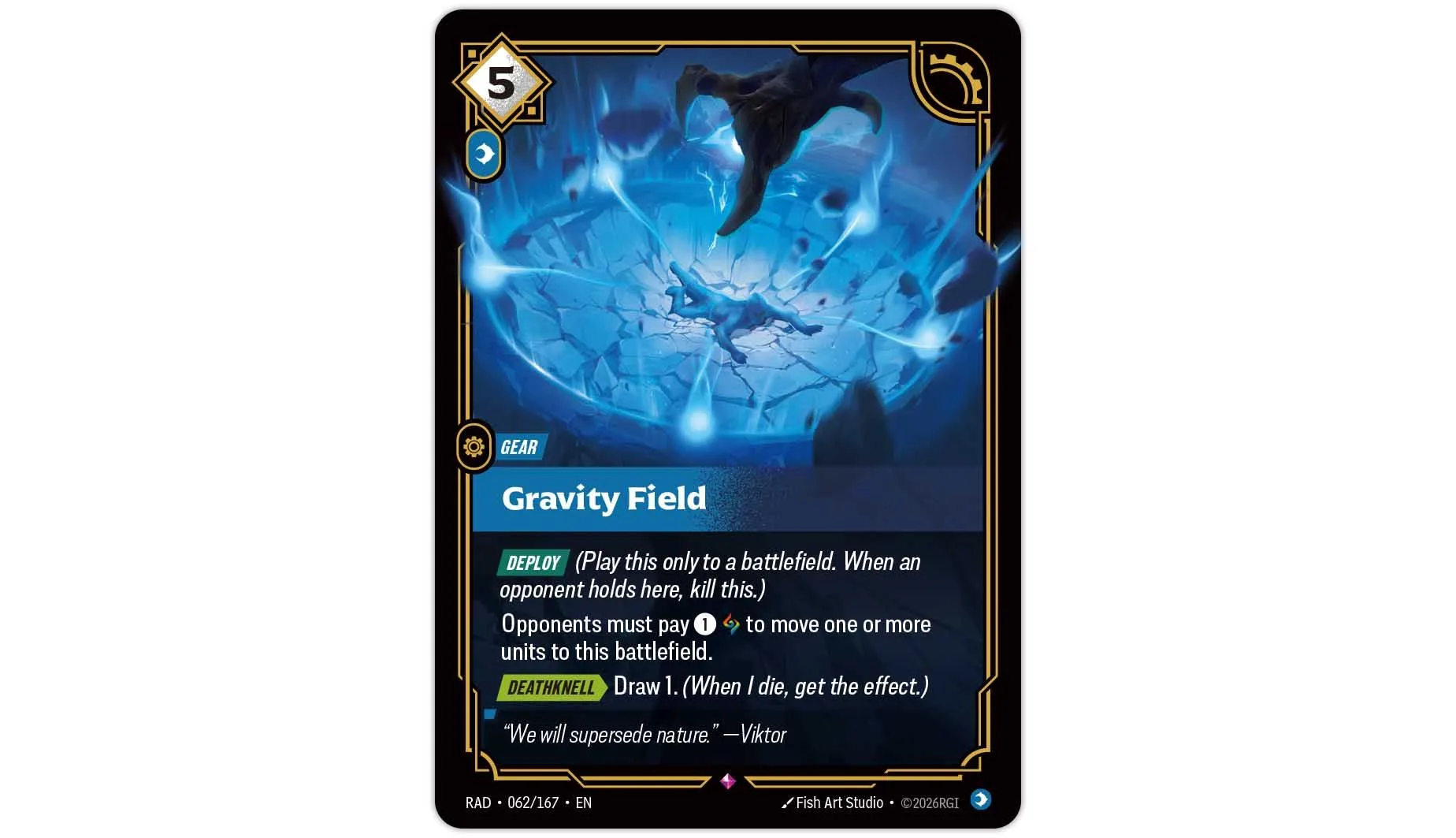
You may standard move multiple ready units simultaneously to the same destination, provided the movement is legal and you pay all associated costs. Some effects make particular moves impossible or add costs. Those restrictions matter before any unit is exhausted, as the official Gravity Field ruling demonstrates.
Showdown versus combat
Moving to an uncontrolled, unoccupied battlefield can open a non-combat showdown. The game provides a response window before control is established. If units from opposing players are at the same battlefield, a combat occurs, and combat includes a showdown. In multiplayer, only two players can participate in the same combat, although other players can interact when they have a legal opportunity.
During combat, each side uses the Might of its units to assign damage according to the combat rules. A unit that has lethal damage marked on it is killed. Damage to surviving units is healed during combat cleanup and at the end of each player’s turn, rather than carrying over indefinitely.
Example: A unit with 4 Might can deal 4 combat damage and needs at least 4 damage marked on it to be killed under normal circumstances. If several units are present, damage assignment, abilities, and prevention effects can change the result, so do not treat every fight as a simple one-unit comparison. See Riot’s gameplay guide and combat rules for the full sequence.
How conquering, holding, and the final point work
| Situation | Rule | Typical result |
|---|---|---|
| Conquer | Take control of a battlefield you have not scored this turn. | Score that battlefield and normally gain 1 point. |
| Hold | Control a battlefield during your Beginning Phase scoring step, without having scored it that turn. | Score that battlefield and normally gain 1 point. |
| Repeat scoring | Each battlefield can be scored only once per player per turn, subject to team rules. | You cannot repeatedly farm the same location in one turn. |
| Final point by conquer | You must have scored every battlefield that turn for conquer to award the final point, subject to specific team exceptions. | If not, you draw 1 instead of gaining that point. |
| Final point by hold | The conquer-specific restriction does not apply to holding. | A hold can provide the winning point. |
Winning example: In a duel with two battlefields, you have seven points and conquer just one battlefield. If you have not scored the other battlefield this turn, you draw a card instead of receiving your eighth point. If you have scored both battlefields that turn, the qualifying conquer can give you the final point. Holding a battlefield at the start of a later turn offers another route to victory.
The default victory score is eight, and the game checks winning conditions during cleanup. Card effects can also grant points, so scoring a battlefield and gaining points are related but not identical rules concepts. The Core Rules, sections 193 and 469, define the exact distinctions.
Riftbound deckbuilding rules and signature spell basics
Your champion legend determines your deck’s domain identity. Cards with no domain can go in decks of any domain identity; cards with one or more domains must satisfy the legend’s domain restrictions unless a special rule or card effect says otherwise. Your chosen champion must normally be a champion unit with the same champion tag as your legend.
| Deck component | Core Rules for regular play | Sanctioned Constructed play |
|---|---|---|
| Champion legend | One legend determining domain identity. | One legal registered legend. |
| Main deck | At least 40 cards, including the chosen champion. | Exactly 40 cards, including the chosen champion. |
| Chosen champion | One matching champion unit in the Champion Zone at setup. | A legal matching champion unit, counted within the 40 cards. |
| Rune deck | Exactly 12 runes matching your domain identity. | Exactly 12 legal runes. |
| Battlefields | Number supplied and used depends on the game mode; names must not duplicate within your set. | Typically three distinct battlefields registered per player, with selections determined by the mode. |
| Copy and signature limits | Up to three of each named main-deck card, including the chosen champion; no more than three signature cards total that match your legend. | Normal construction limits also apply across registered main deck and sideboard, subject to event rules. |
A chosen champion counts toward the normal three-copy limit of its exact card name. For example, choosing one copy as your champion generally leaves room for at most two more copies with that same name in your main deck. Different cards portraying the same character can still have different card names.
Signature cards are subject to a combined three-card limit, not three copies of every available signature card. Many players build around a legend’s signature spell, but that is a deckbuilding choice, not a requirement to run three copies. See our Riftbound hub and Origins guide for related cards and strategies.
For official events, card legality also matters: the Rules Hub maintains format-specific banned cards, battlefields, and 2v2 restrictions. A card can satisfy the normal deckbuilding rules and still be illegal in a particular sanctioned event.
Runes, energy, and power
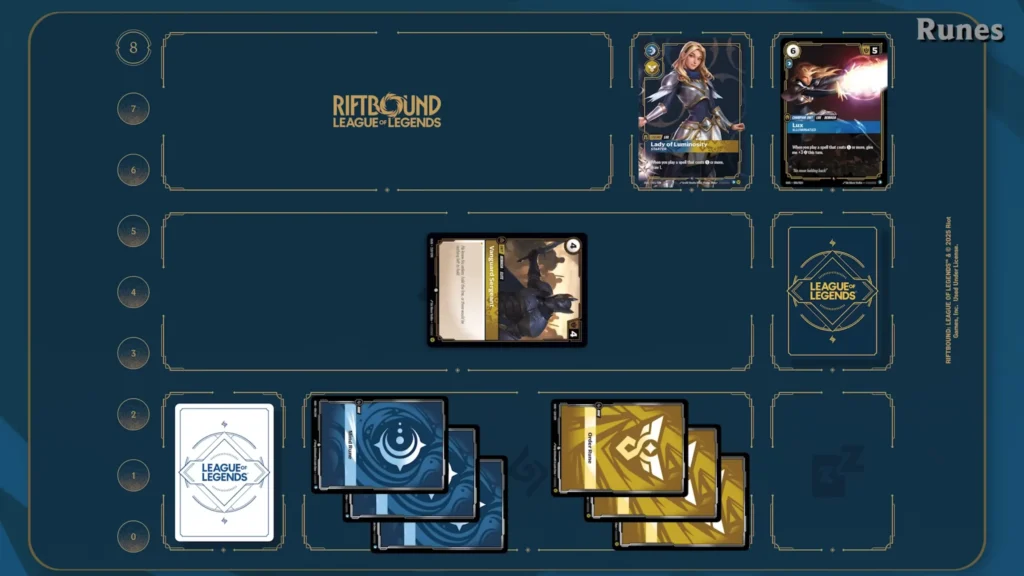
Runes produce the resources that pay for cards. Energy pays the numbered portion of a cost, and power pays domain-symbol costs. A rune can be exhausted to add energy or recycled to produce its corresponding domain power. An exhausted rune may still be recycled for power, so the same rune can contribute energy and then leave your base to help with a power cost.
Recycling sends a rune back to the bottom of the rune deck rather than permanently removing it. Resource planning matters because the runes you recycle are no longer on your board until you channel them again. Unspent energy and power do not carry indefinitely between turns.

Riftbound equipment and Deploy gear rules
Gear normally enters ready in your base. Equipment is gear identified by the Equipment tag. Equipment may have the Equip ability, which lets you pay its listed cost to attach it to a unit you control; attached equipment can provide effect text and a Might bonus. Quick-Draw on eligible gear lets you play and attach it at reaction timing.
Ordinary unattached non-unit gear that ends up at a battlefield is generally recalled to its controller’s base during cleanup. However, Deploy is an important exception: Deploy gear can be played to battlefields and remain there, changing how a location works. If an opponent holds its battlefield, the Deploy gear is killed under the Deploy rules.
There is also a useful advanced interaction: when an attached Equipment becomes a unit through a card such as Orianna, Lady of Clockwork, it detaches because units cannot remain attached to other game objects. Riot explains that interaction in the Radiance Core Rules patch notes.
Champion abilities and important Riftbound keywords
A champion legend stays in your Legend Zone and supplies your deck identity plus its own abilities. A chosen champion is a champion unit set aside in the Champion Zone; you play that unit like a card when permitted. The abilities printed on these cards still follow timing and cost rules, unless the card explicitly changes them.
| Keyword or rule | Plain-English meaning |
|---|---|
| Reaction | Allows a card or ability to be played at designated reaction opportunities, including responses on the chain. |
| Ganking | Adds battlefield-to-battlefield movement as an option for a unit’s standard move. |
| Hidden | Pay one power of any domain to hide a qualifying card face down at a battlefield you control; from the next turn, you may play it with Reaction and ignore its base cost, subject to restrictions. |
| Equip / Quick-Draw | Equip attaches eligible gear to a friendly unit for a cost; Quick-Draw enables a play-and-attach reaction. |
| Deploy | Lets gear be played to a battlefield and remain there, with special rules when an opponent holds that location. |
| Disarm | On the first attack each combat, a unit with Disarm gives an enemy unit at its battlefield a Might reduction for the turn; the number indicates the amount. |
| Show Off | Reveal a qualifying card from hand or identify a qualifying friendly object on the board. The referenced characteristics are locked in at the time it is shown off. |
Two card-reading rules prevent many mistakes. First, the Golden Rule says a card can override the general rules when it fundamentally contradicts them. Second, wording that forbids an action generally beats wording that permits the same action. Always read the current errata wording rather than relying only on what is printed on an older card.
Official Riftbound rules clarifications and card rulings
Riot’s Radiance Rules FAQ and Clarifications is a set of official rulings on situations that are easy to misplay. These examples supplement the Core Rules rather than replacing the entire rulebook. They are especially useful because the result can depend on who performs an action, when a cost is paid, or which effect applies first.
Which Riftbound rules document takes precedence?
- Check the Rules Hub for the currently applicable Core Rules, Tournament Rules, errata, and format restrictions.
- Use the official card errata when printed wording has been corrected, and apply the card-text-over-general-rules principle where appropriate.
- For a specific unresolved interaction, apply Riot’s official Radiance FAQ ruling. Riot explicitly states that its FAQ takes precedence over conflicting parts of the Core Rules document on which it was issued.
- When Riot releases a newer Core Rules document, that document takes precedence over points where it differs from this FAQ. In a sanctioned event, also follow the applicable Tournament Rules and judge instructions.
This is not permission to ignore card text or tournament rules. It is an order for checking authoritative material when apparently reasonable readings lead to different outcomes. Riot’s Radiance patch notes and the FAQ should be read alongside the current Core Rules, not in place of them.
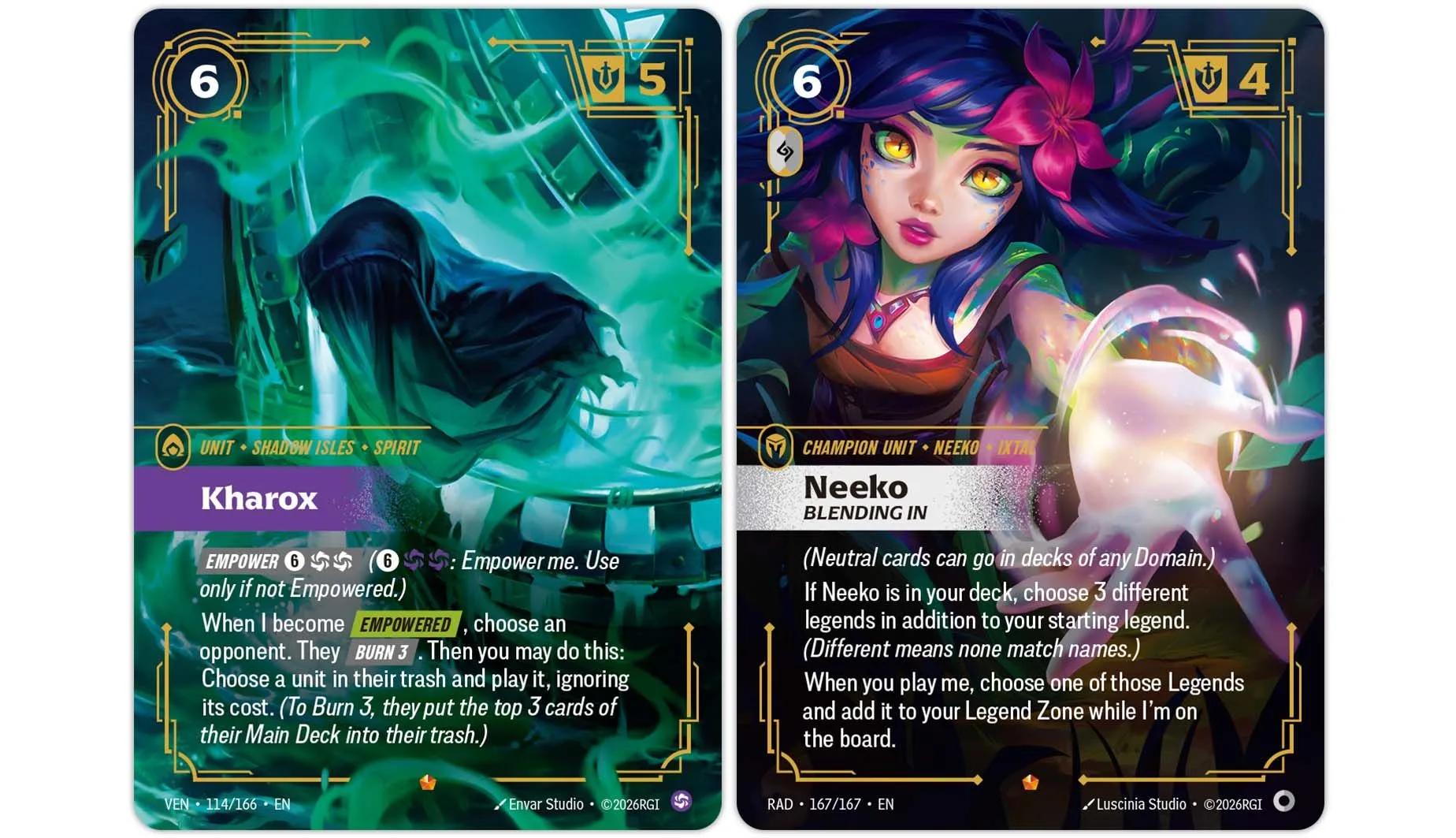
Kharox and Neeko, Blending In: whose legends are used?
Official ruling: If your opponent empowers Kharox and uses that effect to play your Neeko, Blending In from your trash, they do not get the additional legends you selected during your own deckbuilding. If their main deck or sideboard includes Neeko, they can use one of the additional legends they selected for their own deck. If they included no Neeko, the instruction to add a legend is ignored.
The card’s official errata says Neeko’s deckbuilding choice is up to three different additional legends. The Radiance ruling also demonstrates that this choice belongs to the relevant deck, not to the original owner of a Neeko card that another player temporarily plays.
Baron Nashor: Hunters’ Circle and Riven, the Exile
Official ruling: With Hunters’ Circle under your control, you can select that battlefield when playing Baron Nashor and receive its first-unit-or-gear cost discount, even if Baron Pit is not yet on the board. Riot’s example confirms the resulting cost of 9 energy and three power of Baron’s domain. The discount is determined before Baron Nashor’s replacement effect moves him to Baron Pit as he enters.
Similarly, with Riven, the Exile as your legend and a battlefield you control selected as Baron Nashor’s play location, Riven’s replacement effect can make him enter ready. Baron’s own replacement effect sends him to Baron Pit, and he still enters ready there. The key is that the chosen play location and the final entry location need not be the same.
Riven, Broken Blade: when are buffs spent and triggers ordered?
Official ruling: For Riven, Broken Blade, a buff required by the exhaust-triggered ability is spent when that trigger resolves, not while the triggered ability is being finalized. The instruction to spend it comes after the opening choice instruction, rather than being the trigger’s initial cost.
If Riven, Broken Blade and Stellacorn Herder standard move simultaneously, Riven’s exhaust trigger goes on the chain before the Herder’s move trigger. That is because the exhaustion cost is paid before the move itself, so the exhaust event occurs first.
Gravity Field: failed movement, Charm, and Angler Wyrm
Official ruling: If Gravity Field imposes an additional cost on your standard move to its battlefield and you cannot or do not pay, you cannot still exhaust the unit merely to attempt the move. The move is cancelled, and the related actions are undone. A standard move must be possible, and its costs must be payable.
For other effects, who is instructed to move the unit matters. If you play Charm to move an enemy unit to a battlefield where you control Gravity Field, the enemy unit’s controller does not pay Gravity Field’s cost: you are the player performing that move, and your own Gravity Field taxes opponents. If your opponent controls Gravity Field at that destination, you would be the player required to pay its cost.
By contrast, Angler Wyrm instructs the chosen opponent to move a unit. If that movement would take a unit to a battlefield affected by your Gravity Field, that opponent must pay the extra cost. If they decline or cannot pay, the unit does not move.
Mordekaiser, Iron Revenant: Atakhan and alternate costs
Official ruling: You cannot kill a non-token unit as Atakhan’s optional additional cost and then use Mordekaiser, Iron Revenant to banish that same unit from your trash to help pay Atakhan’s power cost. Riftbound pays energy and power before other non-standard costs. The killed unit is therefore not yet in the trash at the moment you need the power.
Riot also confirms a different outcome for Meticulous Restorationist: when its triggered ability lets you play it from the trash for its alternate cost, you may use Mordekaiser’s permitted trash-banish resource ability to pay that unit’s cost. The distinction is between a valid alternate cost and attempting to generate power from a unit that has not died yet.
Angler Wyrm and Hunker Down: can an immovable unit be selected?
Official ruling: No. If Angler Wyrm instructs an opponent to move one of their units and that opponent has used Hunker Down to prevent a particular unit from moving, they cannot choose the immovable unit merely to avoid moving another legal unit. If any of their units can move, they must move one of those units. If none can move, the instruction is negated.
These rulings illustrate a broader lesson: cards that use similar words can produce different results because the actor, the order of costs, and the timing of triggers are different. Use the full official Radiance FAQ for further rulings involving Seraphic Wyvern, Runeblade Anvil, and Possession with Ekko.
Riftbound multiplayer rules: 3-player, 4-player, and 2v2
The core scoring and card rules still apply in multiplayer, but the number of battlefields, seating, and first-turn changes depend on the mode. A battlefield can be contested by several players over time, yet a single combat still involves only two players.
| Mode | Players | Victory score | Battlefields in play | First-turn adjustment |
|---|---|---|---|---|
| Duel | 2 | 8 | 2 | Second player channels one extra rune on their first turn. |
| Match | 2 | 8 per game; normally best of three | 2 per game | Second player channels one extra rune; battlefield selections change after a won game. |
| Skirmish | 3 | 8 | 3 | First player skips first draw; last player channels one extra rune. |
| War | 4, free-for-all | 8 | 3 | First player skips first draw; last player channels one extra rune. |
| Magma Chamber | 4, in 2v2 teams | 11 per team | 3 | First player skips first draw; last player channels one extra rune. |
In 2v2, teammates alternate turns, share points, and count each other’s controlled objects as friendly where the card says so. However, control itself is not shared. You cannot standard move your teammate’s units or hide cards at a battlefield they control. Your teammate can play spells or activate abilities during your turn only when you invite them to use your priority as allowed by the team rules.
The 2v2 final-point and scoring-eligibility restrictions are more specific than in a duel. A battlefield controlled by your teammate during your turn’s Beginning Phase scoring step cannot be scored by your team again that turn; the special conquer condition also includes an exception for certain ally-occupied battlefields. For a close team-game ruling, use the current Core Rules, section 491.
Riftbound sideboard rules, side deck rules, and sealed rules
Sideboarding in sanctioned Constructed play
A sideboard is an additional collection of legal cards available only when the event format permits one. Under the applicable Tournament Rules, sanctioned Constructed play allows up to ten sideboard cards where sideboards are permitted. The number is a maximum, not a requirement that every casual player carry ten.
Between games, Constructed players exchange main-deck and sideboard cards one for one, retaining an exactly 40-card main deck. Combined card-copy limits still apply. You may change to a legal chosen champion from your main deck or sideboard, but you cannot change your registered legend, rune deck, or battlefields during the Constructed match. Check the official Tournament Rules PDF and event-specific requirements on the Rules Hub.
Sealed deckbuilding and sideboarding
Sealed uses an event-provided pool rather than your entire collection. A sealed main deck needs at least 25 cards, normally uses up to three domains, and may include as many copies of a card as you opened. A chosen champion does not need to match the champion tag of a legend in the same way it would in Constructed. You may even play without a champion legend or chosen champion, with the applicable first-turn extra-card rule.
Your unused sealed card pool is generally your sideboard, and you can adjust your domain identity, legend, chosen champion, and runes between games as long as the resulting deck remains legal for that event. Riot’s official Sealed primer explains the differences in beginner-friendly language.
For historical context, RiftDaily also keeps an archived Core Rules FAQ, but its older rulings must not override applicable newer Riot documents. To follow set updates, explore our news coverage and Riftbound release date guide.
Frequently asked questions about Riftbound rules
What are the basic Riftbound rules?
Build a legal deck, channel runes for energy and power, play units and other cards, and contest battlefields. Score by conquering a battlefield or holding one at the start of your turn. The default win target is eight points, with a restriction on earning the last point through conquer.
How many cards do you need for a Riftbound deck?
Under the Core Rules, the main deck has at least 40 cards including the chosen champion, plus 12 runes and a champion legend. Sanctioned Constructed events require exactly 40 main-deck cards, normally with three registered battlefields.
What are the Riftbound mulligan rules?
Draw four cards, set aside up to two, draw the same number of replacements, and then recycle the set-aside cards. You draw the replacements before recycling the cards you rejected.
Does the player going first draw a card?
In standard 1v1 Duel and Match, the first player follows the normal Draw Phase, while the second player channels an extra rune on their first turn. In three-player, four-player, and 2v2 modes, the first player skips their first draw and the last player receives the extra first-turn rune.
Can you recycle an exhausted rune to pay power?
Yes. You can exhaust a rune to add energy and later recycle that exhausted rune to add power. It returns to the rune deck rather than staying in the base.
Do Riftbound units keep damage between turns?
Normally, no. Surviving units heal during combat cleanup and at the end of each player’s turn. Damage can still be lethal during an ongoing combat or effect sequence.
What is the difference between conquer and hold?
Conquer means gaining control of a battlefield that you have not scored that turn. Hold means maintaining control during the Beginning Phase scoring step. Either usually gains one point, but the final-point-from-conquer restriction is special.
Can you win by conquering only one battlefield at seven points?
Not in a normal two-battlefield duel unless you also scored the other battlefield that turn. Otherwise, that conquer makes you draw one card rather than gain your final point. A later hold can also win.
Do gear and equipment enter ready?
Ordinary gear enters ready, while units generally enter exhausted. Equipment is a type of gear that can use Equip to attach to a unit. Deploy gear is a separate special case that can stay at a battlefield.
What happens when your chosen champion dies?
After you play the chosen champion from its starting zone, it follows the normal rules for a unit. When killed, that card ordinarily goes to its owner’s trash, not back to the Champion Zone.
How do Hidden cards work in Riftbound?
While the relevant conditions are satisfied, you may pay one power of any domain to hide a card with Hidden face down at a battlefield you control, subject to facedown-zone limits. Beginning on the next turn, you can play it with Reaction while ignoring its base cost, but location and target restrictions still apply.
Does the Radiance FAQ override the Riftbound Core Rules?
Yes, for points where the FAQ differs from the Core Rules version it supplements. Riot says a newly released Core Rules document takes precedence over conflicting older FAQ points. Check the live Rules Hub before a rules decision.
Can Gravity Field make you exhaust a unit without moving it?
No. If a standard move cannot be completed or its added costs are not paid, it is cancelled and its associated actions are undone. Riot gives this exact example in the Radiance FAQ.
Can your teammate move your units in Riftbound 2v2?
No. Teammates share points and have access to friendly-team interactions, but they do not share control. A teammate cannot issue your units’ standard moves.
What is the difference between Constructed sideboarding and Sealed sideboarding?
Constructed sideboarding exchanges legal cards one for one while keeping the registered deck backbone fixed. Sealed permits broader rebuilding from the event pool, including allowed changes to domains, legend, runes, and chosen champion.
From first game to confident rules calls
The best way to learn Riftbound rules is to master the essentials in order: ABCD turn structure, rune payments, movement, showdowns, combat, and the conquer-versus-hold distinction. Once those feel natural, add champion text, reaction windows, equipment, and card-specific rulings. Strategic shortcuts are useful, but they should never replace the printed rulebook and officially corrected wording.
For more Riftbound coverage, visit the Riftbound hub, follow news and updates, revisit our Origins guide, and use the release guide for set context. For contested gameplay interactions, keep the official Rules Hub and Riot’s Radiance rulings bookmarked.