
The League of Legends Championship Pacific (LCP) is changing significantly in 2027, with every team beginning each split in domestic competition before the strongest teams qualify for the regional stage.
Teams will compete at home through the Pacific Championship Series (PCS), Vietnam Championship Series (VCS) and League of Legends Japan League (LJL). The best performers will then advance to the LCP, which becomes the bracket stage where APAC's leading teams compete for the regional title and qualification to global LoL Esports events.
The change gives every PCS, VCS and LJL team a chance to qualify for the LCP each split, replacing the current once-a-year promotion opportunity for domestic teams. It also allows organizations to spend more of the season in their home regions instead of relocating to Taipei. The LCP itself is not going away and will remain APAC's sole route to global League of Legends events.
LCP 2027 format explained
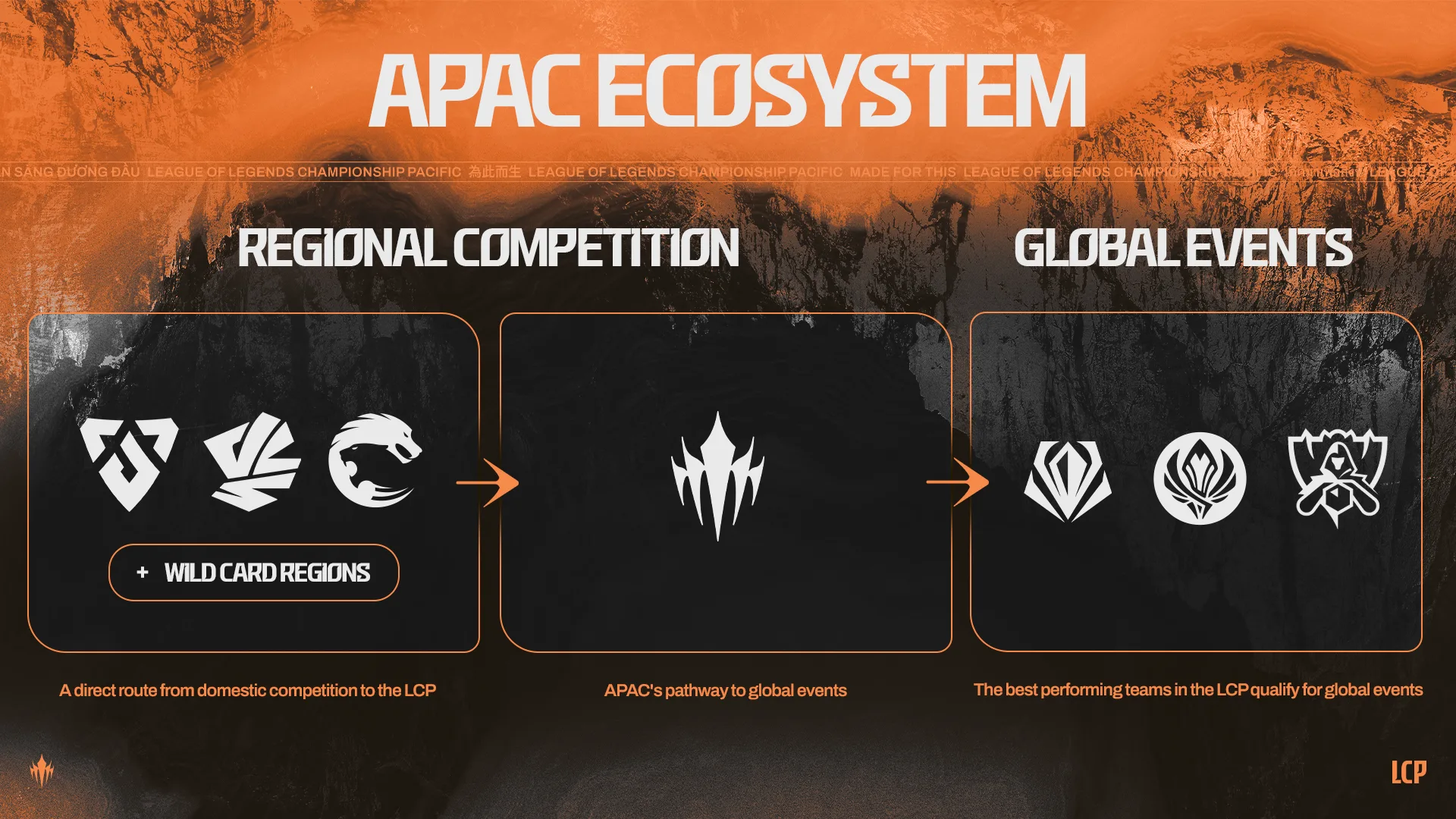
In 2027, all teams will start each split in the PCS, VCS or LJL. The best domestic teams will qualify for the LCP bracket, where APAC's top teams compete for the regional championship and places at global events. Wild Card regions will also retain a pathway into the LCP.
| Area | Confirmed LCP 2027 change |
|---|---|
| Start of each split | Every team begins at the domestic level in the PCS, VCS or LJL |
| LCP qualification | Every PCS, VCS and LJL team can compete for an LCP place each split |
| LCP's role | Regional bracket for APAC's strongest qualifying teams |
| Global events | The LCP remains APAC's sole qualification pathway |
| Wild Card regions | A route into the LCP will remain available |
| Team location | Teams can return home for domestic competition |
| Regional GRP | Support continues for current LCP teams and eligible Promotion Series teams |
| Global Event GRP | Teams that qualify for global events can become eligible |
| Slot distribution | Not yet announced |
Riot announced the overhaul on September 21, 2026, in its official LCP 2027 ecosystem update. The goal is to create a continuous competitive route from domestic League of Legends competition to the LCP and, for the best teams, international events.
Every PCS, VCS and LJL team can compete for an LCP spot
The biggest competitive change is how often domestic teams get an opportunity to reach the LCP.
Under the current structure, Riot says domestic teams have one chance each year to compete for an LCP position through the Promotion Series. Even then, only one or two teams from each domestic league get the opportunity to enter the promotion competition.
That bottleneck is being removed in 2027. Every team in the PCS, VCS and LJL will be able to compete for a place in the LCP during each split.
The basic route becomes domestic competition in the PCS, VCS or LJL, followed by LCP qualification, then a possible place at global events.
For organizations outside the existing LCP field, that means considerably more opportunities to break into APAC's top competition. A team will no longer have to build its entire year around a single narrow promotion window.
Riot has not yet revealed the exact domestic qualification mechanism. The number of LCP slots assigned to each league, the placements required to qualify and the final bracket structure are among the details still to come.
RiftDaily's LCP coverage will track those announcements as the 2027 format takes shape.
The LCP remains APAC's top League of Legends competition
The return to domestic leagues does not mean Riot is dismantling the LCP or breaking APAC back into completely separate top-level regions.
The LCP will remain the pinnacle of LoL Esports competition in APAC. The strongest qualifying teams will meet there each split for a regional showdown, with the championship and international qualification at stake.
Crucially, Riot says the LCP will remain the sole pathway to global events for APAC teams. Success in a domestic competition can earn a team an LCP place, but teams must then perform at the regional level to progress internationally.
That preserves one of the original purposes of the league. Riot created the LCP to bring APAC's strongest talent together more regularly, produce cross-region matchups and rivalries, and increase the region's competitive strength through higher-level regional play.
Why Riot is changing the LCP structure
The LCP delivered competitive progress and audience growth, but Riot also acknowledged that its existing structure fell short in areas related to team sustainability.
One of the biggest issues is the cost of relocation. Teams that had to move to Taipei faced rising operating expenses, increasing the financial burden of competing throughout a long season.
Relocation created other challenges. Organizations competing away from their home markets had fewer opportunities to meet supporters in person, organize local activities and build relationships with regional partners.
Players could also spend extended periods away from friends, family and their usual support networks.
Riot's 2027 solution is to keep the high-level APAC competition that the LCP provides while allowing teams to return home for the domestic phase of each split. The strongest teams then move into regional competition after earning their places.
The LCP changes follow two years of APAC progress
Riot pointed to the LCP's competitive and audience results when explaining why it still sees value in bringing APAC's strongest teams together.
The 2025 LCP Mid Season Finals reached nearly 500,000 peak viewers, according to LoL Esports, setting a new high for the competition at the time.
APAC also produced a deeper international run later that year. CTBC Flying Oyster finished in the top eight at Worlds 2025, becoming the first APAC team since 2015 to reach the League of Legends World Championship quarterfinals.
The balance of power shifted further in 2026 as Vietnamese teams moved to the top of the regional competition. Team Secret Whales won every LCP title during the season and also became the first APAC team to defeat an LPL team in a best-of-five series.
That landmark best-of-five came at MSI 2026, where Team Secret Whales defeated Top Esports 3-1. The deciding fourth game is available through the official LoL Esports broadcast.
The 3-1 result added another international milestone to the region's recent progress. It also came during the same year in which Team Secret Whales established itself as the dominant LCP team.
Those results help explain why Riot is keeping a regional championship rather than returning entirely to isolated domestic ecosystems. The 2027 system changes how teams reach APAC-wide competition, not the value Riot places on that competition itself.
Other changes across professional League of Legends can be followed through RiftDaily's esports coverage.
PCS, VCS and LJL regain a central role in 2027
The new structure makes domestic leagues much more consequential because every team's LCP journey starts there.
For the PCS, VCS and LJL, domestic results will no longer sit beneath an LCP field that most teams can challenge only through a limited annual promotion process. Each split instead becomes part of the qualification route to APAC's regional stage.
That creates a clearer competitive progression. Teams first face rivals from their home ecosystem, the strongest advance to the LCP, and the best LCP performers can continue to global events.
The model also gives domestic storylines more relevance throughout the year. A strong run at home can directly turn into an APAC campaign rather than ending at the domestic level.
Wild Card regions will keep a direct path into the LCP
The 2027 ecosystem will not be restricted to teams from the PCS, VCS and LJL. Riot has confirmed that Wild Card regions will continue to have a route into the LCP.
Wild Card access had already been expanded through the Promotion Series. Riot says it wants to preserve that regional representation while balancing it against the competitive level of the LCP.
Riot followed its main September 21 announcement with an LCP 2027 Wild Card open invitation on September 23. The company said it was still working out exactly how the pathway will operate, but invited organizations interested in running their own Wild Card tournaments to register their interest.

Only shortlisted applicants will be contacted, according to the follow-up announcement. Riot has not yet confirmed the number of Wild Card slots, which regions will receive them or exactly how those tournaments will feed into the LCP.
Global Revenue Pool support will continue in 2027
The structural overhaul also affects how teams can access financial support through the Global Revenue Pool, or GRP.
Riot describes the Regional GRP as one of the most meaningful sources of stable, recurring revenue for LCP teams. That support will continue under the new system.
Current LCP teams will continue receiving Regional GRP in the 2027 season. Riot also says teams that earn promotion or successfully defend their LCP spot in the upcoming Promotion Series will be covered, with an LCP place carrying a direct share of the pool.
The more open format gives domestic teams an additional route to revenue support. A team that progresses from domestic competition through the LCP and successfully qualifies for a global event will also become eligible for Global Event GRP.
In practical terms, a team's potential financial reward can grow with its competitive progress. Riot's stated aim is for the ceiling on earnings to depend more on how far a team advances and less on where it began the season.
The approach forms part of Riot Games' wider effort to make its professional esports ecosystem more sustainable for participating organizations.
Returning home could strengthen local LCP fandom
The move back to domestic competition is also intended to reconnect teams with their home audiences.
Riot says organizations competing away from their home regions had fewer chances to interact with local supporters in person. That made it harder to deepen fan relationships and build connections with the communities surrounding each team.
Starting each split at home should create more opportunities for local engagement while preserving the chance to move into cross-regional competition later in the season.
It also creates a more coherent journey to follow. A team's campaign begins in domestic competition, can continue through the LCP and, if results allow, ends on the global stage.
What Riot has not confirmed about LCP 2027
The overall competitive hierarchy is confirmed, but several details that will determine how the 2027 season works in practice are still missing.
| Unconfirmed detail | What is known |
|---|---|
| PCS, VCS and LJL slot distribution | Riot says details will be announced in the coming months |
| Domestic qualification rules | Every team can compete for an LCP place, but exact criteria are not yet public |
| LCP bracket format | The LCP becomes the regional bracket stage, but its complete structure has not been revealed |
| Wild Card allocation | A pathway is confirmed, but the number of slots is not |
| Wild Card tournament structure | Riot is inviting interested organizers while the pathway is still being developed |
Those details will be important because they determine how many teams reach the LCP from each domestic ecosystem and how difficult the route to international qualification becomes.
Where to follow LCP 2027 updates
Official English-language LCP updates are available through LoL Pacific on Facebook, LoL Pacific on Instagram, LoL Pacific on X and LoL Pacific on TikTok.
Vietnamese updates are published through LoL Esports Vietnam on Facebook, VCS on Instagram and LoL Esports Vietnam on TikTok.
Traditional Chinese coverage is available through LoL Esports Taiwan on Facebook, LoL Esports Taiwan on Instagram and LoL Esports Taiwan on Threads. Japanese updates are posted through LoL Esports Japan on X.
Official match broadcasts, highlights and other tournament video coverage are available through the LoL Esports YouTube channel.
Frequently asked questions about the LCP 2027 format
What is changing with the LCP in 2027?
Every team will begin each split in domestic competition through the PCS, VCS or LJL. The strongest teams will then qualify for the LCP, which becomes the regional bracket where APAC teams compete for the championship and global event qualification.
Can every PCS, VCS and LJL team qualify for the LCP?
Yes. Riot says every team competing in the PCS, VCS and LJL will have an opportunity to qualify for the LCP during each split in 2027.
Is the LCP being removed in 2027?
No. The LCP remains APAC's top regional League of Legends competition. The main change is how teams reach it, with domestic competition becoming the starting point of each split.
Does the LCP still qualify APAC teams for global events?
Yes. Riot says the LCP will remain APAC's sole pathway to global LoL Esports events. Teams must progress from domestic competition into the LCP before they can qualify internationally.
Will Wild Card regions be included in LCP 2027?
Yes. Wild Card regions will retain a direct pathway into the LCP. Riot is still developing the exact structure and has not announced the final slot allocation.
Why is Riot changing the LCP format?
Riot cited rising relocation and operating costs, reduced opportunities for teams to connect with local supporters and partners, and the amount of time players can spend away from their homes and support networks.
How will the Global Revenue Pool work for LCP teams in 2027?
Regional GRP support will continue for current LCP teams and eligible teams that secure or defend an LCP place through the Promotion Series. Teams that progress from domestic competition and qualify for global events can also become eligible for Global Event GRP.
When will Riot reveal the full LCP 2027 format?
Riot has not announced a specific date. It says further details, including slot distribution and the competition format, will be released in the coming months.
Slot distribution is the next major LCP 2027 detail to watch
The broad shape of APAC League of Legends in 2027 is now established. Every split begins in the PCS, VCS and LJL, every domestic team gets a recurring opportunity to reach the LCP, Wild Card regions remain part of the ecosystem, and the LCP continues to decide which APAC teams reach global competition.
The next announcements will fill in the details that matter most competitively: how many LCP places each domestic league receives, exactly how teams earn those slots, what the regional bracket looks like and how Wild Card qualification connects to it.
Those decisions will determine how open the new system is in practice when the 2027 season begins. Further announcements and related League of Legends developments will be covered through RiftDaily's news section.