The Wild Rift patch 7.3 preview confirms major changes to Ranked, Smite, Jungle progression and the pace of matches on the Rift. Riot Games is also bringing Hwei, Sylas and Rek'Sai to Wild Rift, alongside the new 3v3v3 Rift Rumble mode.
The biggest system changes go much deeper than new champions. Patch 7.3 expands Ranked performance evaluation beyond kills and KDA, adds the new Legendary S rating, introduces more Ranked Energy incentives, strengthens minion pressure, adjusts Baron and Dragon progression, reworks Smite and makes Jungle income more consistent.
Riot revealed Patch 7.3: Center Stage across two official preview episodes on September 9 and September 14. The update is scheduled to begin rolling out on September 22, 2026 UTC.
This article covers the confirmed Patch 7.3 preview information, not the final numerical patch notes. Exact damage values, scaling, resistances, Ranked Energy rewards and economy changes will determine how strongly these systems affect the live meta once the update arrives.
Wild Rift patch 7.3 preview: What is changing?
Wild Rift patch 7.3 changes Ranked performance scoring, Ranked Energy, Legendary Ranked, minion pressure, Baron, Dragons, Smite, epic monsters and Jungle progression. Riot has also confirmed Hwei, Sylas, Rek'Sai and Rift Rumble for the wider Patch 7.3 cycle.
| Patch 7.3 change | What is changing | What it means |
|---|---|---|
| Ranked performance | Evaluation considers champion, lane and role | Impact beyond kills and KDA receives more recognition |
| Legendary S | New performance rating above S | Exceptional games can award additional Ranked Energy |
| Role incentives | Bonuses for needed positions, Any Position and autofill | Designed to improve role distribution and matchmaking |
| Legendary Ranked | Easier re-entry and the new Legendary Trial | High-level players receive another progression route |
| Super minions | Scale as more inhibitors are destroyed | Multiple inhibitor wins create stronger lane pressure |
| Siege minions | Reach full structure damage earlier | Successful plays can threaten structures sooner |
| Turret pressure | Destroying enemy turrets strengthens allied minion pressure | Tower wins can create stronger follow-up pushes |
| Baron | Empowered minions reach towers more reliably | Baron creates a clearer siege opportunity |
| Dragons | More momentum before Elder Dragon | Early and mid-game Dragon control should matter more |
| Smite | Persistent True Damage burn | Objective control becomes less dependent on one instant |
| Epic monsters | Increased resistances | Vision, positioning and setup become more important |
| Jungle economy | More stable clearing and baseline income | Junglers should progress more consistently |
| Champions | Hwei, Sylas and Rek'Sai | Three new champions join during the Patch 7.3 cycle |
| Rift Rumble | New three-team 3v3v3 mode | Adds a combat-focused alternative to standard Wild Rift |
The common thread is consistency. Riot wants good individual decisions to receive more recognition in Ranked, while advantages earned during a match should build into meaningful pressure instead of games stalling until one late objective suddenly decides the result.
Watch Riot's Wild Rift patch 7.3 developer deep dive
Riot developers John, Neo and Will break down Ranked, Rift pacing and Jungle in the second Patch 7.3 preview. Their discussion explains why progression, objectives, minion pressure and Jungle changes are being addressed together.
Rather than treating Ranked, Jungle and match pacing as unrelated problems, Riot is approaching them from a similar direction: useful actions should matter throughout a game, not only when they appear as kills on the scoreboard or one decisive Smite at the end of an objective fight.
Ranked performance will consider champion, lane and role
One of the biggest changes in the Wild Rift patch 7.3 preview is a more detailed approach to Ranked performance evaluation. Riot says kills and KDA remain important, but they do not tell the complete story of how someone contributed to a match.
The S/A and MVP scoring system will use a more tailored evaluation model that considers the player's champion, lane and role. That gives the system more room to recognize actions that help create winning opportunities without necessarily producing a standout kill total.
Riot specifically identifies several contributions that the new system can recognize more accurately:
- Vision impact and crowd control
- Objective participation, including Dragon control
- Pushing and coordinated team play
- Frontline damage absorption
- Supporting teammates and creating opportunities
Kills and KDA are not being removed from the calculation. The difference is that they will no longer define the entire evaluation.
That should make it easier to distinguish strong performances across very different jobs. A tank absorbing pressure, a support controlling vision or a jungler repeatedly setting up objectives can have an excellent game without producing the same scoreboard as a carry.
Riot's official Patch 7.3 Ranked progression breakdown says the goal is to encourage decisions and teamwork that create winning opportunities, even when those plays do not lead directly to kills.
Legendary S adds a new Ranked rating above S
The updated performance model also feeds directly into Ranked Energy. Patch 7.3 introduces Legendary S, a new rating above S for truly exceptional performances.
Legendary S is more than a new post-match label. Riot says earning the rating will provide additional Ranked Energy, giving standout individual performances another way to influence progression.
| Ranked change | How it works |
|---|---|
| Performance evaluation | Uses a more tailored model based on champion, lane and role |
| Strong performance | Creates opportunities to earn more Ranked Energy |
| Legendary S | A new rating above S for exceptional performances |
| Legendary S reward | Provides additional Ranked Energy |
Riot has not yet published the exact performance thresholds or Ranked Energy values attached to Legendary S. Those figures will be important when the complete Patch 7.3 notes are released.
Patch 7.3 continues the Ranked Energy overhaul
The changes build on the Ranked overhaul introduced in Patch 7.2. That update replaced Ranked Fortitude with Ranked Energy and created a clearer connection between individual in-game performance and progression.
Outstanding performances can already improve progression after a victory, while exceptional performances in a loss can reduce the impact of that defeat. Patch 7.3 takes the next step by making the performance evaluation itself more sensitive to the champion and role being played.
Riot had already said in its Patch 7.2 Ranked update that improving Ranked would take more than one patch. The changes previewed for 7.3 are a continuation of that longer project.
Needed positions, Any Position and autofill award Ranked Energy
Ranked Energy is also being used to encourage healthier role distribution. Patch 7.3 will provide additional rewards when matchmaking needs more players in particular positions.
| Situation | Patch 7.3 reward | Limit |
|---|---|---|
| Playing a needed position | Additional Ranked Energy | Weekly cap |
| Choosing Any Position | Bonus Ranked Energy | Weekly cap |
| Being autofilled | A larger Ranked Energy bonus | Weekly cap |
The distinction between Any Position and autofill is deliberate. Choosing Any Position means volunteering to help fill the matchmaking pool, while an autofilled player can be placed into a role they did not specifically request.
Riot says the incentives are intended to improve role distribution, matchmaking quality and queue times. Weekly caps prevent those bonuses from becoming an unlimited source of Ranked progression.
Legendary Ranked gets easier re-entry and Legendary Trial
Legendary Ranked is receiving two progression changes in Patch 7.3. One makes it easier for eligible high-ranked players to return to the mode, while the other creates a new promotion target at the Legendary Commander tier.
Players who reached Grandmaster in regular Ranked during the previous season will receive a lower entry threshold when returning to Legendary Ranked, reducing the amount of climbing needed to regain access.
Patch 7.3 also introduces Legendary Trial. Once activated, the Trial runs alongside normal Legendary Ranked progression, giving players another way to earn promotion without replacing their usual point gains and losses.
A strong enough run can complete the Trial and move a player directly into the next tier. Riot's goal is to provide Commander players with a clearer milestone while rewarding sustained strong performance.
Wild Rift patch 7.3 preview targets mid-game stalls
The gameplay side of the Wild Rift patch 7.3 preview focuses heavily on how matches develop after the early game. Riot says some games have been entering long mid-game stalls before ending suddenly around a powerful late-game objective.
Rather than simply trying to shorten every match, Riot wants a healthier tempo curve. Advantages should grow progressively through towers, wave control and objectives, while the defending team retains meaningful opportunities to respond.
- Successful fights should translate more naturally into map pressure.
- Towers and inhibitors should contribute to a growing advantage.
- Wave management should matter more when attacking and defending.
- Repeated objective control should build momentum over time.
- Defenders should still retain meaningful comeback opportunities.
Riot's Rift pacing and Jungle breakdown identifies minion waves as central to that plan because they connect successful fights and objective control to actual tower pressure.
Super minions get stronger as more inhibitors fall
Super minions are being changed so their threat increases alongside a team's success inside the enemy base. As more inhibitors are destroyed, super minions gain additional movement speed, defenses and attack damage.
| Minion change | Patch 7.3 effect |
|---|---|
| Super minion movement speed | Increases as more inhibitors are destroyed |
| Super minion defenses | Increase as more inhibitors are destroyed |
| Super minion attack damage | Increases as more inhibitors are destroyed |
| Siege minion structure damage | Reaches full strength earlier |
Breaking several inhibitors should therefore create a more serious map-management problem. Defenders have a stronger reason to deal with incoming waves rather than ignoring them indefinitely while waiting for another objective fight.
Destroying towers creates stronger follow-up pressure
Patch 7.3 also strengthens the connection between winning a structure and controlling the lane afterward. Riot's first preview shows that destroying an enemy turret gives allied minions additional offensive pressure, helping a successful push continue instead of immediately losing momentum.
That fits the broader pacing changes. A tower is not only a one-time objective; taking it should make it easier to turn an existing advantage into the next play.
Wave management becomes more important on both sides
Patch 7.3 is not designed to let minions win games automatically. Riot wants players to make better use of their waves when attacking while giving defenders clear ways to respond.
- Attackers can stack waves before sieging or starting an objective.
- Defenders have more reason to clear large waves before they become overwhelming.
- Tower and inhibitor advantages translate more naturally into continued pressure.
- Unescorted waves can still be cleared if the attacking team fails to manage them.
- Map positioning remains important when converting a lead into structures.
This makes wave preparation part of objective play rather than a separate task. A team preparing Baron, for example, can first build pressure in another lane and force the opponent to decide whether to answer the wave or contest the objective.
Baron will provide a clearer siege window
Baron Nashor is another part of Riot's attempt to connect objective control more directly to closing out a lead.
In Patch 7.3, Baron-empowered minions should reach towers more reliably, giving the team holding the buff a clearer opportunity to siege enemy structures.
Baron will not become an automatic win condition. Defenders can still contest vision before the objective, prevent Baron from being secured, clear waves that are not properly escorted and punish poor positioning during the siege.
Dragon control will matter more before Elder Dragon
Dragons are being adjusted around the same pacing philosophy. Riot wants early and mid-game investment in Dragon control to provide more forward momentum before Elder Dragon enters the match.
The concern is that several earlier objective wins can sometimes feel overshadowed by a single decisive late-game objective. Patch 7.3 is intended to make repeated Dragon contests contribute more progressively to a team's advantage.
Riot has not yet provided the complete numerical Dragon changes, so the size of that additional momentum remains one of the important details to watch when the final Patch 7.3 notes arrive.
Smite gets a persistent True Damage burn
The headline Jungle change in the Wild Rift patch 7.3 preview is a Smite rework. Riot says the role currently combines significant influence with uneven clears, vulnerable camps, inconsistent income and the pressure of being responsible for major objectives.
- Smite gains a persistent burning True Damage effect.
- The burn scales with the jungler's attributes.
- Both offensive and defensive stats can contribute to the scaling.
- The mechanic is intended to make objective control more reliable.
- Riot wants less of an objective fight to depend on one instant Smite contest.
A missed Smite can still matter. Junglers remain responsible for routes, timing, positioning and objective setup, but more of their impact should happen across the full contest instead of being compressed into a single moment at the end.
Smite scaling supports fighters, mages and tanks
The scaling behind the new Smite burn is important because Riot does not want the mechanic to benefit only one kind of jungler. Both offensive and defensive attributes contribute.
| Jungle archetype | Patch 7.3 design direction |
|---|---|
| Fighters | Offensive stats can contribute to the persistent Smite burn |
| Mages | The system should support viable AP-oriented progression paths |
| Tanks | Defensive scaling prevents the mechanic from favoring only damage-heavy builds |
That could broaden Jungle champion choices, but the final scaling values will determine who benefits most. Specific Patch 7.3 tier-list conclusions would be premature before those figures are published.
Epic monsters are getting increased resistances
Smite's new persistent damage is being paired with increased resistances for epic monsters. Riot wants major objectives to become more meaningful focal points for team fights instead of disappearing too quickly to a burst combination.
- Vision around major objectives should matter more.
- Positioning before and during an objective becomes more valuable.
- Coordinated setup should matter more than relying on a last-second steal.
- Burst-combo steals are intended to become more difficult.
The resistance and Smite changes are designed to work together. Tougher monsters make it harder to instantly burst an objective, while the persistent Smite burn spreads more of the jungler's contribution across the fight.
Jungle income and clear efficiency are being stabilized
Riot is also addressing progression problems that happen away from Baron and Dragon. Uneven clear speeds, vulnerable camps and inconsistent income can put junglers on very different economic trajectories before an objective fight even begins.
| Jungle issue | Patch 7.3 response |
|---|---|
| Uneven clear efficiency | Riot is working to equalize clear efficiency |
| Inconsistent income | Baseline Jungle income will be improved |
| Laners taking camps | The cost for laners taking Jungle camps will increase |
| Covering a teammate's lane | Junglers will be punished less for temporarily covering a lane |
| Narrow progression paths | Smite scaling supports both offensive and defensive attributes |
Jungle will remain an influential role. Riot still expects junglers to plan routes, time ganks and control objectives, but progression should become steadier and less of the role's impact should be concentrated into a handful of high-pressure moments.
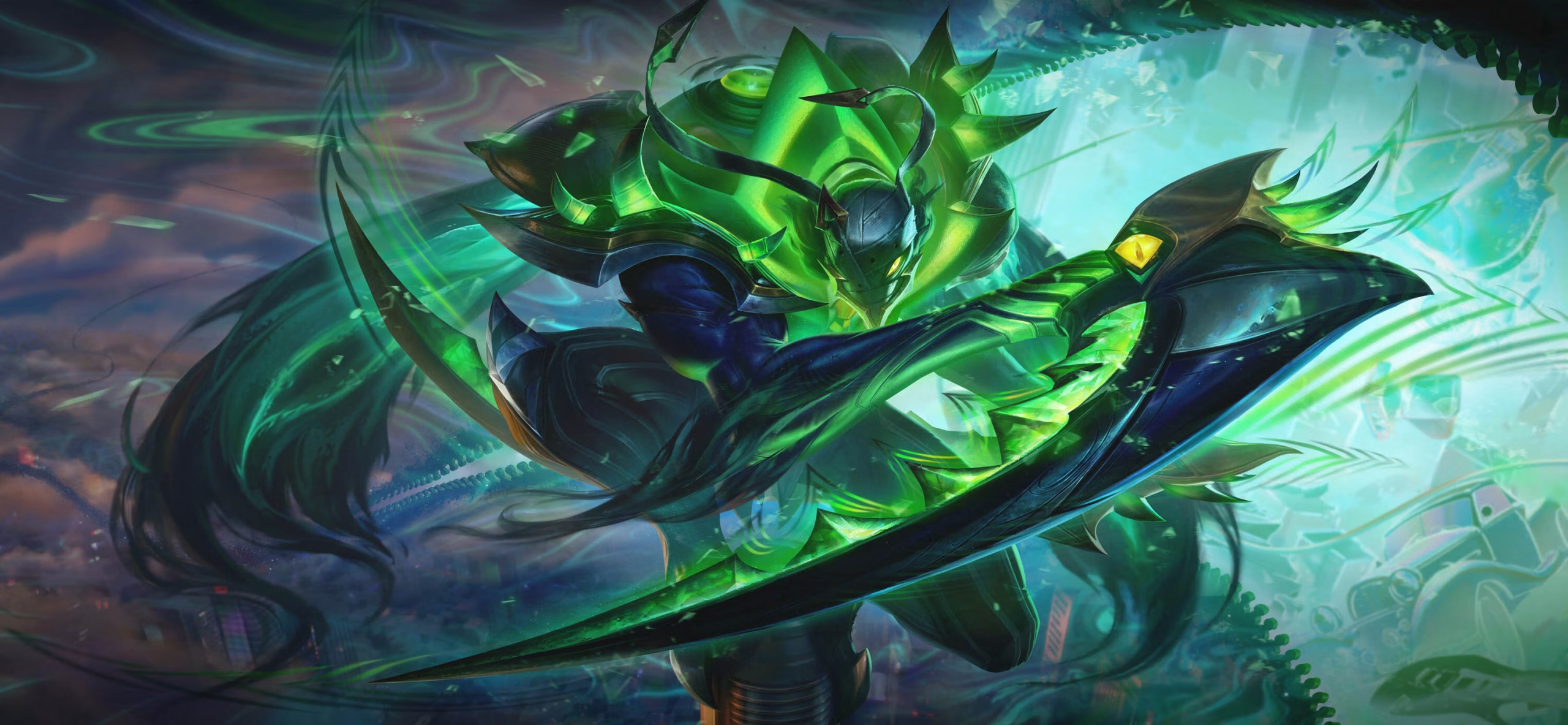
Hwei, Sylas and Rek'Sai are also confirmed for Patch 7.3
The Ranked and gameplay systems are the focus of Riot's second developer deep dive, but the first Wild Rift Patch 7.3 preview also confirms three champions for the update cycle: Hwei, Sylas and Rek'Sai.
| Champion | What to expect |
|---|---|
| Hwei | A highly flexible mage with a large spell toolkit built around different combinations |
| Sylas | A mage/fighter whose signature ultimate lets him steal and use an opponent's ultimate |
| Rek'Sai | A mobile jungler built around burrowing, tunnels and aggressive map pressure |
Their arrival is worth noting in this preview, but exact balance numbers and their place in the Patch 7.3 meta are better judged once the champions and complete patch values are available.
Rift Rumble adds a new 3v3v3 mode
Rift Rumble is another major addition announced in the Patch 7.3 preview. The mode puts three teams of three players on a new symmetrical battlefield and emphasizes direct combat rather than the normal process of pushing lanes and destroying the Nexus.
Players can also use Augment Stones that modify champion abilities during a match, creating combinations that would not normally exist in standard Wild Rift.
Rift Rumble is separate from the competitive Rift changes covered above. It is a new way to play rather than a replacement for Normal or Ranked matches.
Other content revealed in the Patch 7.3 preview
Center Stage also includes additional content beyond Ranked, Jungle and the new champions. Riot's first preview highlighted several other additions planned across the wider Patch 7.3 cycle.
- AAA ARAM receives a music-themed season with additional Augments.
- Pencil Sharpener Kog'Maw is the featured Wild Pass skin.
- Milio receives the new Ranked reward skin.
- Winterblessed Hwei is among the skins revealed for the patch cycle.
- A special Worlds Volibear skin was also previewed.
- Wild Rounds: SMASH 2026 is set to take place in South Korea in November.
These additions help show the overall scale of Center Stage, but the Ranked and gameplay systems are likely to have the biggest effect on regular matches.
What the Wild Rift patch 7.3 preview could mean for the meta
The Patch 7.3 system changes already provide clues about how strategy could shift. Exact champion winners and losers, however, cannot be identified reliably until Riot publishes the final numerical values.
- Wave management could become more valuable because destroyed inhibitors, siege minions and turret wins create stronger follow-up pressure.
- Objective setup could matter more as epic monsters become tougher and burst steals become harder.
- Jungle champion diversity could increase if offensive and defensive Smite scaling works as Riot intends.
- Split-map pressure could become harder to ignore once several inhibitors have fallen.
- Ranked evaluation could better reward low-KDA impact from tanks, supports and objective-focused players.
Wave management may be the most broadly relevant strategic change. A team with an advantage should have more reasons to prepare side lanes before Baron or Dragon instead of treating wave control and objective setup as separate tasks.
Objective fights could also become less about one final burst calculation. Increased epic-monster resistances, combined with Smite's persistent burn, put more emphasis on controlling the area before and during the objective.
The Ranked changes are different because they do not directly buff or nerf a champion. Instead, they change how the game recognizes impact, which could make strong tank, support and objective-focused performances feel more accurately reflected after a match.
What Riot has not confirmed in the Patch 7.3 preview
The September previews explain the direction of the major systems, but several exact values are still needed before the full competitive impact can be calculated.
- The exact damage and scaling values for Smite's persistent True Damage burn
- The precise resistance increases for epic monsters
- The numerical movement speed, defense and attack damage scaling for super minions
- The final siege minion structure-damage progression
- The exact values behind turret-related minion pressure
- The exact changes to baseline Jungle income and clear efficiency
- The additional cost when laners take Jungle camps
- The exact Ranked Energy awarded for Legendary S
- The size of needed-position, Any Position and autofill bonuses
- The weekly caps attached to the new Ranked Energy incentives
- The complete numerical Dragon adjustments
Those figures will matter for objective calculations, champion recommendations and reliable tier lists. RiftDaily will cover the complete Wild Rift patch notes separately once Riot publishes the final Patch 7.3 update.
Until then, RiftDaily will continue separating confirmed Wild Rift news from unofficial Wild Rift leaks as more information appears.
Frequently asked questions about Wild Rift patch 7.3 preview
What is the Wild Rift patch 7.3 preview?
The Wild Rift patch 7.3 preview outlines Riot's confirmed changes to Ranked progression, Ranked Energy, Legendary Ranked, Rift pacing, minions, Baron, Dragons, Smite and Jungle progression. It also reveals Hwei, Sylas, Rek'Sai and the new Rift Rumble mode.
When does Wild Rift patch 7.3 release?
Wild Rift Patch 7.3: Center Stage is scheduled to launch on September 22, 2026 UTC. Individual champions, skins and other content can still become available at different points during the wider patch cycle.
What are the biggest Wild Rift patch 7.3 changes?
The biggest confirmed system changes are role-aware Ranked performance evaluation, Legendary S, additional Ranked Energy incentives, Legendary Trial, stronger minion pressure, Baron and Dragon pacing changes, a persistent True Damage burn for Smite, tougher epic monsters and more stable Jungle progression.
Which champions are in the Wild Rift patch 7.3 preview?
Riot has confirmed Hwei, Sylas and Rek'Sai for the Patch 7.3 cycle. Hwei is a flexible mage with a large spell toolkit, Sylas can steal enemy ultimates, and Rek'Sai is a mobile jungler built around burrowing and tunnels.
What is Legendary S in Wild Rift?
Legendary S is a new Ranked performance rating above S. Riot says it is designed to recognize exceptional performances and will provide additional Ranked Energy.
Is KDA being removed from Ranked performance evaluation?
No. Kills and KDA still matter. Patch 7.3 broadens the evaluation to consider champion, lane and role alongside contributions such as vision, crowd control, objective participation, pushing, frontline play and teamwork.
How is Smite changing in Wild Rift patch 7.3?
Smite gains a persistent True Damage burn that scales with the jungler's attributes, including offensive and defensive stats. Riot wants objective control to become more reliable and less dependent on one instant Smite contest.
Are Baron and Dragons changing in Patch 7.3?
Yes. Baron-empowered minions should reach towers more reliably, creating a clearer siege window. Dragon control is also being adjusted so early and mid-game investment provides more momentum before Elder Dragon.
Will Wild Rift patch 7.3 make games shorter?
Not necessarily. Riot describes the goal as creating a healthier tempo curve rather than simply reducing game length. Advantages should build more progressively through towers, waves and objectives while defenders keep opportunities to respond.
What is Rift Rumble?
Rift Rumble is a new 3v3v3 mode where three teams of three fight on a new symmetrical battlefield. Augment Stones can modify champion abilities during a match, creating combinations not normally available in standard Wild Rift.
Are the full Wild Rift patch 7.3 notes available yet?
No. Riot's Patch 7.3 previews explain the new systems and design direction, but the final numerical patch notes are still needed for exact damage, scaling, resistance, economy and Ranked Energy values.
What to watch next after the Wild Rift patch 7.3 preview
The Wild Rift patch 7.3 preview points to a substantial systems update. Ranked will recognize a wider range of contributions, Legendary S and role incentives expand the Ranked Energy system, and Legendary Ranked receives another progression path through Legendary Trial.
On the Rift, the intended direction is equally clear. Riot wants fights, objective control, structures and wave management to form a more connected path toward victory, while Smite and Jungle changes spread more of the jungler's impact across the full match.
The final numbers are now the biggest missing piece. They will determine how strong the new Smite burn is, which junglers benefit most, how threatening minion pressure becomes and whether the pacing changes significantly alter live games.
Follow RiftDaily's Wild Rift coverage and Wild Rift updates for confirmed Patch 7.3 information. The complete Patch 7.3 notes and balance changes will be covered separately once Riot publishes the finished update.