Teamfight Tactics has revealed Space Gods as its next set, introducing a cosmic theme, a new opening mechanic called the Realm of the Gods, and a roster built around flexible play. The update is set to arrive with patch 17.1, giving players a new structure for early-game decisions and a long list of traits, units, and cosmetics to prepare for.
From the first rounds onward, Space Gods looks designed to change how each lobby develops. Instead of the usual carousel start, players will choose between divine offerings, build allegiance with a favorite god, and later turn that loyalty into a more powerful reward tied to their choices.
Riot outlined the set’s biggest changes in its developer reveal video below.
The presentation focused on the set mechanic, trait lineup, art direction, and the first wave of cosmetics coming with the patch.
Space Gods puts divine choices at the center of every game
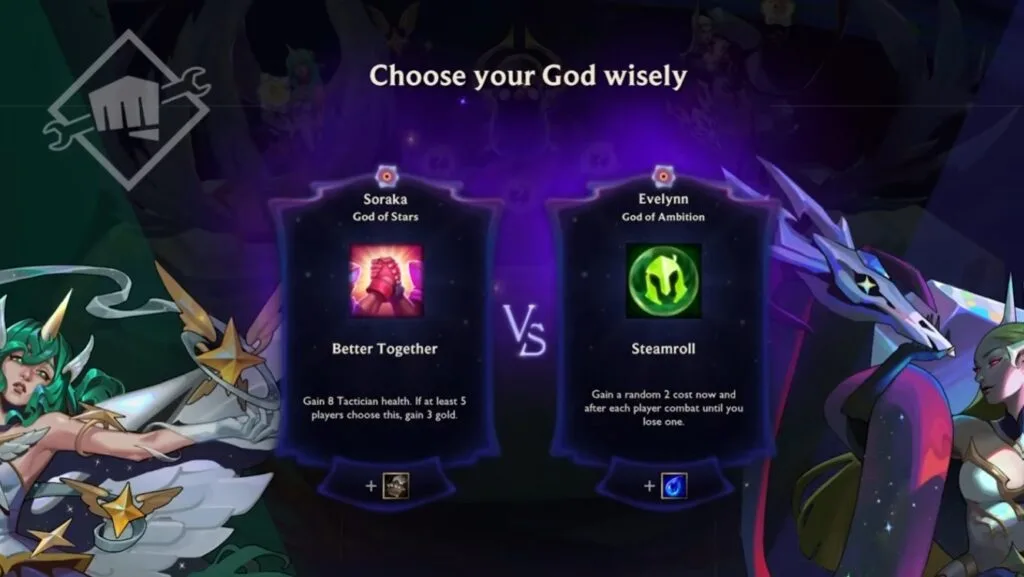
The biggest gameplay shift in Space Gods is the removal of the carousel. In its place is the Realm of the Gods, where two of nine gods appear at the start of a match and offer players a choice between stronger god-themed rewards and a lower-powered generic option from Pengu. Each selection also grants a relic that shows which god a player has chosen to follow.
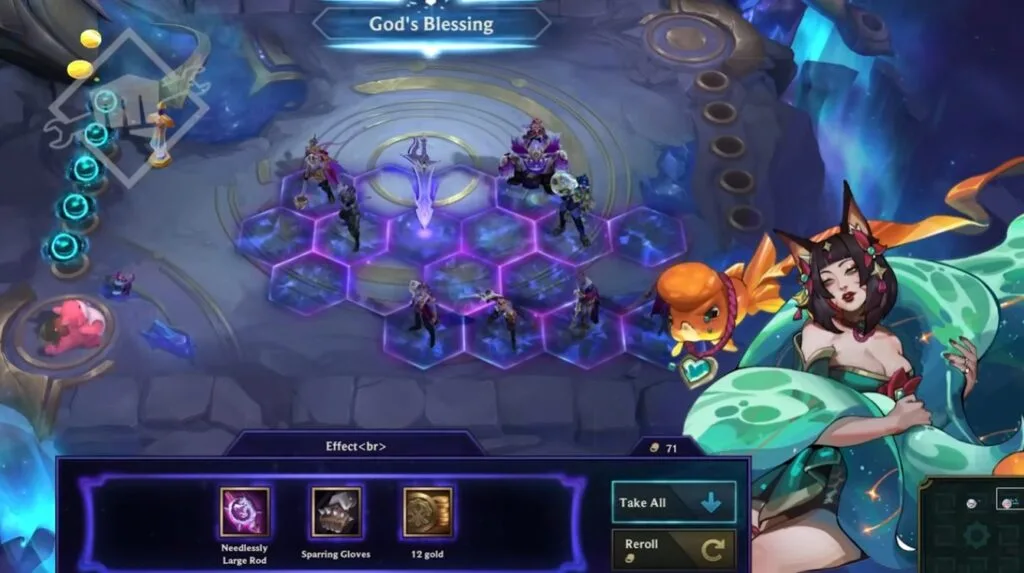
That opening choice is meant to carry through the rest of the game. According to the dev breakdown, Space Gods tracks which god a player has selected most often, then pays that off during the 4-7 boon round. At that point, the leading god returns with an armory-style reward that includes a unique blessing tied to that god’s identity, along with more general options.
| Feature | What was revealed | Why it matters |
|---|---|---|
| Opening mechanic | No carousel, replaced by the Realm of the Gods | Every lobby starts with a more directed strategic choice |
| God allegiance | Players choose offerings from two gods, plus Pengu as a lower-power fallback | Early decisions can shape later rewards and tempo |
| 4-7 boon | Your most-selected god returns with an armory and a unique blessing | Adds a midgame spike tied to earlier decisions |
| Set design | Traditional roster size, splashable units, more flexible play | Encourages pivots and adaptation instead of forcing one line |
| Launch window | Space Gods arrives with patch 17.1 | Sets the timeline for the next major TFT shake-up |
Taken together, those changes suggest a set built around adaptation rather than rigid early commitment. Riot also described Space Gods as a return to a more traditional roster size, with splashable units and an emphasis on reading game states as they develop. That combination could make the set feel more flexible from opener to endgame than some of TFT’s more linear formats.
Highlighted traits point to a more flexible meta
Space Gods introduces a broad trait web, but the reveal singled out a few major pillars. Space Groove gives units ways to enter the Groove for attack speed and health regeneration, with different triggers for each champion. Dark Star centers on feeding a black hole to empower the board, while Meeple scales by adding more units and more meeps, culminating in Bard summoning an “Ultra Friendly Object” that can beam up enemies.
Anima looks like one of the more economy-minded and item-driven traits in the set. It gathers Tech after combat, with larger gains from kills and loss streaks, then lets players cash that resource out for Anima Squad weapons. Those weapons can be equipped broadly, but the dev video makes clear some pairings will be especially potent, such as Rocket Swarm on Jinx.
Mecha also stands out by transforming Urgot, Aurelion Sol, and Galio into Ultimate Mecha Forms that take up two slots and count twice for the trait. Timebreaker may end up being one of the most important glue traits in the early game, offering rerolls on losses, stored XP on wins, and attack speed for the team at three pieces. For players who like to pivot and preserve options, that could make it one of the set’s defining support packages.
Beyond those headline traits, the reveal also mentioned Primordian, Stargazer, and N.O.V.A., along with several trait-agnostic units meant to slot into a range of boards. Graves was presented as a customizable build-your-own unit, Sona as a command-based support, and Miss Fortune as a three-cost choice unit with three possible traits. Rhaast, Tahm Kench, Vex, and Shen were also highlighted as flexible late or mid-game options, which fits the set’s broader pitch around adaptation. We will be tracking how those pieces settle in our TFT coverage as more gameplay emerges.
Gods, art direction, and cosmetics shape the set’s identity
Space Gods is not only changing TFT’s structure, it is also leaning hard into a specific visual identity. The art team said it wanted a more traditional painted style than players usually see in TFT, with visible brushwork and texture instead of smooth blending. That approach carries into the god roster, which turns familiar champions into larger-than-life cosmic figures while keeping their flaws and personality intact.
The reveal used Ekko as a key example, reimagining him as the God of Time with past, present, and future versions of the champion in one composition. Other gods discussed in the presentation included Soraka, Yasuo, Evelynn, and Aurelion Sol, each tied to offerings and boons that reflect their personality. Soraka leans toward health-based rewards, Yasuo emphasizes empowered hexes and positioning, and Evelynn offers high-risk, high-variance power.
On the cosmetic side, the set launches with Dark Star Mordekaiser Unbound and Chosen of the Wolf Katarina Unbound, plus Chibi Star Guardian Syndra, Prestige Star Nemesis Morgana, the First Star’s Lament arena, and Chibi Battle Bat Xayah. The dev video also highlighted Pengu Garen Unbound for the final patch of Lore & Legends before Space Gods takes over. Players looking for official rollout updates can keep an eye on the official Teamfight Tactics site and the TFT account on X.
Teamfight Tactics also paired the announcement with a set cinematic.
The cinematic helps establish the set’s tone, while the dev presentation does the heavier lifting on mechanics, roster design, and the first confirmed cosmetics.
Frequently asked questions about Teamfight Tactics Space Gods
What is Teamfight Tactics Space Gods?
Space Gods is the next TFT set, built around a cosmic theme, divine offerings, and a new start-of-game system called the Realm of the Gods.
When does Space Gods release?
The dev video says players will be able to enjoy Space Gods with patch 17.1.
Is the carousel gone in Space Gods?
Yes. The reveal says Space Gods removes the carousel and replaces it with the Realm of the Gods.
How does the Realm of the Gods work?
At the start of the game, two of nine gods appear. Players choose an offering from one of them, or take a lower-power generic option from Pengu, then later receive a boon from the god they backed most often.
What traits were highlighted in the reveal?
The dev video focused on Space Groove, Dark Star, Meeple, Anima, Mecha, and Timebreaker, while also mentioning Primordian, Stargazer, and N.O.V.A.
Which cosmetics were confirmed for launch?
The reveal named Dark Star Mordekaiser Unbound, Chosen of the Wolf Katarina Unbound, Chibi Star Guardian Syndra, Prestige Star Nemesis Morgana, First Star’s Lament, and Chibi Battle Bat Xayah.
What to watch before patch 17.1
Space Gods looks like a meaningful structural shift for TFT, not just a theme swap. Removing the carousel, tying early choices to later boons, and building around splashable units could make this one of the more reactive sets the game has had in recent memory.
The big question now is how those divine offerings, flexible traits, and threat-like units translate once players start optimizing the strongest lines. Until then, the early reveal gives a clear picture of what matters most: Space Gods wants every lobby to feel shaped by the choices players make from the very first seconds of the game.