Following comments made by Sjokz regarding co-streaming, there has been much discussion about her take on co-streaming. There is also some confusion within parts of the community about what she actually meant. This has brought back to the surface conversations about whether or not changes in the co-streaming rules are needed, and with ESL’s new Counter-Strike 2 co-streaming guidelines, the discussion has divided opinions over how co-streaming will look going forward in League of Legends.
ESL Co-Streaming Rule Updates for 2026 & Beyond
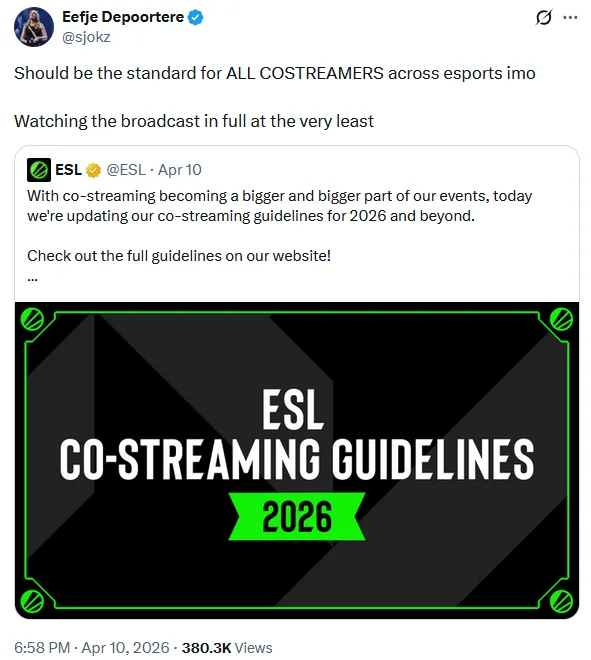
On April 10th, ESL released updated co-streaming guidelines that aim to create uniformity among creators when streaming an official event. The changes focus on aligning co-streamers more closely with the main broadcast, positioning them as an extension of the product rather than a parallel experience.
The new “Always on Coverage” rule is one of the most significant changes to the co-streaming guidelines. As part of this requirement, a co-streamer must show the official broadcast continuously while matches are live. Therefore, co-streamers may not minimize their streams, or switch to alternate non-related content, or move into a different category (i.e. Just Chatting).
Other requirements include maintaining sponsor visibility, limiting overlays, moderating chat behavior, and streaming on approved platforms. ESL has positioned the updates as a means of protecting the ecosystem while still having the positive benefits that co-streamers provide.
Following the official announcement regarding co-streaming, the need for a shared vision was reiterated along with making it clear that co-streaming has become an integral part of modern esports broadcasts.
Sjokz comments ignite discussion and confusion
Shortly after the announcement, Sjokz shared her perspective on social media, saying that ESL’s approach should be the standard across esports and that watching the broadcast in full should be the minimum expectation for co-streamers.
After this statement gained popularity within the League of Legends community, it began to create confusion as some felt her comment was an attack on co-streamers while others felt it was a logical take in support of maintaining the integrity of the broadcast.
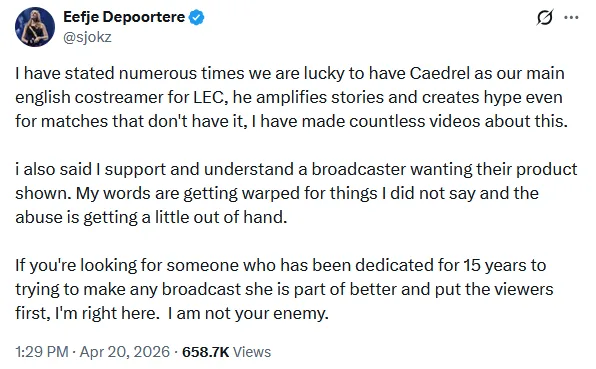
As things began to escalate, Sjokz once again responded by clarifying her original comments. She reiterated her long-standing support for co-streaming and applauded creators such as _Caedrel_ for contributing to the overall experience of the viewing audience while also conveying an understanding that broadcasters to want their product fully shown.
Due to the mixed interpretations of her comments, there has been a greater divide within the community where some members have defended Sjokz and others have pushed back against her comments.
Debate spreads to League of Legends esports
Discussion of this matter has expanded beyond Counter-Strike, with a FlyQuest produced video looking at whether or not co-streaming is beneficial for the future of the League of Legends esports. Essentially, the video poses the question as to whether co-streaming creates a fanbase that will remain after the events are done or if it will be beneficial primarily to those who created the content.
They also pointed to numbers showing how big co-streaming has gotten, with a huge portion of viewers tuning in through co-streams at events like Worlds 2024. It’s great for overall reach, but it also means the audience is more spread out, which brings up questions about what that means for the main broadcast down the line.
To see how this continues to develop, head over to the esports section for ongoing coverage and latest news updates to this story.
Key differences between ESL rules and current LoL approach
| Aspect | ESL co-streaming rules | Typical LoL co-streaming |
|---|---|---|
| Broadcast visibility | Must remain visible at all times | Can be minimized or partially shown |
| Content flexibility | No switching to other content | More freedom to switch or pause |
| Sponsor integration | Strict protection of official sponsors | Less standardized enforcement |
| Streamer role | Extension of official broadcast | Independent commentary style |
Community split on co-streaming and Sjokz’s stance
Community reaction has been divided on two fronts: whether co-streaming rules should become stricter, and how Sjokz’s comments should be interpreted.
Some agree with the idea that co-streamers should fully show and support the broadcast they are using. Like using ESL’s approach. Others argue that stricter rules could limit creativity and reduce the appeal of co-streaming.
Supporters of co-streaming say people are there for the personalities as much as the games. But there’s also a growing concern that if everything leans too heavily on a few creators, it could come back to hurt leagues and teams over time.
Read more about the co-streaming debate
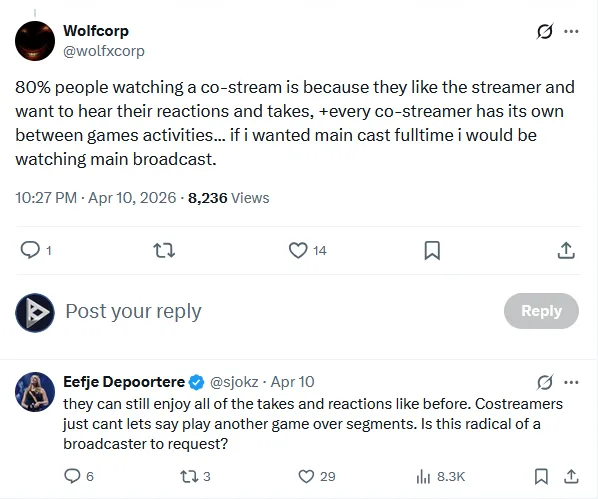
The discussion around Sjokz’s comments didn’t stay on X for long. It’s been spreading across places like Reddit, where people are still arguing over what she meant and what it could mean for co-streaming going forward.
A popular thread on Reddit discussing Sjokz addressing the co-streamer drama highlights how divided opinions have become, with users debating whether stricter rules are necessary or if co-streaming is simply evolving with audience preferences.
One of the bigger threads, where Sjokz addresses the co-streamer drama, really shows how split things are. Some think stricter rules make sense, while others feel co-streaming is just how people prefer to watch now and shouldn’t be restricted.
More than anything, it shows where esports is at right now. Co-streaming isn’t just a side option anymore, it’s a huge part of how people experience esports. Also if it is something that continues to challenge traditional broadcast models.
Frequently asked questions about Sjokz on co-streaming
Why did Sjokz’s comments cause controversy?
Her comments were widely shared and, in some cases, misunderstood, leading to debate about whether she was criticizing co-streamers or supporting stricter rules.
What was Sjokz’s actual stance?
She supports co-streaming but believes that showing the full official broadcast should be a basic requirement.
What are ESL’s new co-streaming rules?
They include always-on broadcast coverage, sponsor visibility requirements, and restrictions on switching content during live events.
Why is co-streaming debated in League of Legends?
It boosts viewership but may split audiences and reduce the impact of official broadcasts, raising sustainability concerns.
Could League of Legends adopt similar rules?
There is no confirmation, but the discussion has intensified following ESL’s update and community reactions.
Ongoing debate highlights bigger esports questions
The reaction to Sjokz’s comments shows just how touchy this topic has become. What started as a response to the new CS2 guidelines has quickly turned into a much bigger conversation about broadcast value and the future of esports content.
As the industry continues to adapt, the balance between creators and official broadcasts will remain a key issue to watch in the months ahead.