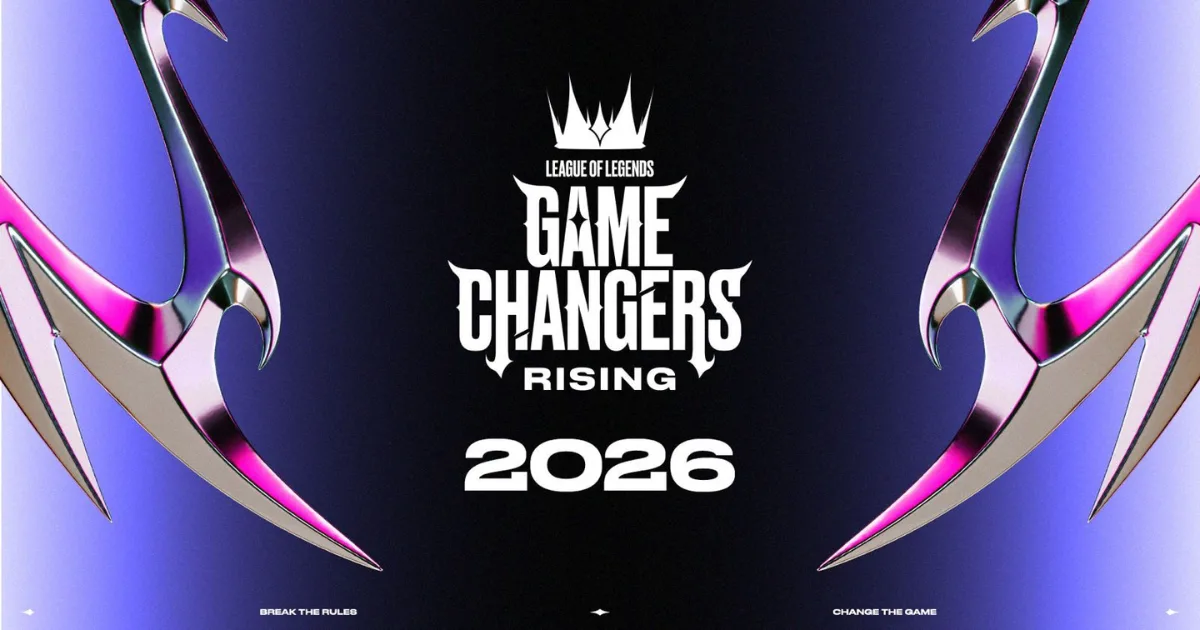
League of Legends Game Changers is back for 2026. Riot’s women’s event for EMEA will run from May through October.
It starts on May 29, 30, and 31. Teams will play for points across the season, with the top six reaching the October playoffs. Riot also plans to bring in teams from existing national inclusive competitions.
What Riot has announced for League of Legends Game Changers 2026
The 2026 tournament is a bigger setup than last year’s. It will run across multiple stages from May to October, with teams earning points during the season and the top six moving on to playoffs.
Riot also confirmed that N.E.O will handle the event again, while co-streaming and community broadcasts are being added this year. That should make it easier for more people to follow the tournament outside the official broadcast.
| League of Legends Game Changers: Rising 2026 | Confirmed detail |
|---|---|
| Region | EMEA |
| Who it is for | Anyone identifying as women |
| Season dates | May to October 2026 |
| Kickoff | May 29, 30, and 31 |
| Playoff qualification | Top 6 teams in the overall standings |
| Additional teams | Invited from national inclusive competitions |
| Broadcast update | Community broadcasts and co-streaming enabled through N.E.O |
| How to join | Teams can register through the official competition sign-up |
New League of Legends Game Changers 2026 details include 32-team stages and €8,750 prize pool
Riot’s announcement confirmed the broad shape of the 2026 season, but follow-up reporting has added more detail on how the competition is expected to work. According to that reporting, LGC Rising will feature five monthly three-day stages, with up to 32 teams able to enter each one.
Those stages are reported to carry both championship points and prize money. Across the first five months, a combined €8,750 is said to be on offer, with €1,000 for first place, €500 for second, and €250 for third in each stage.
The wider playoff picture is also becoming clearer. Riot has already confirmed that the top six teams in the standings will reach the October playoffs, while the same follow-up reporting says two more places are expected to go to the Equal Esports Cup and Nova Series champions.
If that structure is confirmed in full, it would make this year’s edition much more open than the first one, with repeated chances for teams to enter, earn points, and play their way into the final stage of the season.
Why this year’s women’s League of Legends tournament matters more
With a longer season, teams have more time to develop, the standings carry more weight, and rivalries have more room to build.
It also helps with one of the biggest problems women’s League of Legends has faced for years, getting consistent visibility instead of only brief moments of attention. Talented women have been part of the game for years, whether through solo queue, regional play, mixed competition, or women-led rosters. What has often been missing is a stable structure that regularly puts that talent on stage and gives it room to develop over time.
That is what makes LGC Rising interesting. Riot is not just announcing another event. It is trying to create a season that can turn individual names into recurring stories, recurring stories into rivalries, and rivalries into a stronger competitive scene.
For more tournament coverage as the field and format develop, RiftDaily’s esports section will likely be one of the main places following how the season takes shape.
How the earlier Game Changers events shaped this return
The first League of Legends Game Changers edition gave Riot a foundation to build on. It brought in an official women’s competition for EMEA under the Game Changers name and showed there was real interest in it, both in the matches themselves and in the players involved. It was only a first step, but it showed there was something worth building on.
That first season also produced a clear competitive outcome. Eterna emerged as champions, giving the new circuit an immediate title run and a reference point for what success in the scene could look like. More importantly, the event helped show that the appeal of women’s League of Legends competition is not just about representation. It is also about mechanics, confidence, matchups, team growth, and the same competitive tension that makes any esports event worth following.
That came through especially well in Riot’s earlier content around the event, which focused on player identity and rivalry rather than treating the competition like a side note. One of the clearest examples was the bot lane feature built around the first Game Changers period.
The focus was not symbolic. It was competitive. The video focused on competition. The players talked about confidence, mechanics, rivalries, and taking their chance when it came.
Women who helped shape the League of Legends pro scene before this
One of the easiest ways to make this story different from routine coverage is to remember that League of Legends Game Changers is not appearing out of nowhere. Women have already left a mark on the game across several regions, often in scenes that had less structure and far less support than what Riot is now building in EMEA.
Remilia remains one of the most historic names in League of Legends because she became the first woman to compete in the NA LCS era. In Europe, Caltys became a milestone figure through first-division regional league play. G2 Hel helped make all-women rosters more visible in the European conversation. Another name worth mentioning is Shakespeare, the first woman to play in Japan’s LJL. She spent several years in the Japanese scene before retiring in 2023.
Those names matter because they show women have been part of League of Legends history for years. The issue was never whether the talent was there. It was whether there were enough proper chances to keep competing and getting noticed over time. That is where a longer LGC Rising season could make a real difference.
Recent publicly tracked peak ranks among women in League of Legends
The level is already there. Women in League of Legends are already reaching high ranks in solo queue, even if there is no official list for that.
| Player | Recent publicly tracked peak | Date shown in tracking |
|---|---|---|
| Kyanna | Challenger 1054 LP | 21/04 |
| Lumi | Grandmaster 937 LP | 15/04 |
| Nenris | Grandmaster 875 LP | 10/10 |
| Karina | Master 817 LP | 26/04 |
| Caltys | Master 61 LP | 22/04 |
The table is just a snapshot, because the ladder changes all the time, but it still shows the level these players are at.
What to expect from League of Legends Game Changers: Rising
The biggest change this year is time. Instead of being over almost as soon as it starts, Game Changers will play out across several months, which should give the competition more shape. Teams will have room to settle in, recover from bad starts, and build some momentum before the playoffs.
That should also make the standings more interesting. In a short event, one strong weekend can carry a team a long way. Over a longer season, it usually takes more than that. Teams have to stay consistent, and that tends to make the playoff race feel more earned.
It also gives people more time to actually follow the scene. Rather than dropping in for one event and disappearing again, Game Changers now has a better chance of building week by week, with teams, players, and rivalries becoming more familiar as the season goes on.
That may be the most important part. For this tournament to really land, the focus has to move beyond the idea of what it represents and onto the competition itself. Who is winning, who is improving, who handles the pressure best, and which matchups start to matter. If that happens, this year’s edition could feel a lot bigger than the first one.
Official announcement and community reaction
Riot’s post kept it simple. More chances for women in League esports. That is what this tournament is meant to be about.
The 2026 format is one reason that announcement has landed well. A longer season, a points race, and extra integration with national inclusive competitions all make the tournament feel more substantial than a simple return post on its own might suggest.
Laure’s reaction
That official announcement was later followed by a positive reaction from Laure Valée, one of the most recognizable on-air names in European League of Legends.
That kind of outside support matters for any growing scene. It helps move the conversation beyond a single announcement and toward a broader sense that women’s League of Legends deserves sustained attention over the course of the season.
How to join the women’s League of Legends tournament
Riot has already opened the door for teams that want to compete. The publisher’s message is direct, if you are ready to play, register your team. That gives teams a clear way in.
Riot said more details on the format and schedule will be shared later. For now, teams can sign up, and co-streamers or community casters can also get involved this year, which should help more people follow the tournament.
The main announcement is on LoL Esports, with the main League of Legends website covering the wider game. RiftDaily’s news section should also be a useful place to watch for follow-up announcements, team reveals, and format updates.
Frequently asked questions about League of Legends Game Changers
What is League of Legends Game Changers?
It is Riot’s official EMEA League of Legends competition for anyone identifying as women.
When does League of Legends Game Changers: Rising 2026 start?
The opening stage is scheduled for May 29, May 30, and May 31, with the full season running from May to October.
How do teams reach the playoffs?
Teams earn qualification points throughout the season, and the top six in the standings advance to the playoffs.
Was there a previous Game Changers event for League of Legends?
Yes. The earlier edition introduced the competition and was won by Eterna, giving the scene its first official champion under the banner.
Why is Shakespeare relevant to this story?
She became the first female player to compete in Japan’s LJL, which makes her one of the clearest examples of women already breaking into established regional League competition before this new EMEA season.
Why are people hyped for this tournament?
Because the 2026 version is longer, more structured, and better positioned to build real rivalries, player storylines, and playoff stakes across the season.
Can community casters and co-streamers get involved?
Yes. Riot said the 2026 edition will include community broadcasts and co-streaming through its licensing partner, N.E.O.
Why is this important for the history of women in the League of Legends pro scene?
Because it gives more structure and visibility to a scene that already has talent and history, but has not always had a long-term official pathway.
A bigger chance for women’s League of Legends to grow
League of Legends Game Changers returning is important on its own, but the bigger test is what Riot does with the extra time and structure in 2026. If the format works, this season could be remembered as the point where women’s League of Legends in EMEA stopped feeling occasional and started feeling established.
That is why the announcement matters. It is not just another tournament reveal. It is a chance for the women’s side of League esports to build deeper rivalries, introduce new stars, and finally get the kind of season-long platform that helps a competitive scene grow in public.