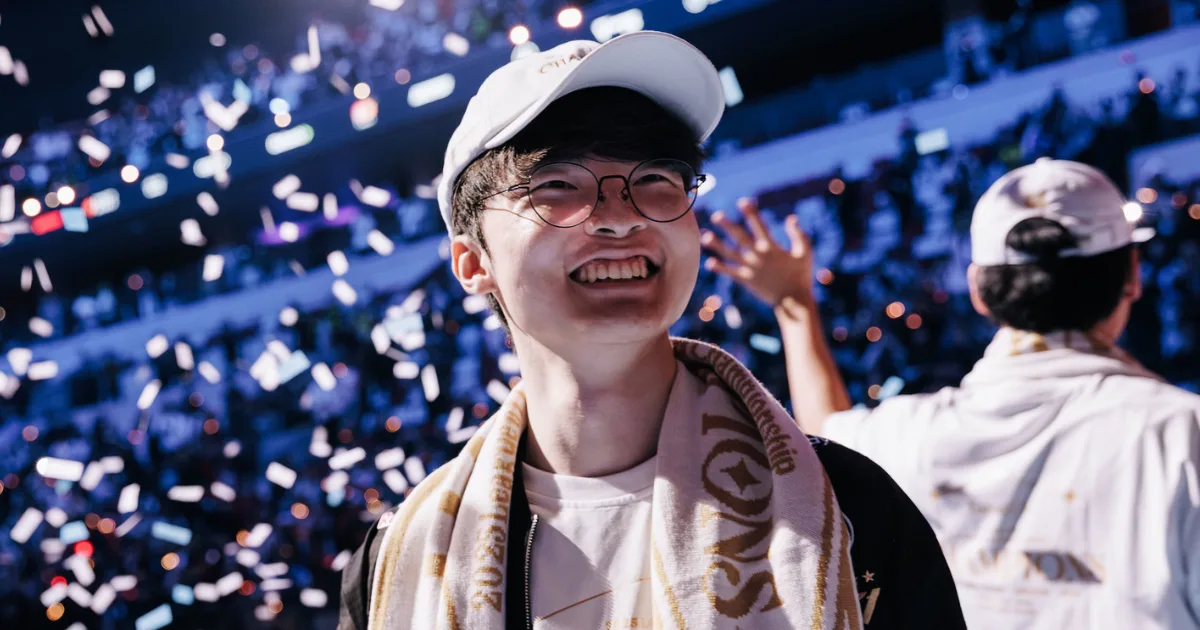
Thursday, May 7th, 2026 marked the 30th birthday of Lee “Faker” Sang-hyeok, a birthday that is considered a unique milestone at the highest level of competitive League of Legends. A lot of the time, professional League of Legends players peak in their early to mid-20s and a lot of them are already considered veterans by their mid to late 20s, but Faker is one of the rare examples of a player in this genre maintaining his ability to be the leader of T1, being part of nearly every story in his professional game, and still aiming for more titles.
That is a major reason his birthday carries more weight than a simple age update. Faker is not just the most recognizable player in League of Legends, he is also one of esports’ clearest examples of longevity, adaptation, and pressure management. More than 13 years after his 2013 debut for SKT T1, now T1, he remains the face of the organization and the benchmark every mid laner is measured against.
Faker’s birthday date and why 30 matters so much in LoL
Faker was born in Seoul on May 7, 1996, and debuted in 2013 as a 17-year-old. He never left, through the SKT T1 years and into the current T1 era, which is part of what makes his career feel so different from almost anyone else’s in League.
Turning 30 is not a big story in most sports. In League, it is. The scene has always been younger, and players are often called veterans before they even get close to that age. That is why Faker’s birthday stands out. He is not hanging on for nostalgia, he is still playing matches that matter and still expected to win them.
Even within the biggest events, Faker stands out. At this stage of his career, he is older than most active stars and well beyond the age where players in League are usually described as veterans. That does not mean he has faded into a symbolic role. He is still competing at the highest level and still carrying real expectations.
| Category | Age range | How Faker compares at 30 |
|---|---|---|
| Typical elite traditional athletes | Mid to late 20s | Older than average in many sports, but still within a realistic elite range |
| Typical top LoL pros | Late teens to early 20s | Far older than the usual elite age range |
| Established LoL veterans | Mid to late 20s | Older than most long-running stars |
| Faker at contract end in 2029 | 33 | Would push his career into exceptionally rare territory for LoL |
Faker’s history from debut to 30
Faker’s career has been longer and stranger than most. He showed up in 2013 as a 17-year-old and became the face of SKT almost straight away. He had the years where everything seemed to go his way, and later the defeats that stuck with people just as much. Even the injury issues became part of the story. What still feels unusual is that he found his way back to the top after all of it. Now he is 30 and still playing for the biggest prizes with T1.
| Year | Stage of Faker’s career | Why it mattered |
|---|---|---|
| 2013 | Debuted for SKT T1 and won Worlds | Announced himself as the game’s next superstar almost immediately |
| 2014-2016 | Built the SKT dynasty | Established himself as the best player in the world and the face of LoL esports |
| 2017 | Reached another Worlds final, then lost to Samsung Galaxy | Became one of the most emotional defeats of his career |
| 2018-2021 | Transitioned through roster and meta changes | Showed he could remain elite beyond the first great SKT era |
| 2022 | Returned to Worlds final, then lost to DRX | Another crushing near-miss that tested his legacy and resilience |
| 2023 | Won Asian Games gold and another Worlds title | Turned a comeback into a new championship era |
| 2024-2025 | Stayed central to T1’s title ambitions | Proved his longevity was not symbolic, he was still winning at the top |
| 2026 | Turned 30 while still leading T1 | Reinforced his status as one of esports’ greatest longevity stories |
What makes it even more unusual is that he never left. Through all the roster changes and all the shifts in the game Faker stayed put. In esports, that almost never happens.
That is why turning 30 matters so much in his case. Faker is no longer just the best player of one era. He has become the rare star whose career stretches across nearly the entire modern history of League of Legends.
A career spent entirely with T1
What makes Faker’s career even stranger is that he did all of it in one place. He joined SKT T1 in 2013 and just stayed. The team changed, the game changed, the name changed, but Faker did not. In League, where players move around all the time, that really stands out.
He is signed until 2029 after extending in 2025. If he stays through the deal, he will be 33 in the final year. For a League pro, that is a huge number. It would also mean spending parts of 17 seasons with the same organization, which is almost unheard of.
T1’s own message around the extension framed it as another legendary chapter, which fits both the marketing and the reality. Faker is not only the team’s mid laner, he is the player most closely identified with the entire brand. The official T1 team page still reads like a continuation of his era.
His biggest achievements are almost impossible to match
By the time Faker turned 30, there was not much left for him to prove. He won his first Worlds title in 2013, won again in 2015 and 2016, and then added another run of titles in 2023, 2024, and 2025. No one else in League has stacked that kind of record across so many different years.
And it is not just Worlds. Faker has also won a long list of domestic titles, lifted MSI trophies, and took Asian Games gold with South Korea in 2023. Even now, people still go back to that Zed play against Ryu when they talk about the most iconic moments in esports. What makes his career feel different, though, is that the story did not end with those early highlights. He kept going, and he kept finding ways to add more.
Here below are some of Faker’s biggest wins across his career.
| Year | Major achievements |
|---|---|
| 2013 | Champions 2013 Summer, Worlds Season 3 |
| 2014 | Champions 2014 Winter |
| 2015 | LCK Spring 2015, LCK Summer 2015, Worlds 2015 |
| 2016 | LCK Spring 2016, MSI 2016, Worlds 2016 |
| 2017 | LCK Spring 2017, MSI 2017 |
| 2019 | LCK Spring 2019, LCK Summer 2019 |
| 2020 | LCK Spring 2020 |
| 2022 | LCK Spring 2022 |
| 2023 | Asian Games Gold Medal, Worlds 2023 |
| 2024 | Esports World Cup 2024, Worlds 2024 |
| 2025 | Worlds 2025, KeSPA Cup 2025 |
For a broader view of the competitive scene around him, RiftDaily’s esports coverage shows how unusual it is for any player to remain central across so many eras.
The struggles mattered as much as the trophies
A lot of what people remember about Faker is not just the winning. Not every defining Faker moment came in victory. The 2017 Worlds final loss to Samsung Galaxy is still one of the first that comes to mind. SKT were swept, and Faker sitting on stage in tears became one of the lasting images of that era.
The same kind of feeling came back in 2022. T1 made it back to the Worlds final and a lot of people thought that was going to be the moment Faker won it all again. Instead, they lost to DRX in one of the biggest upsets the game has had. It became another one of those defeats people still bring up when they talk about his career.
There were injury problems too. In 2023, Faker had wrist and arm issues that were serious enough to take him out of the lineup for a while and clearly affect his level. T1 looked much worse without him, which said a lot about how important he still was. It also showed what more than a decade of pro play can take out of someone. Even so, he came back and helped lead T1 into another title run.
Those setbacks are part of why his career now resonates beyond wins alone. Faker has spent years carrying extraordinary expectations, adjusting to younger rivals, and proving that longevity in League is not just about staying in the server, but staying relevant when every new season tries to replace the last one.
The birthday tributes and Faker’s message
Faker’s 30th birthday quickly became a shared moment across the League community, with fans, creators, and T1 itself posting tributes to one of the most influential figures the game has ever produced. The milestone felt bigger than a routine player birthday because it marked how far beyond the usual timeline of a pro League career he has already gone.
One fan post captured that mood as the birthday celebrations spread online.
T1 also marked the occasion on its official account, underlining how central Faker still is to the organization after all these years.
The birthday video tied the celebration to a more reflective side of Faker. Rather than turning the moment into a victory lap, he spoke about difficult periods feeling long when you are inside them, but much shorter when viewed across a wider stretch of time. It was a simple thought, but one that fits a career built as much on resilience as on wins.
It means a bit more coming from someone like Faker, who has been through pretty much every stage of a career like this. He has had the biggest wins, the hardest losses, and enough time at the top to see both sides of it.
His short birthday message is below.
In the video, Faker says difficult periods can feel endless when you are in them, even if they seem much smaller once you look back later.
It also makes the birthday piece feel a little more human. With Faker, people have never only cared about the trophies. A lot of it is the way he has dealt with the pressure that comes from being the biggest name in League for so long.
How old are League of Legends players on average, and how unusual is Faker now?
Age has always been a big part of the conversation in League. The player base is generally young, and the pro scene is younger still. Most top players break through in their late teens or early 20s, so by the time someone reaches 30, it already stands out.
That is why Faker at 30 feels extraordinary. In League specifically, older stars do exist, but they are usually discussed as exceptions, not norms. By the time a LoL pro reaches 27 or 28, the word older already starts appearing around them. At 29 or 30, they are often treated as elder statesmen of the scene.
Faker has moved beyond that label. He is now operating in a space where every extra year changes the conversation about what a League career can look like. Instead of simply surviving, he is still expected to contend for titles, which is what makes the comparison so extreme.
How T1 are doing lately
T1 are still one of the most dangerous teams in the scene, but this year has not been smooth from start to finish. They looked strong in Split 1 group play, yet the season also brought setbacks, including the playoff loss to BNK FEARX in the LCK Cup and a less convincing run once the year moved deeper into LCK play.
That is really where some of the pressure around T1 comes from now. The team still has the kind of lineup that should be fighting for titles, but the spring showed they were not untouchable in LCK. There were stretches where they looked like themselves, and others where they dropped series and left more questions than answers.
Faker’s presence means T1 are almost never counted out, but the standard around this roster is much higher than simply staying in the mix. For T1, the expectation is always the same, contend for LCK titles and be a real threat internationally. That is why the uneven parts of spring stood out as much as they did.
For more recent domestic context, the LCK section on RiftDaily’s LCK hub is where this season’s pressure points around T1 and Faker matter most.
What Faker’s goals look like now
Faker does not sound like someone winding things down. He still sounds like he wants to win, and that is really the main thing.
The contract says a lot too. He is signed through 2029, and if he plays it out he will be 33 in the final year. In League, that stands out straight away.
The birthday clip fits with that. He talks about how difficult times can feel long when you are living through them, even if they seem smaller later on. Coming from him, it feels like something earned.
For now, the goal is pretty clear. T1 need to get back to their best, stay in the fight for titles, and make another run at the biggest tournaments. After that, the bigger question is just how much further Faker can take this.
Faker has also been open about wanting more on the domestic side. For all the international success T1 have had, their LCK results have been more uneven, and that seems to be part of what still drives him. It is not only about adding to a legacy that is already secure. It is also about doing better at home and helping T1 turn their domestic form into something more consistent again.
Anyone tracking his next steps can keep an eye on the latest news updates as the season moves deeper into the year.
Frequently asked questions about Faker turning 30
When is Faker’s birthday?
Faker was born on May 7, 1996, and he turned 30 on May 7, 2026.
How long has Faker been with T1?
He has been with the organization since 2013, which means he is now in his 14th competitive year with T1 and has spent more than 13 years there.
What are Faker’s biggest achievements?
His biggest achievements include multiple World Championships, a huge run of domestic titles, MSI wins, and the 2023 Asian Games gold medal.
Is 30 old for a League of Legends pro?
Yes, by LoL standards it is unusually old for an active elite starter. In traditional sports, 30 can still be close to peak years depending on the discipline, but top-level esports usually skew much younger.
How old will Faker be when his current T1 contract ends?
His current contract runs through 2029, so he will be 33 during that final season.
What has been the hardest part of Faker’s career?
Some of the most difficult chapters were the 2017 Worlds final loss, the 2022 Worlds loss to DRX, and the wrist and arm issues that disrupted his 2023 season.
What are T1 and Faker aiming for now?
The immediate target is to improve T1’s form, stay in the title race, and make another serious international push, with Worlds still the biggest prize.
What to watch from here
There is the birthday part of it, and then there is everything else it says about where Faker is in his career. By now, most players would be long gone or far from the top. Faker is still in important matches, still under contract, and still sounding like he believes there is more left to do.
That is what makes 30 feel different in his case. He is not just older than most League players. He is still trying to stretch the limits of what a career in this game can look like.
What to watch from here
There is the birthday part of it, and then there is everything else it says about where Faker is in his career. By now, most players would be long gone or far from the top. Faker is still in important matches, still under contract, and still sounding like he believes there is more left to do.
That is also why the reaction to his long-term future stands out. When T1 announced the four-year extension, a lot of the response from fans was some version of disbelief. Not just because of the length of the deal, but because Faker is still in a position where more years at the top feels possible.
That is what makes 30 feel different in his case. He is not just older than most League players. He is still trying to stretch the limits of what a career in this game can look like.